
Aramco Targets Europe With Deeper-Than-Expected Crude Price Cut
Aug 17, 2026


A single gas supply warning from one counterparty was enough to halve output at one of the world’s largest alumina refineries, exposing a dependency risk that could cost Norsk Hydro up to USD 100 million in a single quarter. Alunorte, the company’s 6.3 million tonne-per-year refinery in Barcarena, Pará, Brazil, dropped to roughly 50% capacity in early August 2026 after its gas supplier CELBA, a unit of New Fortress Energy, flagged disrupted natural gas availability. By 14 August 2026, Hydro had secured temporary terminal access and begun ramping production back toward full capacity, but not before an estimated 100,000-120,000 tonnes of alumina output had been lost. The company has flagged a potential USD 75-100 million impact on its Q3 2026 Bauxite and Alumina segment. What follows covers the cause of the disruption, the scale of the financial hit, how Hydro contained it, and why a regulatory approval secured during the crisis could permanently alter the refinery’s gas supply structure.
Alunorte’s refining process depends on natural gas. That dependency runs through a single supplier: CELBA, part of New Fortress Energy, which provides gas via the Barcarena LNG receiving and regasification terminal. When CELBA warned of disrupted gas availability earlier in the week prior to the Thursday announcement, Hydro had no contractual fallback in place. The refinery moved to approximately 50% of its 6.3 million tonne-per-year nameplate capacity before any alternative supply arrangement could be activated.
The speed of the curtailment underscored the concentration risk. One counterparty’s warning was sufficient to force a global-scale facility into half-production mode within days.
BNamericas reporting on CELBA’s Barcarena terminal confirms that an arbitration process between Alunorte and New Fortress Energy over supply delays predates this August 2026 curtailment, suggesting the gas supply tension had a longer history than the immediate warning implies.
Hydro deployed three contingency measures in rapid sequence:
The combination kept Alunorte running, but at a cost that would soon register in the company’s quarterly guidance.
Hydro estimates that the curtailed period cost the refinery 100,000-120,000 tonnes of alumina output. That volume loss is substantial, but it is only one of two forces driving the financial impact.
The second is cost. Procuring gas on the spot market at prices above CELBA’s contracted rates added a premium to every tonne produced during the disruption. The combination of lost revenue from unproduced alumina and inflated input costs for the alumina that was produced generates the USD 75-100 million range Hydro has flagged for Q3 2026.
The cost of Hydro’s emergency spot gas purchases was partly a function of prevailing LNG market conditions: a structural shift from projected surplus to deficit in global LNG supply had tightened spot pricing through 2026, meaning that any industrial buyer forced onto the open market faced materially higher input costs than a contracted-rate baseline would imply.
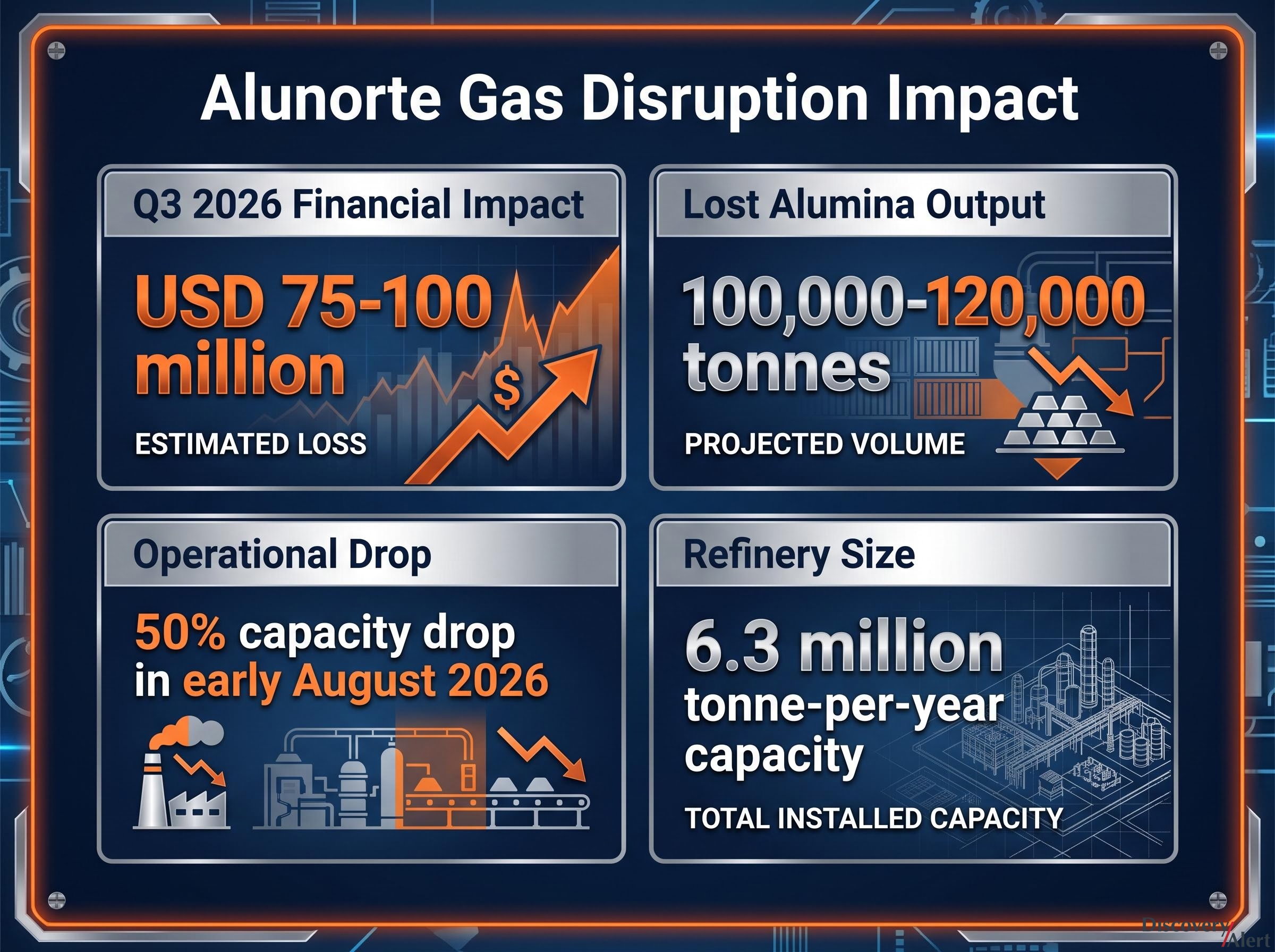
| Impact Driver | Description |
|---|---|
| Lost production volume | An estimated 100,000-120,000 tonnes of alumina output forgone during the period at approximately 50% capacity |
| Above-contract gas procurement costs | Spot gas purchases at premium prices above the existing CELBA contract rate, inflating per-tonne production costs |
Hydro Q3 2026 Guidance: The potential impact on the Bauxite and Alumina segment is estimated at USD 75-100 million, subject to actual production recovery and gas procurement outcomes.
Hydro has emphasised that this figure remains a range estimate. Where the final number lands depends on two variables investors can track: how quickly full capacity is restored, and what spot gas prices do through the remainder of the quarter.
Alumina is the intermediate product between raw bauxite ore and finished aluminium metal. Without it, smelters cannot operate. The production chain runs in three stages:
Alunorte’s 6.3 million tonne-per-year capacity makes it one of the largest single nodes in this chain. A disruption at this scale does not stay local. Smelters in Europe and Asia that depend on Brazilian alumina face tighter supply when Alunorte’s output drops, and alumina spot prices can move quickly in response to any perceived shortfall.
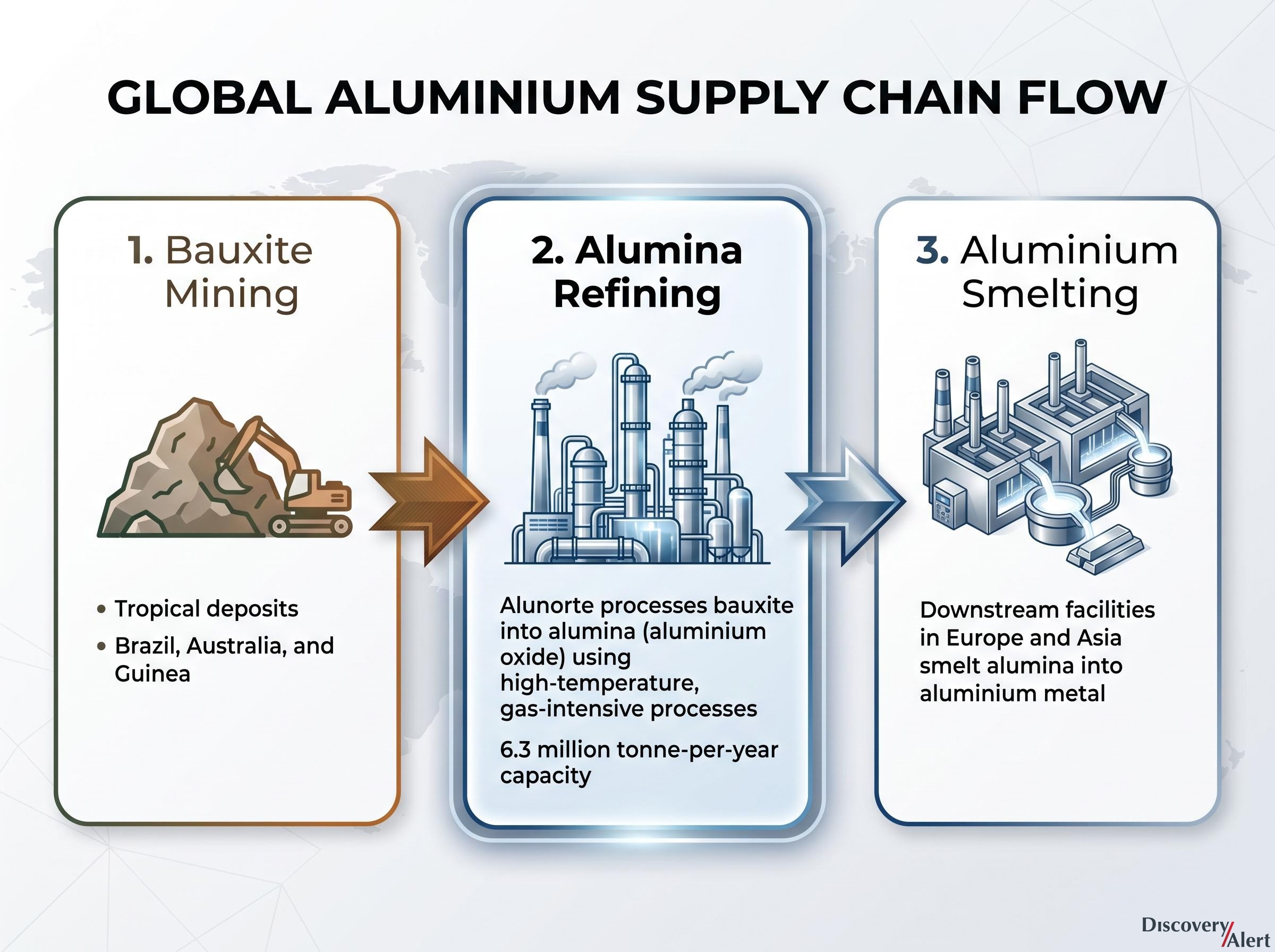
This is why the gas disruption at a single refinery in Pará registered as a global commodity event rather than a contained operational issue.
The Alunorte disruption did not occur in isolation: the global aluminium supply squeeze already underway in mid-2026 meant that any curtailment at one of the chain’s largest single refining nodes arrived at a moment of pre-existing tightness, amplifying the price sensitivity of even a temporary output reduction.
Hydro’s response separated into two distinct tracks: an immediate fix and a structural upgrade. The sequencing was deliberate.
The short-term solution arrived by Thursday 14 August 2026, when Alunorte secured temporary terminal access at the Barcarena LNG receiving and regasification terminal under a new agreement with CELBA. This allowed gas to flow again and initiated the ramp-up back toward full capacity.
The medium-to-long-term solution carries greater significance. Brazil’s ANP (the national oil, natural gas and biofuels regulator) approved Alunorte as a self-importer of natural gas, effective mid-August 2026. This regulatory clearance gives Hydro the legal authority to import gas directly, bypassing CELBA’s intermediary role entirely.
The ANP regulations on LNG terminal access, updated in June 2026 to mandate non-discriminatory access to essential natural gas infrastructure, form the legal basis under which Alunorte’s self-importer approval was granted and through which Hydro can now seek direct terminal access independent of CELBA.
Regulatory milestone: Alunorte’s ANP approval as a self-importer of natural gas represents a potential permanent reduction in counterparty concentration risk at the facility.
Hydro has stated it is preserving its contractual rights under the existing Gas Supply Agreement with CELBA while pursuing these alternative arrangements. The crisis, in effect, accelerated a structural shift in gas procurement that could reduce the refinery’s vulnerability to single-supplier disruptions going forward.
The immediate crisis has been contained. What remains unresolved is whether the containment holds and whether Hydro’s structural response delivers a permanent fix. Five indicators will determine the answer:
Alumina spot prices had already begun moving before the Alunorte curtailment was publicly disclosed, with LME-linked alumina benchmarks surging and exchange stocks falling toward multi-decade lows in early August 2026, a backdrop that made any additional supply shock from a major refinery especially consequential for downstream buyers.
The gap between temporary containment and permanent resolution is where the investment risk sits. Hydro’s ANP approval is a meaningful step, but regulatory clearance and operational execution are not the same thing.
A gas supply warning from one counterparty halved output at a 6.3 million tonne-per-year refinery and generated a potential USD 75-100 million quarterly impact, all contained within days through emergency terminal access. The speed of both the disruption and the response illustrates how concentrated Alunorte’s gas dependency had become, and how rapidly Hydro moved to address it.
The ANP self-importer approval is the most structurally significant outcome of this episode. Whether it delivers a lasting reduction in counterparty risk depends on execution: securing alternative suppliers, activating import capabilities, and demonstrating that the refinery can operate independently of CELBA’s supply chain.
Brazil’s critical minerals infrastructure, including the LNG terminals, regasification facilities, and port logistics that industrial-scale refineries like Alunorte depend on, has attracted growing foreign capital interest precisely because infrastructure gaps create both operational vulnerabilities for existing producers and entry opportunities for investors willing to fund the missing links.
Investors tracking Norsk Hydro should watch the company’s next Q3 operational update for clarity on whether the financial impact falls at the lower or upper end of the USD 75-100 million range, and whether a permanent gas supply agreement has been reached.
This article is for informational purposes only and should not be considered financial advice. Investors should conduct their own research and consult with financial professionals before making investment decisions. The financial projections referenced are subject to actual production and gas procurement outcomes and may vary from the guided range.
An ANP self-importer approval is a regulatory clearance from Brazil's national oil, natural gas and biofuels regulator allowing a facility to import natural gas directly, without relying on an intermediary supplier. For Alunorte, this means Hydro can now source gas independently of CELBA, reducing the single-supplier concentration risk that caused the August 2026 curtailment.
Alunorte lost an estimated 100,000-120,000 tonnes of alumina output during the period when the refinery was operating at approximately 50% of its 6.3 million tonne-per-year capacity, before Hydro secured temporary terminal access and began ramping back toward full production.
Norsk Hydro has flagged a potential USD 75-100 million impact on its Q3 2026 Bauxite and Alumina segment, reflecting both the revenue loss from unproduced alumina and the above-contract costs of procuring spot gas on the open market during the disruption.
Hydro deployed three contingency measures: spot gas purchases on the open market, a formal request for direct terminal access at the Barcarena LNG facility, and continued operation at reduced capacity while alternatives were secured. By 14 August 2026, a temporary terminal access agreement with CELBA had been reached and production ramp-up had begun.
Investors should track five key signals: any announcement of a permanent long-term gas supply agreement, Hydro's Q3 2026 Bauxite and Alumina segment result relative to the USD 75-100 million guided range, confirmation that Alunorte has returned to its 6.3 million tonne-per-year run rate, alumina and aluminium spot price movements, and any changes to Hydro's broader Brazil capital allocation or risk management strategy.


