
White Cliff Hits 42m at 1.43% Cu 250m From Discovery Extending Danvers System

White Cliff expands Danvers copper system with 42m at 1.43% Cu step-out
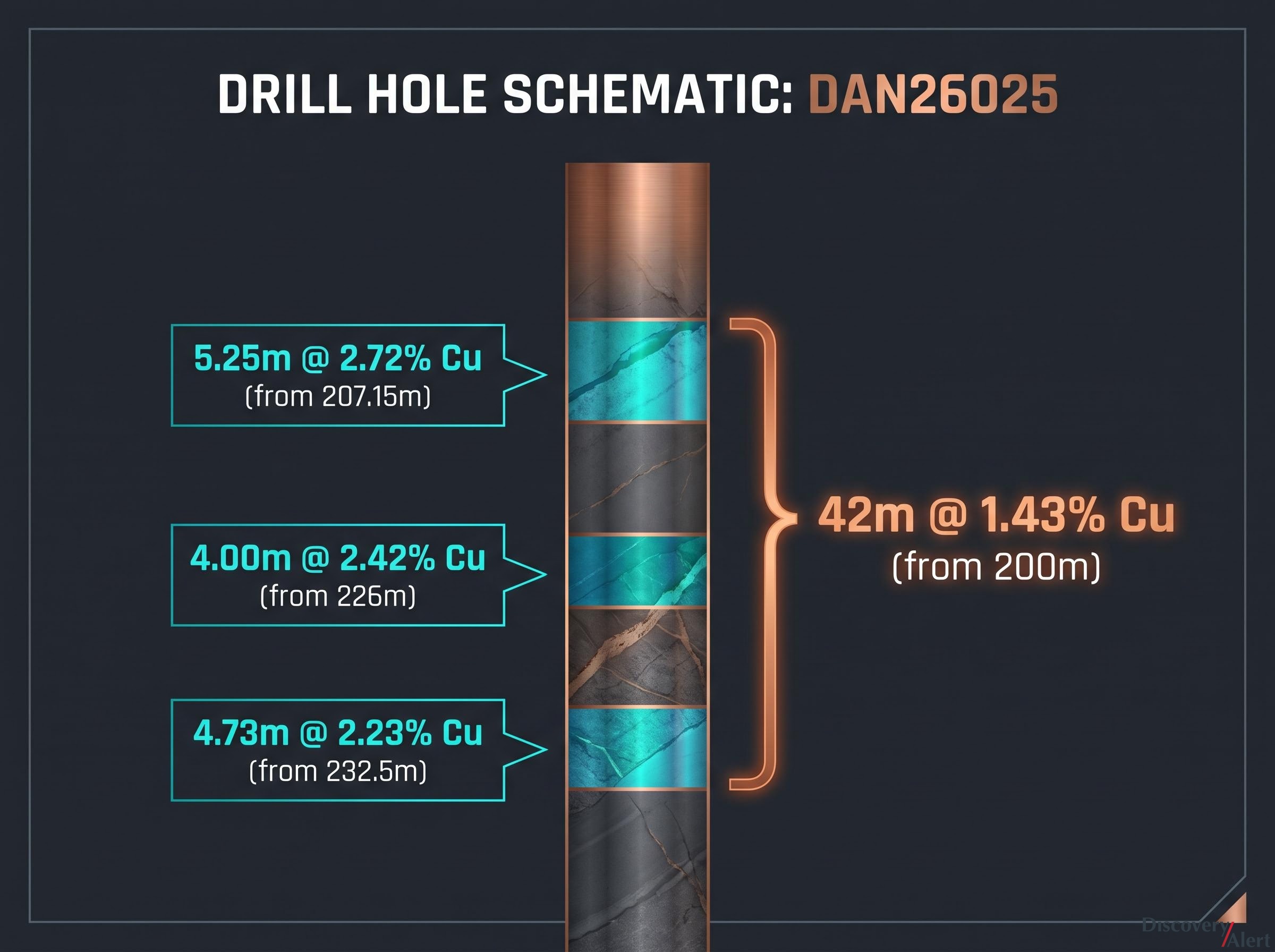
White Cliff Minerals has returned assay results from step-out drilling at its Danvers 3 copper target within the Rae Copper Project in Nunavut, Canada. Diamond drillhole DAN26025 intersected 42m @ 1.43% Cu from 200m, collared 250m northwest of the original high-grade discovery hole DAN26012. The result confirms the mineralised breccia system extends well beyond the initial discovery footprint, with assays now verifying copper mineralisation across 6.6km of strike and visual copper sulphides logged across 9.8km. Two diamond rigs remain active on site, with more than 20 holes awaiting assays.
When big ASX news breaks, our subscribers know first
Inside the Danvers 3 expansion results
Step-out drilling confirms system extension
DAN26025 delivered multiple high-grade internal intervals within the broader 42m @ 1.43% Cu intersection, demonstrating continuity of chalcocite-dominant mineralisation northwest of DAN26012. Key sub-intervals include:
- 5.25m @ 2.72% Cu from 207.15m
- 4.00m @ 2.42% Cu from 226m
- 4.73m @ 2.23% Cu from 232.5m
Drillhole DAN26028, collared 10m southwest of DAN26012 and drilled in the opposite direction, returned 8m @ 0.9% Cu from 309m, including 5m @ 1.18% Cu from 312m. This hole forms a drill fence with DAN26025, confirming copper mineralisation on both flanks of the interpreted breccia corridor. The Danvers 3 target now covers approximately 300m of lateral strike with repeatable high-grade intercepts.
| Hole ID | Interval (m) | Grade (% Cu) | From (m) | Status |
|---|---|---|---|---|
| DAN26025 | 42.0 | 1.43 | 200 | Assayed |
| DAN26025 | 5.25 | 2.72 | 207.15 | Assayed |
| DAN26025 | 4.00 | 2.42 | 226 | Assayed |
| DAN26025 | 4.73 | 2.23 | 232.5 | Assayed |
| DAN26028 | 8.0 | 0.9 | 309 | Assayed |
| DAN26036 | 83.1 (combined) | Visual sulphides | Multiple intervals | Assays pending |
Oriented core points toward higher-grade zones
Diamond drillhole DAN26036, collared more than 105m west of DAN26012 and drilled near perpendicular to earlier drilling, logged 83.1m of combined copper sulphides (chalcocite-dominant) across multiple intervals. Visual observations include chaotic and crackle breccias containing up to an estimated ~7% chalcocite. Assays for DAN26036 remain pending. The intersection represents a >280m strike expansion of the chalcocite-dominant system southwest of the discovery hole. Oriented diamond core from DAN26036 and DAN26025 provides direct structural measurements, refining the interpreted geometry of the breccia system and enabling targeted drilling toward thicker, higher-grade zones.
Troy Whittaker, Managing Director
“DAN26025 is a strong step-out result that expands Danvers 3 collared 250m northwest of the exceptional-grade intersection in DAN26012 – returning 42m @ 1.43% Cu, with several higher-grade internal intervals, the result demonstrates that the mineralised breccia system extends well beyond the initial discovery area.”
Regional drilling stretches the copper footprint to 9.8km
First-pass regional drilling across the 12km target corridor along the Teshierpi Fault Zone has logged copper sulphides across 9.8km of strike, with assays confirming mineralisation over 6.6km. The company has now drilled a total of 7,078m along the Teshierpi Fault and 2,680m along the Danvers 1 structure. Drillhole DAN26031 marks the first test of greenfield strike more than 1km northeast of Danvers 1, intersecting 4m of visually logged chalcocite veining. Additional regional step-out holes returned visual copper sulphide intercepts pending assay:
- DAN26033: 105.3m combined chalcopyrite-dominant sulphides
- DAN26035: 39m combined sulphides, extending the footprint 310m northeast
- DAN26034: 19.35m combined chalcocite-dominant sulphides
Visual logging guides where to expect grade confirmation from pending assays. The company has systematically advanced the regional drilling footprint, establishing copper sulphide continuity across multiple kilometre-scale targets.
Why copper sulphide styles matter for investors
Copper mineralisation at Danvers occurs primarily as chalcocite and chalcopyrite. Chalcocite is a high-grade copper sulphide mineral containing approximately 80% copper by weight, whereas chalcopyrite contains roughly 35% copper. The presence of abundant chalcocite within breccia-hosted systems is a positive grade indicator. A breccia system refers to fractured rock fragments cemented by copper-bearing minerals. When these systems extend along strike (getting longer) and demonstrate repeatable high-grade internal zones, they signal potential for a large-scale deposit. Visual logging indicates where copper sulphides are present, but only laboratory assays confirm actual grades. The 20+ pending assay results represent the next catalyst pipeline for White Cliff Minerals. Growing strike length combined with repeatable high grades indicates scale potential within a tier-one mining jurisdiction in Nunavut, Canada.
The next major ASX story will hit our subscribers first
What comes next for White Cliff
The company has outlined three forward-looking priorities for the next phase of drilling:
- Step out from high-grade Danvers 3 zones
- Test strike and depth extensions at Danvers 1
- Test extensions at Danvers 2 and Danvers 4, where previous drilling returned high-grade copper
Two diamond rigs remain active, with assays pending for more than 20 holes. Results are expected to arrive approximately every 10–14 days, establishing a sustained news flow period. Historic (non-JORC compliant) resource estimates at Danvers outline 4.16Mt @ 2.96% Cu, though this estimate does not meet current JORC Code standards and requires further evaluation and drilling to confirm.
Eric Sondergaard, Executive Technical Director
“Oriented diamond drilling is rapidly refining our understanding of the structures controlling high-grade mineralisation at Danvers 3. DAN26036 intersected a combined 83.1m of visually logged copper sulphides, including chalcocite-rich chaotic and crackle breccias, from an orientation near perpendicular to earlier drilling, with assays pending.”
“These observations, together with the 42m @ 1.43% Cu result in DAN26025, demonstrate that the breccia system extends well beyond DAN26012 and provide clear structural vectors towards the thicker and higher-grade parts of the system. The next phase of drilling will directly test these extensions along strike and at depth.”
White Cliff Minerals has entered a sustained results period across multiple high-grade copper targets at Rae, with systematic drilling progressively defining the scale and continuity of the Danvers copper system.
Get ASX Copper News Before the Market Moves
Join 30,000+ investors receiving FREE breaking ASX copper alerts delivered within minutes of release, complete with in-depth analysis. Click the “Free Alerts” button at Discovery Alert to stay ahead on market-moving copper announcements the moment they drop.