
Vital Metals Extends Tardiff Rare Earth Resource With 6m at 3.86% TREO

Vital Metals extends high-grade rare earth mineralisation beyond Tardiff resource, uncovers gallium upside
Vital Metals (ASX: VML) has reported assays from its 2026 diamond drilling programme at Nechalacho in Canada’s Northwest Territories that confirm and extend rare earth element (REE) and niobium mineralisation across the Tardiff deposit, including beyond the current 192.7Mt Mineral Resource envelope. The results deliver two material breakthroughs: mineralisation extending past the resource boundary, and anomalous gallium identified across both eastern and western zones. These results will feed directly into an updated Mineral Resource Estimate and the Tardiff Pre-Feasibility Study (PFS), targeted for completion February 2027, advancing the deposit currently valued at a post-tax NPV of US$445M in the July 2025 Scoping Study.
When big ASX news breaks, our subscribers know first
Standout intercepts confirm grade and stretch the boundaries
The 2026 programme returned the highest-grade result of 6.0m @ 3.86% TREO and a broad 47.0m @ 1.66% TREO intercept, with mineralisation remaining open in multiple directions across both eastern and western zones.
| Hole ID | Interval | TREO % | Nb₂O₅ % | Notes |
|---|---|---|---|---|
| L26-703 | 6.0m @ 3.86% from 100m | 3.86 | 0.49 | Highest grade, Eastern, ~1% NdPr |
| L26-689 | 47.0m @ 1.66% from 37m | 1.66 | 0.31 | Broad Eastern margin, 26% NdPr |
| L26-688 | 27.0m @ 1.93% from 84m | 1.93 | 0.43 | Eastern, 25% NdPr |
| L26-690 | 10m @ 2.4% incl. 4m @ 3.8% | 2.39 | 0.52 | Western, 27% NdPr |
| L26-692 | 102.0m @ 1.47% from 4m | 1.47 | 0.37 | Western, 26% NdPr, 218 ppm Ta₂O₅ |
| L26-694 | 22.0m @ 1.14% + 8.0m @ 2.18% | 1.14 / 2.18 | 0.23 / 0.44 | Western, end-of-hole zone |
NdPr represents approximately 22–27% of contained TREO across intersections, consistent with the deposit’s higher-than-average permanent-magnet metal profile.
Eastern zone — new higher-grade zone outside the resource
L26-703’s 6m @ 3.86% was previously unrecognised, intersected at the end of hole, and carries close to 1% NdPr. L26-689’s 47.0m @ 1.66% intercept is significantly thicker than previously recognised on the eastern margin, confirming mineralisation remains open in this direction.
Western zone — shallow, thick continuity
L26-692’s 102m @ 1.47% TREO intercept improves geological continuity confidence through this portion of the deposit, with elevated tantalum (218 ppm Ta₂O₅) and an average of 182 ppm Ga₂O₃ across the full 106m drilled.
What TREO, NdPr and gallium mean for investors
Understanding the mineral suite at Tardiff is essential for evaluating the deposit’s economic potential. The key elements are:
- TREO (Total Rare Earth Oxide): The headline grade measure, representing the sum of all rare earth elements expressed as oxides.
- NdPr (Neodymium-Praseodymium): The value driver. These two elements power permanent magnets used in electric vehicles, wind turbines, defence systems and consumer electronics. NdPr represents approximately 25% of contained TREO in the current resource.
- Niobium (Nb₂O₅): A critical mineral used in high-strength steel alloys and superconductors, adding by-product value to the project.
- Gallium (Ga₂O₃): A critical mineral used in semiconductors and defence technology. The identification of anomalous gallium values across both zones represents a potential future revenue stream, though it requires dedicated mineral deportment and metallurgical test work to confirm economic viability.
The gallium discovery, averaging 182 ppm Ga₂O₃ across the full 106m of L26-692, is anomalous and warrants further investigation, but investors should note this is early-stage identification requiring additional study.
Why this strengthens the Tardiff investment case
These results strengthen the Tardiff investment case on two fronts: resource growth and resource upgrade.
Front 1 — Resource Upgrade: Thick consistent intercepts such as L26-692’s 102m @ 1.47% TREO lift geological confidence in ground currently classified as Inferred, supporting potential conversion of selected Inferred material to the Indicated category.
Front 2 — Resource Growth: New intercepts beyond the envelope, including L26-689’s 47.0m @ 1.66% and L26-703’s 6.0m @ 3.86%, show mineralisation extending past the current boundary and remaining open, pointing to scope to grow the resource itself.
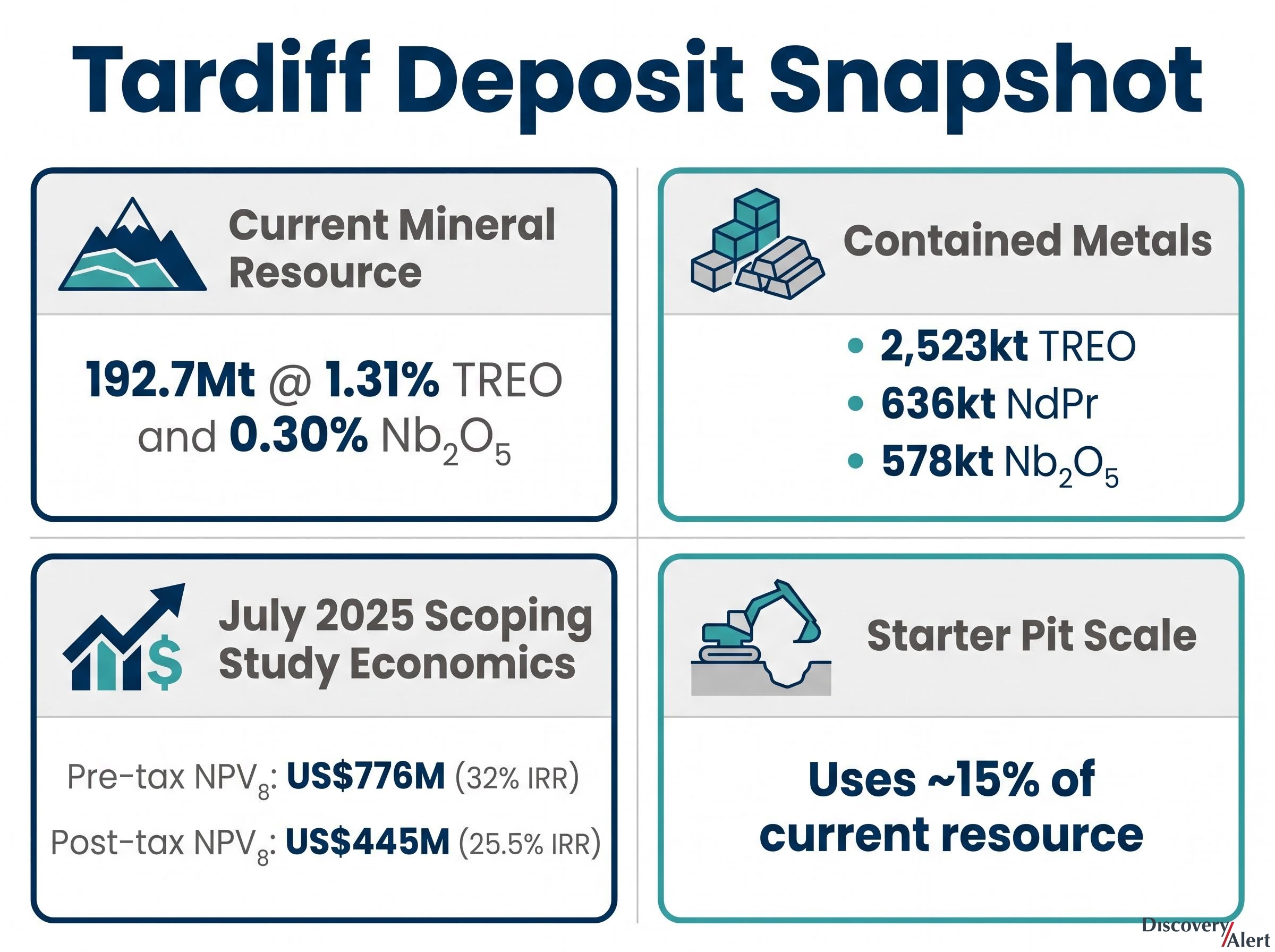
The current Mineral Resource stands at 192.7Mt @ 1.31% TREO and 0.30% Nb₂O₅, containing 2,523kt TREO, 636kt NdPr and 578kt Nb₂O₅. The July 2025 Scoping Study delivered robust economics with a pre-tax NPV₈ of US$776M (32% IRR) and post-tax NPV₈ of US$445M (25.5% IRR), based on a starter pit using approximately 15% of the current resource and excluding the adjacent North T and South T deposits.
Management’s framing reinforces the district-scale potential: Nechalacho is a large, dynamic rare earth element and critical mineral system rather than a single deposit. Tardiff already ranks among the largest REE deposits in the world.
Managing Director and CEO Lisa Riley
“These results do exactly what we set out to achieve. They confirm the quality and continuity of the Tardiff resource while extending mineralisation beyond its current limits. Intersecting new, higher-grade zones outside the resource envelope, alongside encouraging niobium and gallium results, gives us real confidence as we advance an updated resource and drive the Tardiff Pre-Feasibility Study toward completion in early 2027.”
The next major ASX story will hit our subscribers first
What comes next for Vital Metals
The company has outlined a clear roadmap to advance Tardiff and unlock district-scale value:
-
Updated Mineral Resource — Incorporate new drilling data into an updated 3D geological model and Mineral Resource Estimate to assess resource growth and Inferred-to-Indicated conversion.
-
Tardiff PFS — The updated resource will underpin the Pre-Feasibility Study, targeted for completion February 2027.
-
District-scale exploration — Complete the planned airborne geophysical survey (magnetic and radiometric) and advance 2026 regional targets to drill-ready status for Winter 2027, testing North T and South T.
-
Near-term cash flow — Continue preparations to process North T stockpiles.
-
Gallium — Undertake dedicated mineral deportment studies and metallurgical test work on anomalous gallium values.
The 2026 programme completed 17 of 46 planned resource holes (17 diamond holes / 1,824m in the Tardiff area plus 3 exploration holes / 279m at S-Zone and R-Zone) due to severe winter conditions and equipment demand, leaving remaining holes as further upside potential. The path forward centres on the updated resource and the February 2027 PFS completion, with district-scale exploration testing the broader Nechalacho system.
Get ASX Critical Minerals News Before the Market Reacts
Join 30,000+ investors receiving FREE real-time alerts on ASX rare earths, lithium, and critical minerals—delivered within minutes of release with full analysis. Click the “Free Alerts” button at Big News Blast to stay ahead on sector-moving news the moment it breaks.