
Enova Mining Hits 26% NdPr Rare Earths From Surface at Brazilian Saprolite Deposit

Enova confirms high-grade rare earth mineralisation from surface at Santo António do Jacinto
Enova Mining (ASX: ENV) has confirmed rare earth element (REE) mineralisation from surface across all four auger holes at its Santo António do Jacinto Project in Minas Gerais, Brazil. The initial scout drilling programme intersected consistently high magnetic rare earths, averaging approximately 25% neodymium-praseodymium (NdPr) of total rare earth oxides (TREO).
The results validate the company’s geological model for a granite-derived saprolite-hosted REE system. Mineralisation occurs within saprolite overlying the Santo António do Jacinto Porphyritic Granite Complex, demonstrating near-surface accessibility that could support cost-effective extraction pathways if a resource is eventually defined.
The drilling programme comprised four auger holes totalling 27 metres, supported by a 52-sample surface geochemical programme. All assays were completed by SGS Geosol Laboratory.
When big ASX news breaks, our subscribers know first
Standout drilling results from surface
All four holes intersected REE mineralisation immediately from surface, with high-grade intercepts distributed across the sampled area. The near-surface nature of the mineralisation is a key feature of saprolite-hosted deposits, where weathered material may be amenable to simpler processing methods compared to hard-rock sources.
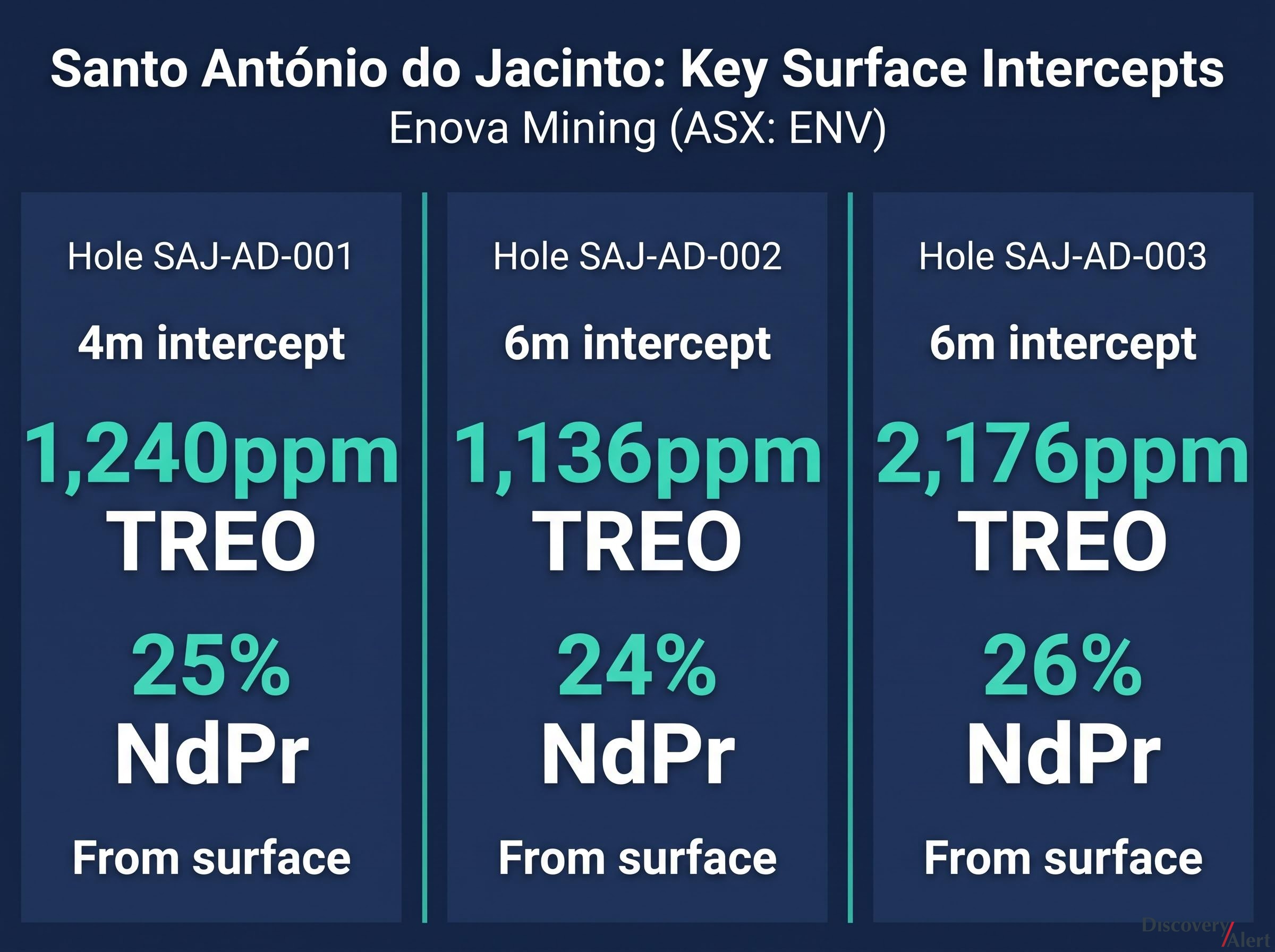
Key intercepts include:
- 4m @ 1,240ppm TREO and 25% NdPr from surface (SAJ-AD-001)
- 6m @ 1,136ppm TREO and 24% NdPr from surface, including 2m @ 2,140ppm TREO and 26% NdPr (SAJ-AD-002)
- 6m @ 2,176ppm TREO and 26% NdPr from surface (SAJ-AD-003)
Peak point results demonstrate higher-grade zones within the broader intercepts:
- 2,485ppm TREO @ 26% NdPr from 0–1m (SAJ-AD-002)
- 2,319ppm TREO @ 25.5% NdPr from 0–1m (SAJ-AD-003)
| Hole ID | Intercept | Peak NdPr % | Significance |
|---|---|---|---|
| SAJ-AD-001 | 4m @ 1,240ppm TREO | 25% | From surface; consistent grade across intercept |
| SAJ-AD-002 | 6m @ 1,136ppm TREO (incl. 2m @ 2,140ppm TREO) | 26% | Highest peak assay at 2,485ppm TREO |
| SAJ-AD-003 | 6m @ 2,176ppm TREO | 26% | Broadest high-grade intercept; 2,319ppm TREO peak |
Eric Vesel, CEO / Executive Director
“Initial auger drilling at Santo António do Jacinto has confirmed significant rare earth element mineralisation within near surface saprolite overlying the Santo António Do Jacinto Porphyritic Granite Complex. The consistently high NdPr content, averaging approximately 25% of TREO, is particularly encouraging and supports the prospectivity of the project with broad intercepts from surface including 6m at 2,176ppm TREO and 26% NdPr, and 6m at 1,136ppm TREO and 24% NdPr, including 2m at 2,140ppm TREO and 26% NdPr. Peak results of up to 2,485ppm TREO and 26% NdPr from surface further highlight the quality of the mineralised system identified to date. With only four auger holes completed to date, these results provide a strong foundation for further exploration. Additional auger drilling is planned to define the extent and thickness of the mineralisation, while our current priority remains the resource delineation drilling program at the Naked Hill Project.”
Why NdPr and saprolite-hosted deposits matter
Neodymium-praseodymium (NdPr) represents the highest-value fraction of rare earth elements due to its critical role in permanent magnets used in electric vehicle motors, wind turbine generators, and advanced electronics. NdPr typically commands a premium price relative to other rare earths, making deposits with high NdPr ratios economically attractive.
Saprolite-hosted REE systems, also referred to as ionic adsorption clay (IAC) deposits, form through deep weathering of granitic or alkaline intrusive rocks. This weathering process concentrates rare earths in clay minerals near the surface, where they can be extracted using simpler leaching techniques compared to hard-rock mining methods.
The investment case for saprolite-hosted deposits rests on several factors:
- Lower capital intensity: Near-surface deposits typically require less upfront investment in underground mining infrastructure
- Simpler metallurgy: IAC deposits can often be processed using dilute acid or salt solutions rather than energy-intensive crushing and grinding
- High NdPr ratios: Weathering processes can selectively concentrate magnetic rare earths relative to light rare earths
At Santo António do Jacinto, the average 25% NdPr ratio across all intercepts positions the project favourably if a resource is eventually defined. However, these are early-stage results, and further drilling and metallurgical evaluation are required to determine economic viability.
Key terms:
- TREO: Total Rare Earth Oxide including yttrium, measured in parts per million (ppm)
- NdPr: Neodymium-praseodymium oxide, the most valuable magnetic rare earth fraction
- Saprolite: Deeply weathered rock material that retains the structure of the parent rock
- IAC: Ionic adsorption clay deposit, where rare earths are loosely bound to clay minerals
Metallurgy, geology and the Brazil advantage
The company conducted ionic adsorption clay (IAC) leach test work at SGS Geosol Laboratory on 26 saprolite samples collected from Santo António Do Jacinto. The preliminary results demonstrate variable recovery rates, with TREO recoveries ranging from 1.4% to 15.1% and heavy rare earth oxide (HREO) recoveries reaching up to 45.3% in some intervals.
These results are early-stage and represent the first-pass assessment of metallurgical behaviour. Further leach test results are still under process, and the company has not disclosed optimal leach conditions or process parameters. The variability in recovery suggests the mineralised zones exhibit different clay mineralogy or weathering intensity across the sampled intervals.
Geological logging from the auger drilling indicates mineralisation occurs within the saprolitic clay weathering profile developed over the Santo António Porphyritic Granite. This granite-derived saprolite-hosted REE system aligns with the company’s pre-drilling geological model, which predicted near-surface enrichment of rare earths in weathered material.
The Santo António do Jacinto Project comprises 13 granted exploration licences totalling 23,409 hectares, all held 100% by Enova Brasil Ltda. The tenements are registered in the state of Minas Gerais.
Brazil as a mining jurisdiction
Brazil ranks among the world’s top exporters of iron ore, gold, bauxite, lithium, and rare earths, with mining recognised as a cornerstone of economic development in resource-rich states such as Minas Gerais. The country’s regulatory framework allows for 100% foreign ownership of mining projects, with no government equity mandates or mandatory joint ventures.
The jurisdiction offers established mining services infrastructure, a skilled workforce, and proximity to major population centres and export routes. These factors contribute to Brazil’s classification as a tier-one mining destination for exploration and development capital.
The next major ASX story will hit our subscribers first
What’s next for Enova
The company will prioritise step-out auger drilling across previously untested areas at Santo António do Jacinto to assess strike and dip continuity of the mineralised saprolite horizon. These holes will systematically test along interpreted trends defined by the current four holes, with the objective of expanding the known mineralised footprint and refining the geological model.
Metallurgical evaluation will continue as additional samples arrive from future drilling programmes. The company has not disclosed timelines for completion of leach test work or progression to resource estimation studies.
Enova’s broader project portfolio includes resource delineation drilling currently underway at Naked Hill (ASX announcement: 27 July 2026), which remains the company’s stated priority. Metallurgical studies for the concentration of titanium, REE, niobium, and scandium metals continue at the CODA project, with test work focusing on magnetic separation, pre-treatment, and leach recovery. Work at Charley Creek has validated earlier drill results with recent deep drilling into high-grade REE mineralisation in saprolite.
The Santo António do Jacinto results provide a foundation for a staged exploration pathway, with the next phase focused on expanding the mineralised footprint through cost-effective auger drilling before advancing to deeper reverse circulation or diamond drilling.
Next steps:
- Step-out auger drilling across untested areas to test lateral and down-dip continuity
- Continued metallurgical and leach evaluation as additional samples become available
- Refine geological targets to guide future reverse circulation or diamond drilling programmes
Precautionary statement: There has been insufficient exploration to define a Mineral Resource at Santo António do Jacinto, and it is uncertain if further exploration will result in the delineation of a Mineral Resource.
Get Brazil’s Next Rare Earths Discovery in Your Inbox
Join 30,000+ investors receiving FREE ASX mining alerts within minutes of release, complete with expert analysis. Click the “Free Alerts” button at Discovery Alert to get rare earths and critical minerals news delivered before the market reacts.