
Saudi Aramco’s Exports Hold, but War-Risk Costs Tell a Darker Story
Aug 17, 2026


The United States government has banned Russian enriched uranium imports effective January 2028 and committed $17.5 billion in conditional loans to accelerate new reactor construction, yet the country’s ability to deliver on either policy depends on a processing infrastructure that, as of August 2026, remains structurally undersized for the task. A single conventional uranium mill in rural Utah processes virtually all domestically mined hard-rock uranium. The in-situ recovery network that operates alongside it adds meaningful capacity but still leaves the system well short of stated requirements. For utilities and investors making fuel-chain contracting decisions now, the planning window is narrowing. The January 2028 deadline carries no built-in extension mechanism, and the DOE’s June 2026 loan announcements have accelerated potential reactor deployment into the 2030s, deepening the demand signal that the existing processing chain cannot yet service. What follows maps the precise gap between US uranium policy ambition and processing reality, identifies where in the fuel chain the bottlenecks sit, and explains which facility types, technologies, and regulatory positions are best placed to partially close that gap before the policy window closes.
Two federal policy commitments are converging on the same undersized infrastructure, and neither was designed with the other’s demands fully in view.
The first is the prohibition on imports of Russian-origin enriched uranium, effective January 2028. Russia has historically provided close to one-quarter of US uranium enrichment services, a concentration of foreign dependency that the ban is intended to eliminate on a fixed statutory timeline.
The statutory pressure behind the January 2028 deadline reflects a years-long policy debate about reducing dependence on Russian uranium that extends well beyond enrichment services to include conversion capacity, fuel fabrication standards, and the geopolitical leverage Moscow retains at each stage.
The second arrived in June 2026, when the DOE’s Office of Energy Dominance Financing announced $17.5 billion in conditional loan commitments for long-lead components supporting up to ten Westinghouse AP1000 reactors, with estimated deployment timelines potentially shortened by up to three years.
The DOE Office of Energy Dominance Financing confirmed the conditional loan structure supports long-lead component procurement for the AP1000 fleet, with accelerated deployment timelines creating a demand obligation that extends well beyond the January 2028 enrichment import deadline.
Both policies assume that domestic uranium processing infrastructure exists at scale to support them. That assumption is the problem.
Russia has historically provided close to one-quarter of US uranium enrichment services, a concentration the January 2028 import ban is designed to eliminate on a fixed statutory timeline with no extension mechanism in existing legislation.
The import ban creates a hard deadline for restructuring fuel supply chains. The reactor financing extends demand well beyond that deadline. Together, they produce a structural tension that neither policy was individually designed to resolve: the supply side must scale to meet both the near-term substitution requirement and the longer-term demand growth, simultaneously.
White Mesa Mill in Utah, operated by Energy Fuels for more than four decades, is the only fully licensed and operating conventional uranium mill in the United States. Its licensed capacity is approximately 8 million pounds of U3O8 per year, and its multi-commodity profile, processing uranium, vanadium, and rare earths, gives the facility revenue diversification beyond simple uranium throughput. Energy Fuels’ Pinyon Plain mine provides lower-cost feed material at a reported weighted average production cost of approximately $23 per pound.
Two additional conventional mills exist on standby. Shootaring Canyon in Utah, held by Anfield Energy, has restart planning underway targeting 2027. Sweetwater in Wyoming remains on standby with no publicly announced restart timeline. Neither facility relieves the practical bottleneck in the near term. They are better understood as optionality on a sustained high-price environment.
In-situ recovery (ISR) facilities process uranium on-site by injecting solution into ore-bearing formations and extracting uranium-laden fluid at the surface, bypassing conventional mills entirely. This distinction matters because ISR expansion timelines are materially shorter than new conventional mill construction.
As of end-2025, according to EIA data, operating ISR plant capacity totalled approximately 13.3 million pounds of U3O8 per year. Five additional ISR plants sat on standby with combined capacity of approximately 8.8 million pounds per year: Alta Mesa (enCore Energy), Lost Creek (Ur-Energy), Smith Ranch-Highland (Cameco), Ross (Energy Fuels), and Willow Creek (Uranium Energy Corp).
Uranium Energy Corp is currently pursuing licensing to expand its Christensen Ranch/Irigaray ISR plant capacity from 2.5 million to 4.0 million pounds of U3O8 per year, illustrating how ISR operators are responding to the policy signal within constrained but achievable timelines.
| Facility | Operator | Type | Status | Capacity (lbs U3O8/yr) |
|---|---|---|---|---|
| White Mesa Mill | Energy Fuels | Conventional | Operating | ~8 million |
| Shootaring Canyon | Anfield Energy | Conventional | Standby (restart targeting 2027) | TBD |
| Sweetwater | — | Conventional | Standby | TBD |
| Operating ISR plants (combined) | Various | ISR | Operating | ~13.3 million |
| Standby ISR plants (5 facilities) | enCore, Ur-Energy, Cameco, Energy Fuels, UEC | ISR | Standby | ~8.8 million |
IsoEnergy CEO Philip Williams has cited a US domestic production requirement of approximately 50 million pounds of U3O8 per year. The arithmetic against that benchmark is straightforward and sobering.
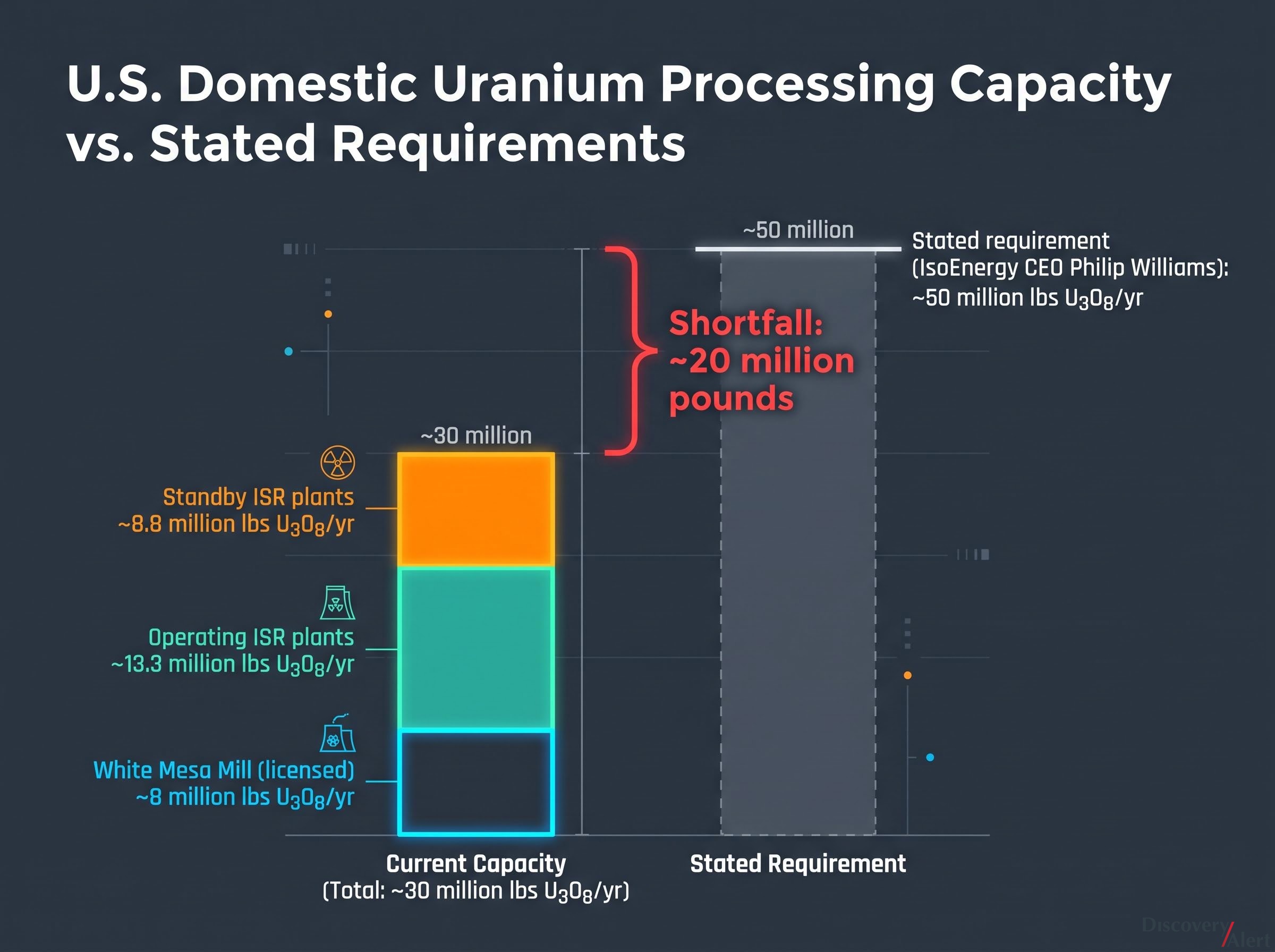
IsoEnergy CEO Philip Williams has cited a US domestic uranium production requirement of approximately 50 million pounds of U3O8 per year.
White Mesa’s licensed capacity accounts for roughly 8 million pounds. Operating ISR plants add approximately 13.3 million pounds. Restoring every standby ISR facility to full operation contributes another 8.8 million pounds. The total, assuming every facility runs simultaneously at 100% of nameplate capacity, reaches approximately 30 million pounds per year.
| Capacity Component | Volume (lbs U3O8/yr) |
|---|---|
| White Mesa Mill (licensed) | ~8 million |
| Operating ISR plants | ~13.3 million |
| Standby ISR plants | ~8.8 million |
| System total at nameplate | ~30 million |
| Stated requirement (Williams) | ~50 million |
That 30-million-pound ceiling is a theoretical maximum, not a practical outlook. Real-world utilisation runs below nameplate. Feedstock availability creates further constraints. Actual 2025 US uranium concentrate production remained well below nameplate capacities across all facility types. Broader planned and permitted ISR nameplate capacity exceeds 35 million pounds per year, but partial overlap with existing facilities and the operational ramp-up required to reach those figures mean the gap persists under any realistic near-term scenario.
The arithmetic does the persuading: even fully operational, the system falls approximately 20 million pounds short of the stated requirement.
The 20-million-pound gap identified here is the domestic processing dimension of a much larger uranium supply deficit that encompasses global mine production shortfalls, long-term contract underpinning, and the structural underinvestment in new projects that characterised the decade following the 2011 Fukushima shutdown.
The processing bottleneck described above covers only the first stage of the journey from ore to reactor. The full uranium fuel chain involves four separately licensed, separately constrained stages, and progress at one gate can stall at the next.
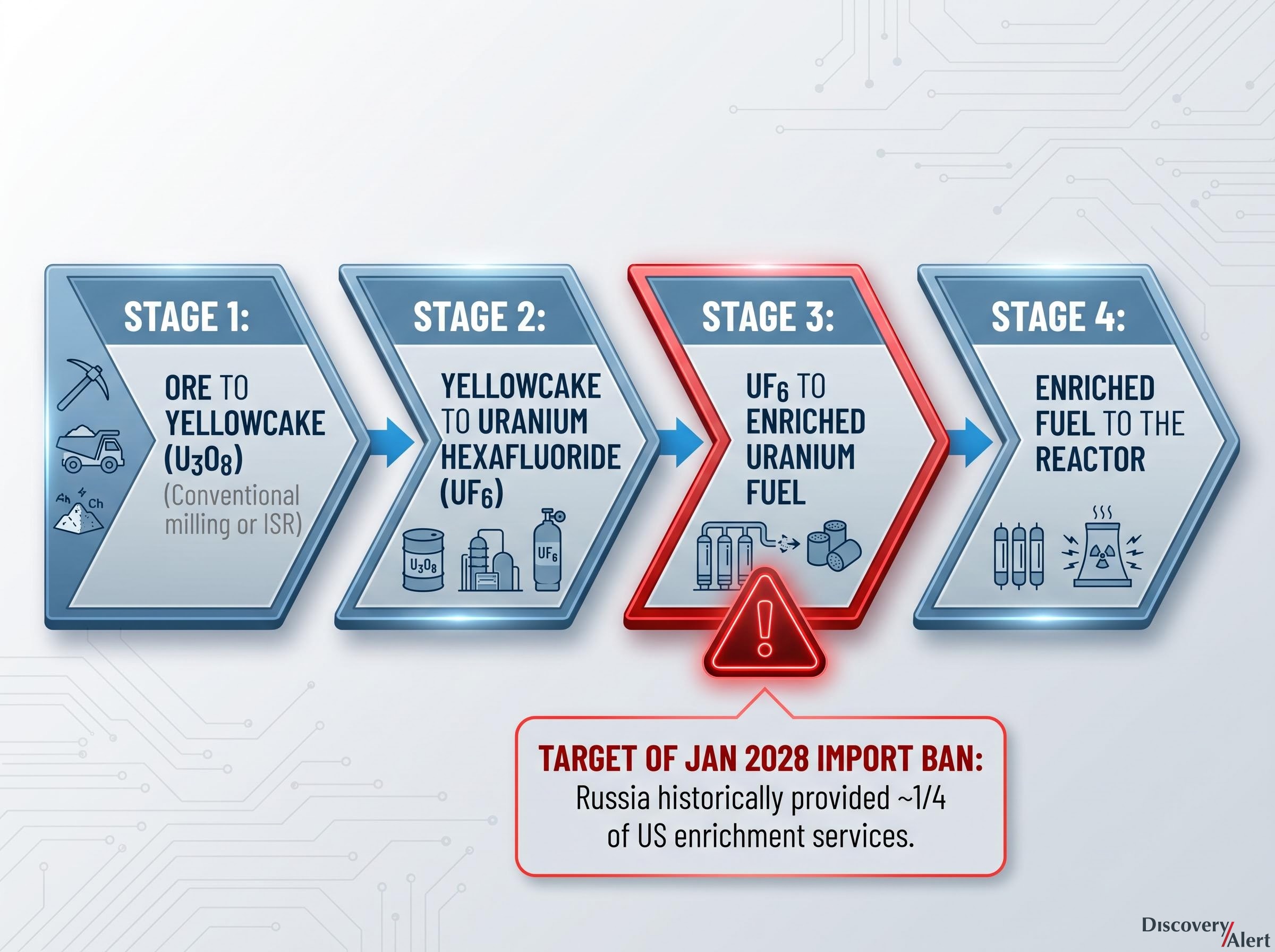
Each stage requires its own licensed infrastructure. Increasing ore production or ISR throughput does not guarantee reactor-ready fuel availability if conversion or enrichment capacity lags behind.
The January 2028 prohibition targets enrichment services, not raw uranium supply. Russia’s approximately one-quarter share of US enrichment services represents the largest single point of foreign dependency being removed by the deadline.
Removing that enrichment capacity without corresponding domestic or allied enrichment infrastructure online by January 2028 creates a conversion-and-enrichment bottleneck even if upstream mine and milling capacity improves. No new conventional mills entered operation between end-2024 and August 2026, and new conventional mills require multi-year NRC licensing that capital alone cannot compress.
Investors who evaluate uranium sector exposure only at the mining or concentrate stage may be mispricing risk at the conversion and enrichment stages that sit between their investment and the end-user utility.
Investors who evaluate uranium sector exposure only at the mining or concentrate stage may be mispricing risk at the conversion and enrichment stages that sit between their investment and the end-user utility, a distinction that becomes sharper when individual operators are assessed against which fuel chain stage they actually control.
No new conventional uranium mill is likely to be built and operating before 2028. NRC licensing and state permitting for conventional mills involve multi-year timelines that capital deployment alone cannot compress. The near-term response is confined to restarting standby facilities, expanding ISR operations, and improving processing efficiency within existing licensed capacity.
FAST-41, the federal permitting coordination programme, improves inter-agency sequencing but does not remove substantive review requirements:
enCore Energy’s Dewey Burdock project in South Dakota illustrates the advantage of maximally positioning within this framework. The project holds a 20-year NRC source materials license renewal valid through June 2046 and became the first ISR uranium project in South Dakota admitted to the FAST-41 programme. That licensing position is a durable regulatory asset in an environment where timing is the primary constraint.
On the processing-efficiency side, IsoEnergy is integrating its Utah uranium holdings with a High-Pressure Slurry Ablation (HPSA) processing technology through a venture called DISA Uranium.
Metallurgical testing of the HPSA process produced a fourfold improvement in feed grade, with the company targeting an 88% recovery rate, according to IsoEnergy and Crux Investor Research.
This approach has the potential to improve uranium recovery from the same volume of mined ore, partially addressing the domestic processing gap without requiring new conventional mill licences. Processing-efficiency technologies function as bridge plays: they enhance output from fixed licensed capacity rather than betting on new licences being granted under tight policy deadlines.
The analytical framework built across the preceding sections points to four distinct asset categories, each with a different advantage and a different risk profile within the policy timeline.
| Asset Category | Key Example(s) | Primary Advantage | Key Risk |
|---|---|---|---|
| Licensed conventional mill | White Mesa (Energy Fuels) | Sole operating gateway for hard-rock domestic uranium | Single-facility concentration risk |
| ISR operators | Ur-Energy, enCore, UEC, Cameco | Near-term expansion capacity bypassing conventional mills | Geology-dependent and permitting-driven ramp-up constraints |
| Standby conventional mills | Shootaring Canyon, Sweetwater | Restart timelines shorter than greenfield construction | Restart execution risk; sustained high-price dependency |
| Advanced-licensed / bridge technologies | enCore Dewey Burdock, IsoEnergy DISA Uranium | Durable regulatory position or efficiency gains within existing licences | Development capital risk; metallurgical scale-up risk |
The scarcity premium on White Mesa derives not from its throughput alone but from the absence of any licensed alternative for hard-rock uranium seeking a domestic conventional processing pathway before 2028. Energy Fuels controls what amounts to an irreplaceable gateway.
ISR is where most actual production response is occurring. Restart and expansion timelines, while non-trivial, are materially shorter than those for new conventional mills. Uranium Energy Corp’s Christensen Ranch/Irigaray expansion from 2.5 million to 4.0 million pounds per year is under licensing. Broader planned and permitted ISR nameplate capacity exceeds 35 million pounds per year, representing the ceiling of the ISR growth scenario.
ISR operators face geology-dependent constraints. Not every permitted wellfield delivers at nameplate. Permitting and operational sequencing impose their own timelines. But for investors seeking exposure to the near-term physical response to the policy signal, ISR operators represent the most active category.
For investors who accept the structural demand case but want to understand why the bull thesis and individual stock outcomes can diverge so sharply, our deep-dive into uranium stock selection risk examines which operator characteristics, balance sheet structures, and fuel chain positions historically separate the survivors from the casualties in commodity bull markets.
The capacity arithmetic is clear. Even under a fully operational scenario in which White Mesa and every ISR facility runs at 100% nameplate, the US processing system reaches approximately 30 million pounds of U3O8 per year against a stated requirement of 50 million pounds. Actual 2025 production was well below nameplate across all facility types.
January 2028 is a statutory deadline with no built-in extension mechanism in existing legislation. Utilities contracting fuel supply in 2026 cannot rely on regulatory timelines being compressed to meet it.
Three structural conditions define the investment environment beyond the immediate deadline:
The undercapacity of US uranium processing is not a short-term dislocation that one or two years of investment corrects. It is a decade-long infrastructure deficit that the DOE’s reactor financing has deepened by creating additional demand the existing processing chain cannot service. No new conventional mills entered operation between end-2024 and August 2026. The near-term supply response is ISR-led and constrained.
This article is for informational purposes only and should not be considered financial advice. Investors should conduct their own research and consult with financial professionals before making investment decisions. Past performance does not guarantee future results. Financial projections cited in this article are subject to market conditions and various risk factors.
As of August 2026, the US uranium processing system includes one operating conventional mill (White Mesa, with ~8 million lbs U3O8/yr licensed capacity) and operating ISR plants totalling ~13.3 million lbs/yr, with standby ISR plants adding a further ~8.8 million lbs/yr, for a theoretical maximum of roughly 30 million lbs/yr against a stated requirement of ~50 million lbs/yr.
The January 2028 ban eliminates a supply source responsible for approximately one-quarter of US enrichment services, with no built-in legislative extension mechanism, forcing utilities and investors to restructure fuel contracts around domestic or allied enrichment capacity before that fixed statutory deadline.
The uranium fuel chain has four separately licensed stages: milling, conversion to UF6, enrichment, and fabrication, and increasing mine or concentrate output does not guarantee reactor-ready fuel if conversion or enrichment capacity remains constrained, particularly given the January 2028 enrichment import ban.
ISR operators such as Uranium Energy Corp, enCore Energy, and Ur-Energy offer the shortest expansion timelines, while Energy Fuels' White Mesa Mill remains the only licensed conventional processing gateway for hard-rock uranium, and advanced-licensed projects like enCore's Dewey Burdock provide durable regulatory positions within the tight policy window.
The June 2026 conditional loan commitments supporting up to ten Westinghouse AP1000 reactors extend structural demand for domestic uranium processing well into the 2030s, deepening the supply gap beyond the immediate January 2028 enrichment deadline and reinforcing the long-term case for processing infrastructure investment.


