
Saudi Aramco’s Exports Hold, but War-Risk Costs Tell a Darker Story
Aug 17, 2026


LME aluminium spot bid reached USD 3,270/tonne on 4 August 2026, a level roughly 15-20% above where most analyst consensus ranges had prices sitting at this point in the year. The forward curve is not signalling relief any time soon. Falling warehouse stocks, a backwardated curve structure, and flooding across Sichuan province, where hydropower-dependent smelters face compounding disruption risks, have combined to push prices higher across every contract tenor in a single session. Critically, this is a supply-side event, not a demand-led rally, and that distinction carries significant weight for how long the current price level can hold. What follows breaks down the 4 August price action across all contract tenors, explains what the curve shape reveals about physical availability, and identifies the three variables that will determine whether this tightness persists into Q4 or unwinds.
Every LME aluminium contract posted gains on 4 August, but the gains were not uniform, and the differences matter.
Spot bid: USD 3,270/tonne, up 0.34% from USD 3,259/tonne on 3 August.
The spot offer moved to USD 3,271/tonne from USD 3,260/tonne, holding the bid-offer spread at just USD 1/tonne, an orderly but firm market. Three-month aluminium advanced further: the bid climbed 0.81% to USD 3,236/tonne from USD 3,210/tonne, while the offer reached USD 3,236.50/tonne, up 0.76%. Even the December 2027 forward registered gains, with the bid rising 0.48% to USD 3,148/tonne and the offer to USD 3,153/tonne.
| Contract | Bid (4 Aug) | Prior Bid | Change % |
|---|---|---|---|
| Spot (cash) | USD 3,270/t | USD 3,259/t | +0.34% |
| Three-month | USD 3,236/t | USD 3,210/t | +0.81% |
| December 2027 | USD 3,148/t | USD 3,133/t | +0.48% |
Simultaneous advances across all tenors are not routine. The three-month contract outpacing spot on a percentage basis is particularly telling: the market is pricing in tightness that extends well beyond a single session. The LME three-month Asian Reference Price settled at USD 3,223/tonne, while the LME alumina Platts benchmark stood at USD 343.10/tonne. For investors tracking aluminium exposure, the breadth of this advance carries as much signal as the headline spot figure.
Spot aluminium at USD 3,270/tonne is trading above the three-month forward at USD 3,236/tonne, a USD 34/tonne backwardation. In practical terms, buyers are paying a premium to secure metal now rather than waiting for delivery three months out.
That premium is a physical-market signal, not a sentiment indicator. When spot trades above the forward, it reflects competition for prompt availability. Consumers and traders need aluminium delivered sooner, and they are willing to pay more to get it. This curve shape is not consistent with demand-led price discovery; it points directly to constrained supply.

The December 2027 contract at USD 3,148/tonne sits USD 122/tonne below spot, suggesting the market views longer-dated conditions as more balanced. The near-term tightness that is compressing availability today is not expected to persist indefinitely. The three-month Asian Reference Price of USD 3,223/tonne provides a cross-check, confirming the regional pricing signal aligns with the exchange curve.
The LME alumina Platts benchmark at USD 343.10/tonne on 4 August sits within a broader context of alumina price surge pressure that has been compressing smelter margins globally, with stocks near levels not seen since 1998 adding a feedstock dimension to the tightness narrative.
For investors, the curve shape is one of the most reliable real-time tools for separating genuine tightness events from speculative rallies. A backwardated market with falling warehouse stocks is a qualitatively different situation from a contango market where prices are rising on positioning alone.
The London Metal Exchange operates a global network of registered warehouses that function as a publicly visible buffer stock for the aluminium market. Each day, the exchange publishes inventory data covering total stocks held on warrant, providing a real-time signal of how much metal is available for prompt delivery.
LME price discovery operates through a layered mechanism where exchange-registered warehouse stocks, forward curve structure, and daily warrant activity all interact to produce the reference prices that physical traders, consumers, and financial participants use to hedge and transact.
Two categories within the inventory data carry particular interpretive weight:
The distinction between live and cancelled warrants matters. A cancelled warrant represents metal that someone has tagged for physical removal from the exchange system. When both live warrants and cancelled warrants decline simultaneously, it suggests metal is not simply being shuffled between warehouses. It is leaving the exchange system entirely and entering the physical supply chain, where it is consumed or held off-exchange.
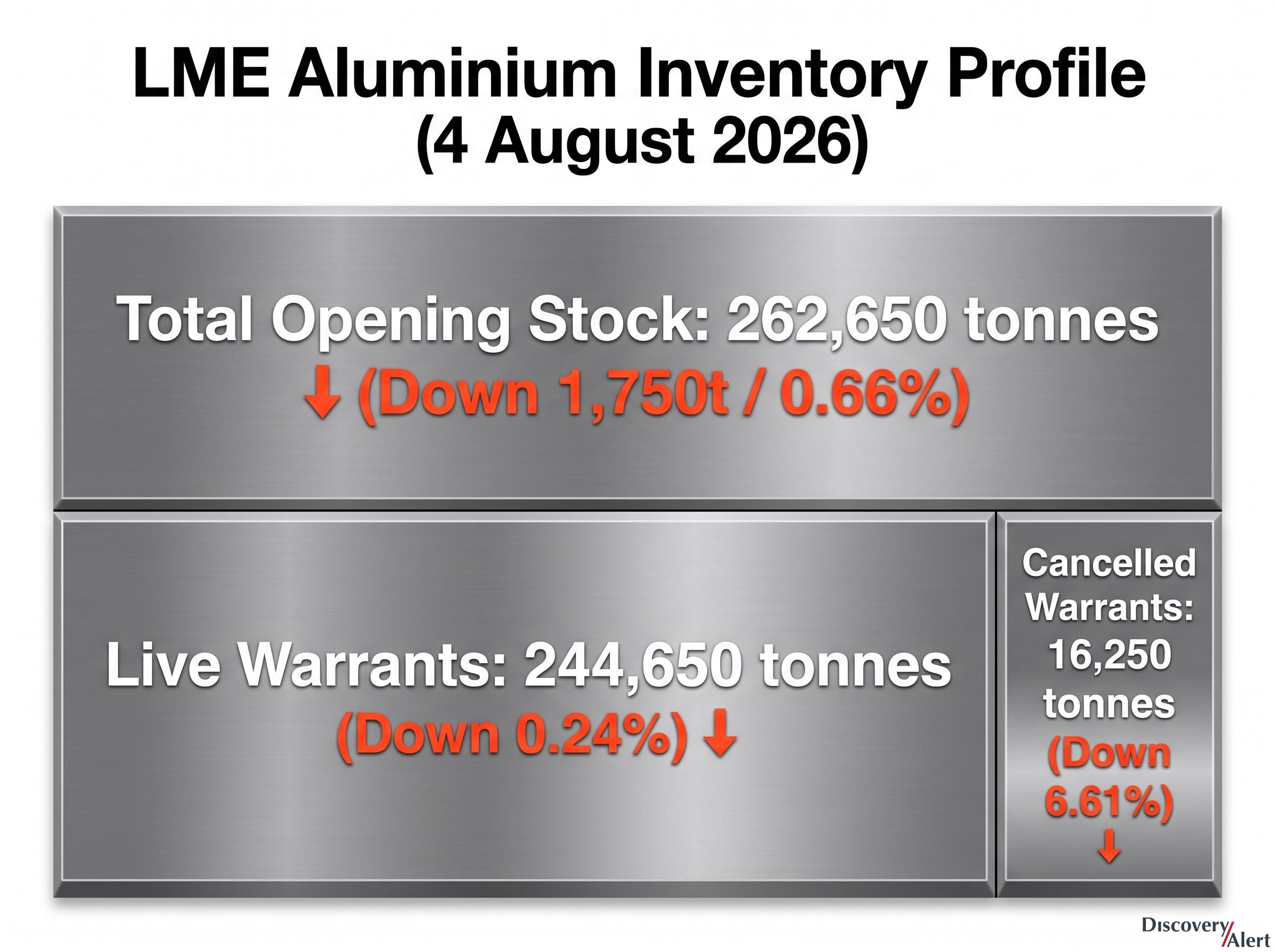
That pattern is supply-constructive. Metal leaving warrant during a period of rising prices signals genuine competition for prompt aluminium, reinforcing the backwardation visible in the forward curve. A drawdown that occurs alongside falling prices would carry a very different implication, potentially reflecting weak demand rather than tight supply. The current combination, rising prices and falling stocks, points firmly toward the latter interpretation.
Sichuan province produces aluminium at low cost under normal conditions because its smelters run on hydroelectric power rather than coal. That is what separates it from production hubs such as Inner Mongolia and Xinjiang, where coal-fired generation dominates. The cost advantage is real, but it comes with a specific vulnerability: extreme variations in river flow, whether too little water or too much, can disrupt the entire production chain.
Severe flooding across Sichuan in late July and early August 2026 introduced that vulnerability into market pricing. The disruption risk operates through three distinct channels, each compounding the others:
These are not independent risks. A flood event that disrupts logistics simultaneously reduces the ability to bring alumina feedstock in and ship finished metal out, while precautionary shutdowns compound any generation losses.
Sichuan’s flood risk sits within a wider pattern of aluminium supply chain stress that extends from bauxite mining in Guinea through refining to smelting, with each node carrying its own concentration risk and disruption potential that can propagate rapidly into LME-visible tightness.
The aluminium market is explicitly benchmarking the current flood risk against the August 2022 Sichuan drought episode. In 2022, the mechanism was the opposite: too little water reduced hydropower generation, forcing smelter curtailments that drew down exchange inventory and drove price backwardation. The 2026 mechanism differs in direction (too much water disrupting operations rather than too little reducing generation) but is structurally analogous in its impact on power availability and output.
The 2022 episode demonstrated how quickly a Sichuan disruption can transmit into LME-visible tightness. The market is treating the current flood risk as an active supply premium embedded in near-term futures prices, consistent with the backwardated curve and ongoing inventory draws.
China accounts for more than 50% of global aluminium consumption, making Chinese end-use demand the dominant variable in the global supply-demand balance.
That dominance is precisely why the demand side of the current equation is so important to understand. Recent Chinese manufacturing and property-sector indicators have been weak, meaning the 4 August rally is supply-driven, not demand-reinforced. The distinction is material.
China’s share of global aluminium production currently sits at approximately 60% of world output, a concentration that means any disruption to domestic smelting capacity, whether from energy constraints or extreme weather, transmits rapidly into exchange-visible tightness and forward curve repricing.
According to available analyst forecasts, the 2026 consensus price range for aluminium was centred around USD 2,700-2,900/tonne (estimates sourced from early-to-mid 2026 consensus reports; not independently verified). The current spot of USD 3,270/tonne sits materially above that band, underscoring the size of the supply-risk premium the market has priced in. Earlier in 2026, Middle East-related supply disruptions pushed three-month aluminium to a multi-year high of approximately USD 3,372/tonne (sourced from market reports; not independently verified).
The Gulf supply disruption that drove three-month aluminium to approximately USD 3,372/tonne earlier in 2026 established the regime of successive supply shocks that frames the 4 August move; that prior episode showed how quickly a concentrated production loss can overwhelm demand-side weakness and reset the consensus price band.
The implication is direct: if Sichuan disruptions prove brief or shallower than feared, there is no demand-side support to prevent a meaningful price correction back toward those consensus ranges. Current prices rest on a supply-risk premium, and that premium requires the supply narrative to hold.
Two scenarios bracket the near-term outlook. Prolonged Sichuan curtailments extending through September could tighten the market enough to challenge the prior 2026 multi-year high around USD 3,372/tonne. A rapid normalisation of smelter output, conversely, would unwind the supply premium into soft Chinese demand, pulling prices back toward the USD 2,700-2,900/tonne consensus band.
Three data streams will determine which scenario develops:
Seasonal context frames the timeline. Hydropower output in Sichuan typically eases as rainfall diminishes from late Q3 onward, establishing a natural window for when the flood-related disruption risk either materialises fully or begins to dissipate.
The near-term bias is conditionally bullish, contingent on all three variables remaining supply-constructive.
Rising prices, falling warehouse stocks, and a backwardated forward curve are internally consistent with a supply-driven tightness event. Spot at USD 3,270/tonne, a USD 34/tonne backwardation against the three-month contract, and LME opening stock of just 262,650 tonnes all point in the same direction.
They also depend entirely on the Sichuan disruption remaining active. 2026 has been defined by successive supply shocks rather than demand-led price discovery, and the 4 August move fits that broader regime.
The conditional is clear. If Sichuan disruptions deepen or persist into September, the market has further upside. If they resolve quickly, prices lack an independent demand floor at current levels. The data streams identified above, inventory movements, provincial guidance, and Chinese demand readings, will determine which outcome the evidence supports over the coming weeks.
This article is for informational purposes only and should not be considered financial advice. Investors should conduct their own research and consult with financial professionals before making investment decisions. Price forecasts and forward-looking statements cited in this article are speculative and subject to change based on market developments and supply-demand conditions.
LME aluminium backwardation occurs when the spot price trades above the forward price, meaning buyers pay a premium for immediate delivery. On 4 August 2026, spot aluminium at USD 3,270/tonne sat USD 34/tonne above the three-month forward, signalling constrained physical availability rather than speculative demand.
Sichuan province operates hydropower-dependent aluminium smelters, making output vulnerable to extreme weather. The 2026 flooding disrupted hydropower generation, logistics, and prompted precautionary smelter shutdowns, removing near-term supply and contributing to the supply premium embedded in LME prices.
LME warehouse stocks represent the publicly visible buffer of aluminium available for prompt delivery through the exchange's global registered warehouse network. On 4 August 2026, total opening stock fell to 262,650 tonnes, a draw of approximately 1,750 tonnes, reinforcing the tightness signal already visible in the backwardated forward curve.
The 4 August 2026 spot bid of USD 3,270/tonne sits roughly 15-20% above where most analyst consensus ranges had prices at this point in the year, with early-to-mid 2026 consensus forecasts centred around USD 2,700-2,900/tonne.
Investors should track three data streams: daily LME inventory changes for signs of accelerating draws or restocking, concrete guidance from Sichuan smelters and provincial authorities on curtailment duration, and Chinese manufacturing PMI and property-sector data for any demand recovery signals.


