
Saudi Aramco’s Exports Hold, but War-Risk Costs Tell a Darker Story
Aug 17, 2026


In December 2025, India achieved a fuel-blending milestone that was not supposed to arrive until 2030, making it one of the fastest voluntary energy-substitution programmes an emerging economy has ever executed. The Ethanol Blended Petrol (EBP) programme now delivers 20% ethanol in every litre of petrol sold nationally, displacing 31 million metric tonnes of crude oil and avoiding an estimated 93 million metric tonnes of CO2 since Ethanol Supply Year (ESY) 2014-15.
With 85% of its crude imported, the stakes for India were always more than environmental. This was an energy-security intervention built on the chassis of climate policy. What follows is an analysis of how the five-year acceleration was engineered, what it has actually delivered, and what the model means for other import-dependent economies and the investors watching those markets.
India’s blending rate sat below 1.5% in 2013-14. Although the EBP programme had existed in some form since the early 2000s, meaningful progress only began after 2014, when a coordinated set of enabling policies activated supply-side capacity and pricing structures simultaneously. What followed was not linear progress but a deliberate compression.
In 2022, the government formally advanced the 2030 deadline to ESY 2025-26, signalling that the acceleration was itself a policy decision rather than a fortunate overshoot. India reached the 20% target in December 2025 and has maintained it through mid-2026.
Global oil-flow disruptions driven by chokepoint constraints create asymmetric exposure across import-dependent economies, with those lacking substitution capacity forced to compete for spot cargoes at the worst moments in the commodity cycle, which is the structural risk the EBP programme partially insulates India against.
Key regulatory milestones trace the arc:
From April 2026, all BS-VI vehicles (India’s current emission standard) must be E20 compatible, and all petrol sold nationally must contain 20% ethanol at a minimum Research Octane Number (RON) of 95. E20 is no longer a target. It is the regulatory baseline.
The speed of this transition matters analytically because fast timelines imply unusually strong enabling conditions. Identifying what those conditions were is the question the rest of this analysis addresses.
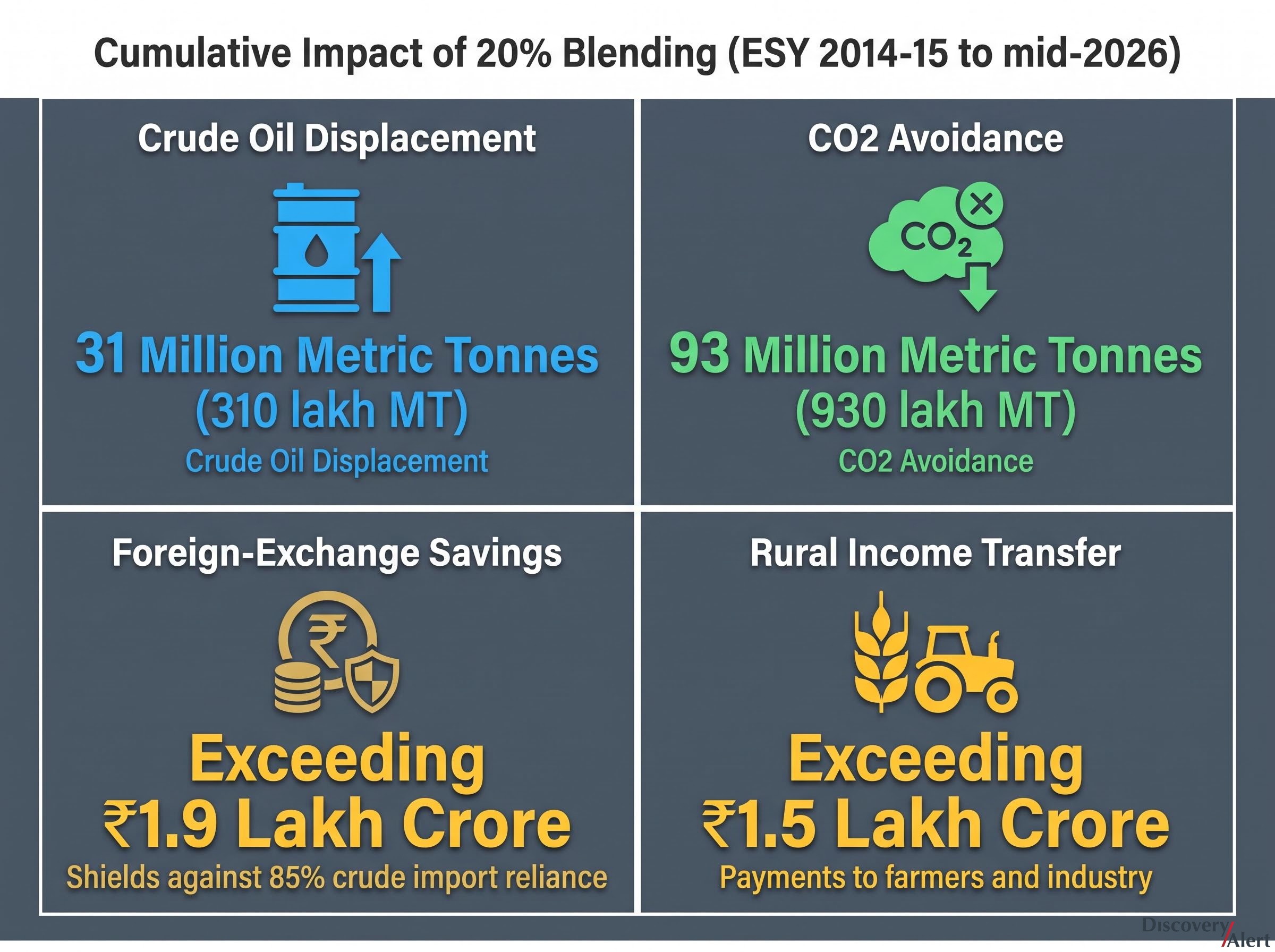
Four headline metrics, drawn from Indian government data covering ESY 2014-15 through mid-2026, capture the programme’s cumulative impact. Each converts a government statistic into a real-world consequence that extends well beyond the fuel pump.
| Impact Category | Metric | Cumulative Value | What It Means |
|---|---|---|---|
| Crude oil displacement | Metric tonnes substituted | 31 million (310 lakh MT) | Direct reduction in imported barrel volumes |
| CO2 avoidance | Net emissions reduction | 93 million MT (930 lakh MT) | Equivalent to removing tens of millions of vehicles from roads annually |
| Foreign-exchange savings | Reduced dollar-denominated crude imports | Exceeding ₹1.9 lakh crore | Current-account insulation from global oil-price shocks |
| Farmer and industry payments | Feedstock procurement payments | Exceeding ₹1.5 lakh crore | Structural rural income transfer tied to energy demand |
The ₹1.9 lakh crore in foreign-exchange savings is not merely a fiscal figure. For an economy that imports 85% of its crude, it represents a national-security dividend: every rupee not spent on imported oil is a rupee shielded from geopolitical supply disruptions and dollar-denominated commodity volatility.
Peer-reviewed life-cycle greenhouse gas analysis of sugarcane ethanol production in India finds reductions of 70-76% compared to gasoline on a well-to-wheel basis, providing the methodological foundation for the CO2 avoidance figures that government reporting aggregates at programme level.
The ₹1.5 lakh crore paid to farmers and the ethanol industry represents something distinct from a conventional subsidy. These are procurement payments for feedstock that feeds a mandated national blending programme, creating a structural rural income transfer anchored to energy policy rather than agricultural welfare.
These outcomes were achieved through existing agricultural and fuel-distribution infrastructure, not greenfield construction, which is what makes the model credible as a replicable template.
The 20% outcome was not accidental. It was the product of five interlocking policy levers, each designed to address a specific failure mode that had stalled the programme during its slower early years.
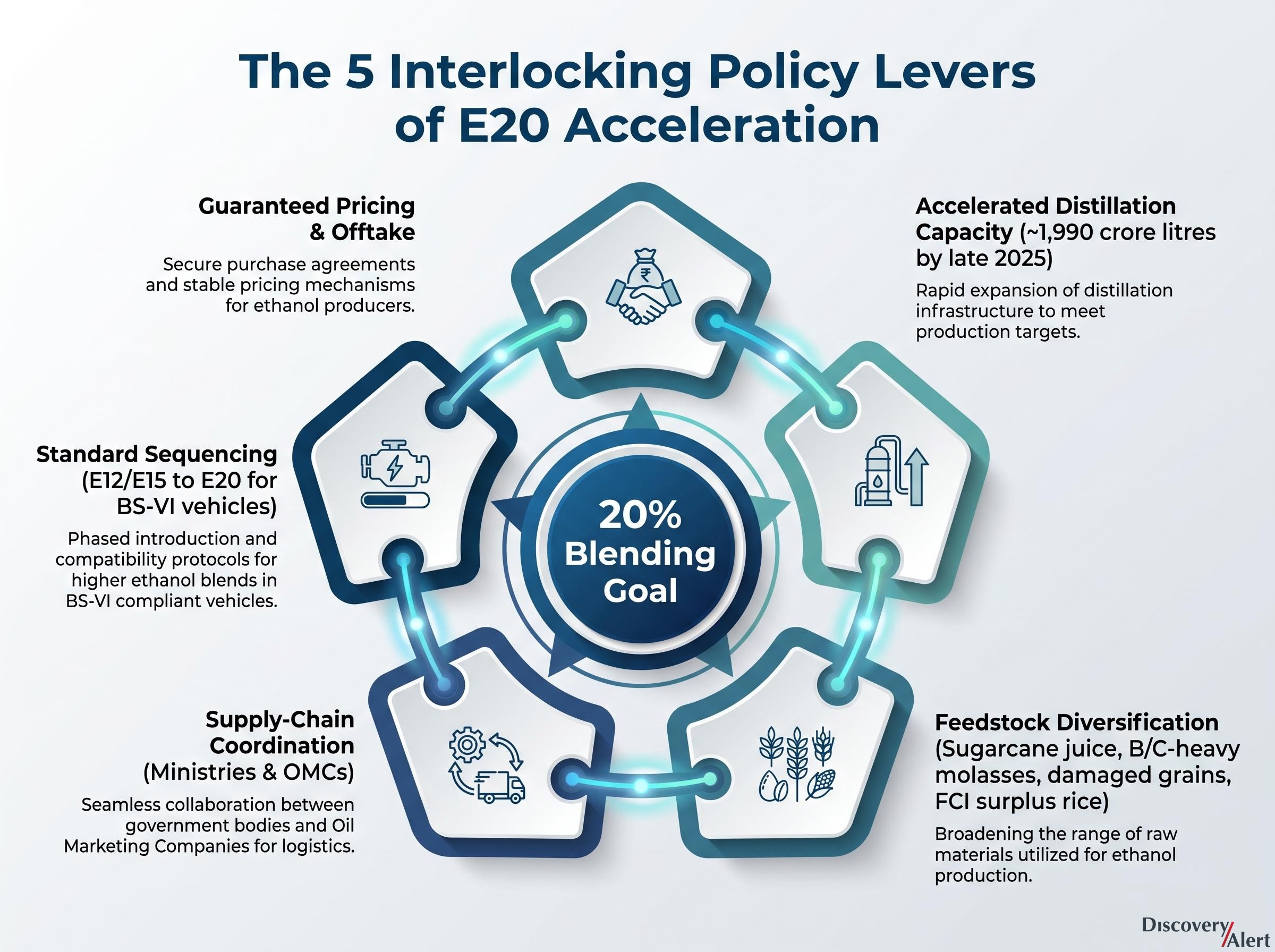
India’s own early struggles underline the sequencing principle embedded in this architecture: infrastructure must precede the mandate, not follow it. Mandates that outrun capacity create compliance gaps, not acceleration.
A reader approaching this programme through the lens of climate policy sees one story. The macroeconomic logic tells a different one, and it is the second story that explains why the programme has survived electoral cycles where single-purpose climate initiatives have not.
India imports approximately 85% of its crude oil. Every percentage point of ethanol blending directly reduces dollar-denominated import exposure and current-account vulnerability. The cumulative foreign-exchange savings exceeding ₹1.9 lakh crore represent the headline energy-security metric, not the emissions reduction.
The scale of that import vulnerability is visible in how sharply Asian economies diverge when supply routes are threatened; economies with domestic substitution capacity, whether biofuel, LNG, or strategic reserves, absorb disruptions that send others into spot-market scrambles.
The distinction between climate framing and energy-security framing matters because the latter has been more politically durable. Three factors anchor the programme’s political constituency, listed in the order of their actual policy weight:
This dual-purpose structure, energy security wrapped in a climate framework, is what makes the model unusually resilient. Brazil’s ethanol programme and Japan’s energy-efficiency push, both originating in response to the 1970s oil crisis, serve as historical precedents for strategic energy diversification driven by import vulnerability rather than emissions targets alone.
As of mid-2026, the Indian government has stated no immediate plan to push blending beyond 20%. This signals a consolidation phase: E20 as a stable, system-wide baseline rather than a stepping stone to higher mandates that could strain vehicle compatibility or fuel efficiency.
India’s programme is not universally replicable. The scale of its agricultural base, its sugarcane production volumes, and its institutional capacity give it advantages that smaller economies cannot easily replicate. The policy architecture, however, is separable from that scale advantage. Four lessons travel well, each framed around the specific failure mode it prevents.
The concept of “compatible decarbonisation,” leveraging existing agricultural systems and liquid-fuel infrastructure rather than requiring immediate modal shifts, is particularly relevant for rapidly growing, import-dependent economies where road-transport fuel demand is still rising.
These lessons are most transferable to economies that share India’s structural profile: high import dependency, rising road-transport demand, and existing agricultural feedstock capacity. Mature-market or EV-heavy contexts present a different calculus.
Emerging-market energy transition investment increasingly follows a pattern where foreign capital targets economies with large domestic feedstock advantages but underdeveloped processing infrastructure, a dynamic visible in Brazil’s critical minerals sector that parallels the agricultural-to-ethanol conversion India has already executed at scale.
The EBP programme offers a live case study in how policy-anchored mandates create durable demand rather than cyclical exposure. For investors, the critical question is which parts of the value chain benefit from structural demand and which carry more cyclical risk.
| Value Chain Segment | Demand Anchor | Investment Profile |
|---|---|---|
| Distillation assets | E20 regulatory mandate from April 2026; installed capacity ~1,990 crore litres | Multi-year revenue visibility tied to national blending targets |
| Logistics and storage | Physical infrastructure required for nationwide E20 distribution | Durable demand linked to regulatory baseline, not spot pricing |
| Feedstock supply chains | Sugarcane, grain, and surplus-rice processing with structural off-take certainty | Agriculture-energy convergence; diversified revenue for agricultural producers |
Distillation, storage, and logistics assets enjoy multi-year revenue visibility anchored to the E20 mandate. These are infrastructure plays with policy-backed demand, distinct from commodity exposures subject to spot-price volatility. Feedstock supply chains represent an agriculture-energy convergence story: structural off-take certainty tied to the energy mandate, with payments to farmers and the ethanol industry already exceeding ₹1.5 lakh crore.
The government’s stated position as of mid-2026, no near-term mandate beyond 20%, suggests the investment environment is oriented toward optimising and consolidating E20 infrastructure rather than chasing the next mandate step.
India’s demonstrated ability to deliver aggressive fuel-substitution at national scale and on a compressed timeline is itself a signal. It suggests that similar government-backed accelerations are achievable in other import-dependent emerging markets, which carries implications for how investors price transition risk across those economies.
The structural supply deficit in global oil markets, which persists even through periods of temporary geopolitical de-escalation, reinforces why governments in import-dependent economies treat biofuel substitution as a long-term infrastructure investment rather than a transitional measure.
This article is for informational purposes only and should not be considered financial advice. Investors should conduct their own research and consult with financial professionals before making investment decisions.
The five-year acceleration was not luck. It was the product of five co-designed policy levers operating simultaneously: pricing certainty, capacity expansion, feedstock diversification, supply-chain coordination, and standard sequencing. That co-design is the replicable unit.
The programme’s dual-purpose nature, serving energy security and emissions reduction through the same mechanism, is the structural reason it survived electoral cycles where single-purpose climate programmes have not.
India’s E20 consolidation phase as of mid-2026 is not the end of the story. It is a stable base from which other rapidly growing, import-dependent economies can now observe a fully operational model at national scale. The blueprint exists. The question for policymakers and the investors watching their markets is whether they can read it clearly enough to build their own.
India's Ethanol Blended Petrol (EBP) programme is a national fuel policy that mandates a set percentage of ethanol be mixed into every litre of petrol sold across the country. The government sets administered price bands for ethanol by feedstock type and Oil Marketing Companies issue tenders with assured offtake, giving distillers the revenue certainty needed to invest in production capacity.
India accelerated from below 1.5% blending in 2013-14 to 20% nationally in December 2025 by simultaneously deploying five policy levers: guaranteed pricing, soft-loan-backed distillation capacity expansion, feedstock diversification to include surplus rice and food grains, cross-ministry supply-chain coordination, and phased vehicle compatibility standards that preceded the mandate rather than following it.
The programme has generated foreign-exchange savings exceeding Rs 1.9 lakh crore by reducing dollar-denominated crude imports, and transferred more than Rs 1.5 lakh crore in procurement payments to farmers and the ethanol industry, creating a structural rural income stream anchored to energy demand rather than agricultural welfare policy.
Distillation assets, logistics infrastructure, and feedstock supply chains all benefit from demand anchored to the E20 regulatory mandate rather than spot commodity pricing. Installed distillation capacity reached approximately 1,990 crore litres by late 2025, and the government's stated position of no near-term mandate beyond 20% suggests the investment environment favours consolidation and optimisation of existing E20 infrastructure.
The policy architecture is considered separable from India's specific scale advantages in sugarcane production and agricultural base, making four core lessons transferable: pricing certainty to unlock private capital, engineered supply-chain coordination, sequencing mandates after capacity is built, and framing biofuel programmes around energy security and rural income to ensure political durability across electoral cycles.


