
Aramco Targets Europe With Deeper-Than-Expected Crude Price Cut
Aug 17, 2026


An ICSID tribunal has rescheduled the merits hearing in the Almaden Minerals arbitration against Mexico from December 2026 to July 2027, expanding the proceedings from roughly six days to ten. The case, registered as ICSID Case No. ARB/24/23, now carries an approximate damages claim of US$2.68 billion, positioning it as one of the largest active mining-sector investor-state proceedings against Mexico. Filed under the investment chapter of the Comprehensive and Progressive Agreement for Trans-Pacific Partnership (CPTPP), the Almaden Minerals arbitration carries relevance well beyond the two companies directly involved. What follows is a breakdown of how the Ixtaca project dispute reached this scale, what the expanded hearing signals about complexity, and what the outcome could mean for sovereign risk assessments across Mexico’s mining sector.
The hearing was originally scheduled for 14-18 December 2026 in Washington, D.C., a five-day window that reflected earlier procedural expectations. Tribunal availability constraints forced the postponement to July 2027, the earliest window the panel could accommodate.
The new hearing block allows for up to ten days, nearly double the original allocation. That expansion is not cosmetic. A tribunal committing ten days to a single proceeding is treating it as an evidence-heavy merits case with substantial fact-witness and expert-quantum examination requirements.
Almaden expressed disappointment at the delay but acknowledged the additional time would allow for a more thorough presentation of its case. Key procedural milestones ahead include:
Almaden Minerals discovered the Ixtaca gold-silver deposit on the Tuligtic claim in Puebla State, Mexico, in 2010. Almadex Minerals held a 2% net smelter return royalty interest in the project.
The pivot came in February 2022, when Mexico’s Supreme Court ruled that the country’s mining authority had failed to adequately conduct indigenous consultation processes. The concessions were suspended pending completion of those consultations. Almaden alleges that Mexico’s Ministry of Economy subsequently exploited technical irregularities to retroactively reject historical title applications, cancelling the concessions outright rather than completing the required process.
Mexico’s mining regulatory framework underwent significant structural changes from 2022 onward, including amendments to the Mining Law that altered concession tenure conditions, strengthened environmental review requirements, and formally incorporated indigenous consultation obligations into the permitting process, each of which has direct bearing on how future concession disputes are assessed.
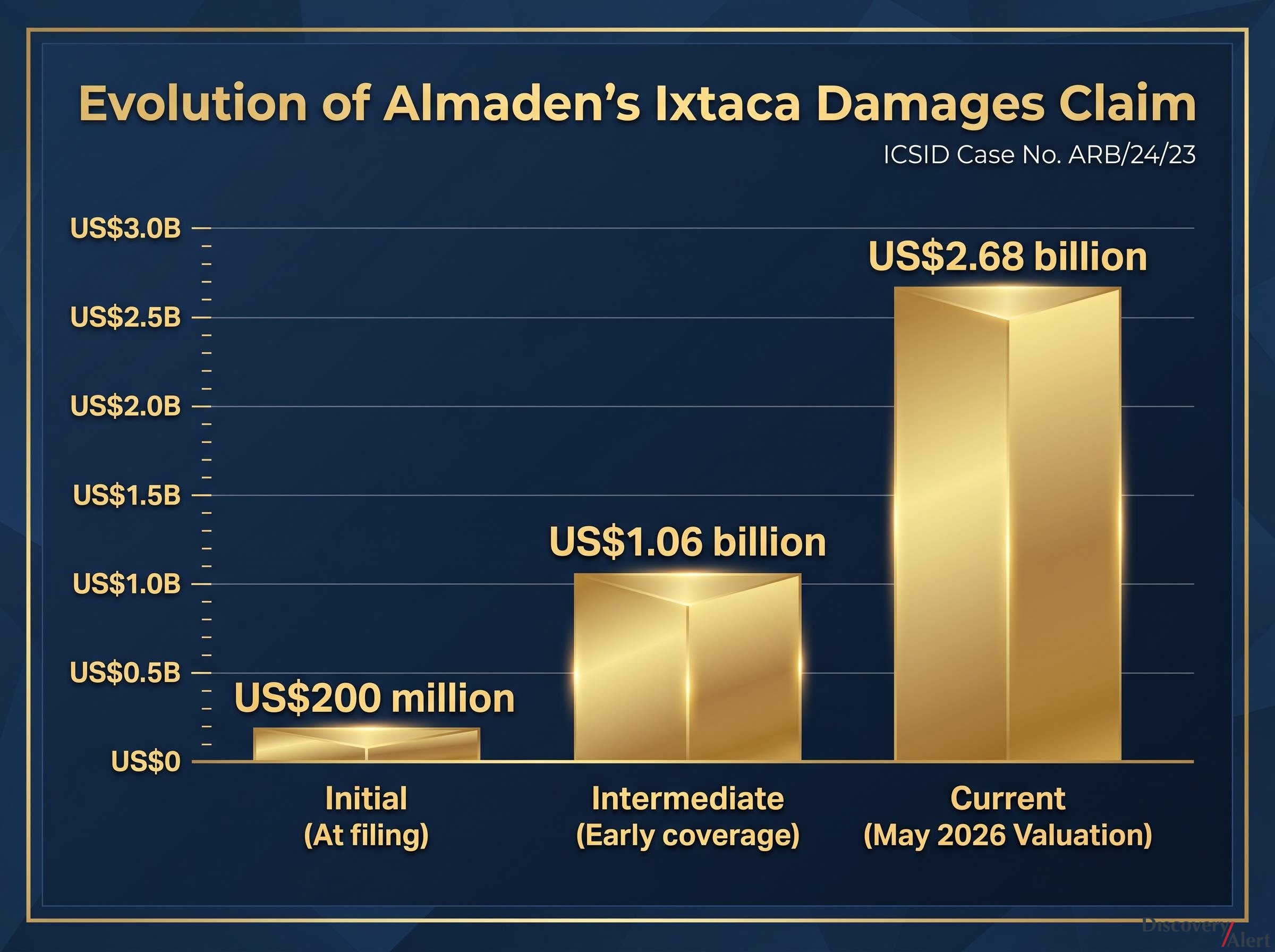
The damages claim has escalated materially across three stages, reflecting updated metal prices, interest rates, and economic inputs.
| Claim Stage | Approximate Figure | Timing Context |
|---|---|---|
| Initial | US$200 million | At filing |
| Intermediate | US$1.06 billion | Early coverage and regulatory filings |
| Current | US$2.68 billion | May 2026 independent expert valuation |
That trajectory, from US$200 million to US$2.68 billion, reflects not a change in legal theory but a recalibration of inputs. Investors assessing the financial stakes of this proceeding need to work from the current figure.
The practical question is straightforward: how can two Canadian mining companies sue the Mexican government in an international tribunal?
ICSID, the International Centre for Settlement of Investment Disputes, is the World Bank’s arbitration body for investment claims between foreign investors and sovereign states. It provides the institutional framework, the procedural rules, and the mechanism for a binding, enforceable award.
The ICSID Convention arbitration procedures govern the institutional framework, procedural rules, and administrative regulations that apply to proceedings like this one, establishing the binding and enforceable character of any award a tribunal issues against a sovereign state.
The legal basis for the claim sits in the CPTPP’s investment chapter. Canada and Mexico are both signatories, which grants eligible investors the right to bring treaty-based arbitration when a member-state government is alleged to have breached its investor-protection obligations. The three principal claim types in this case are unlawful expropriation, denial of fair and equitable treatment, and related investor-protection breaches.
Mexico sought to have its jurisdictional objections heard separately, before any examination of the merits. A successful bifurcation bid would have created an early exit opportunity, potentially ending the case before the evidence-heavy merits phase.
The tribunal rejected that request via Procedural Order No. 3 in July 2025, directing that jurisdiction and merits be heard together in a single integrated proceeding. For investors tracking this case, the procedural signal is clear: the tribunal intends to hear the full dispute, not resolve threshold questions in isolation.
ICSID procedural decisions on bifurcation, expedition, and hearing length have significant strategic consequences for both claimants and respondent states, as the Barrick-Mali case illustrates: the tribunal’s rejection of Barrick’s request for expedited proceedings extended the timeline by years and altered the commercial calculus for all parties involved.
The legal mechanics tell one story. The commercial structure behind them tells another.
Almaden has secured a non-recourse litigation funding facility of approximately US$9.5 million to finance the arbitration through to completion.
Non-recourse, in practical terms, means the funder bears the financial risk. If the case fails, Almaden is not required to repay the facility. The company’s litigation costs will not drain its resources regardless of outcome, a material consideration for investors assessing its financial position during what could be a multi-year proceeding.
The funding arrangement, combined with a US$2.68 billion damages quantum and a ten-day hearing window, positions this as a well-resourced, long-duration case. Almaden’s posture suggests an intention to prosecute the claim fully through to a final award rather than treating the proceeding as leverage for an early settlement.
For investors wanting to understand how non-recourse litigation funding fits within the broader landscape of alternative capital structures available to junior miners, our dedicated guide to mining litigation financing structures covers the full range of mechanisms, from royalty streaming and offtake arrangements to third-party litigation funding, with analysis of how each structure affects corporate risk exposure during multi-year proceedings.
Whatever the tribunal ultimately decides, this case is already shaping how investors and legal practitioners assess sovereign risk in Mexico’s mining sector.
The February 2022 Supreme Court ruling on indigenous consultations introduced a structural uncertainty that extends well beyond Ixtaca. Mining project developers across the country now face a regulatory environment where concessions can be challenged, suspended, or cancelled on consultation grounds, with limited procedural clarity around how those processes are conducted.
The scale of the claim (approximately US$2.68 billion) and the sophistication of the legal arguments make the eventual award a potential reference point, not just for Mexico but for future CPTPP cases against other member states. Key sovereign risk indicators this case illustrates include:
The Almaden case is not an isolated event: investor-state disputes across the mining and resources sector reached record levels in 2025, reflecting a broader pattern of concession cancellations, regulatory reversals, and indigenous consultation challenges that have pushed sovereign governments into international arbitration at an accelerating pace.
For investors with exposure to Mexico’s mining sector or to CPTPP-member-state jurisdictions more broadly, this proceeding is a live test of whether treaty investor protections translate into enforceable remedies.
The timeline ahead contains specific procedural gates that will generate material news. Rather than waiting passively for a final award, investors can monitor three milestones:
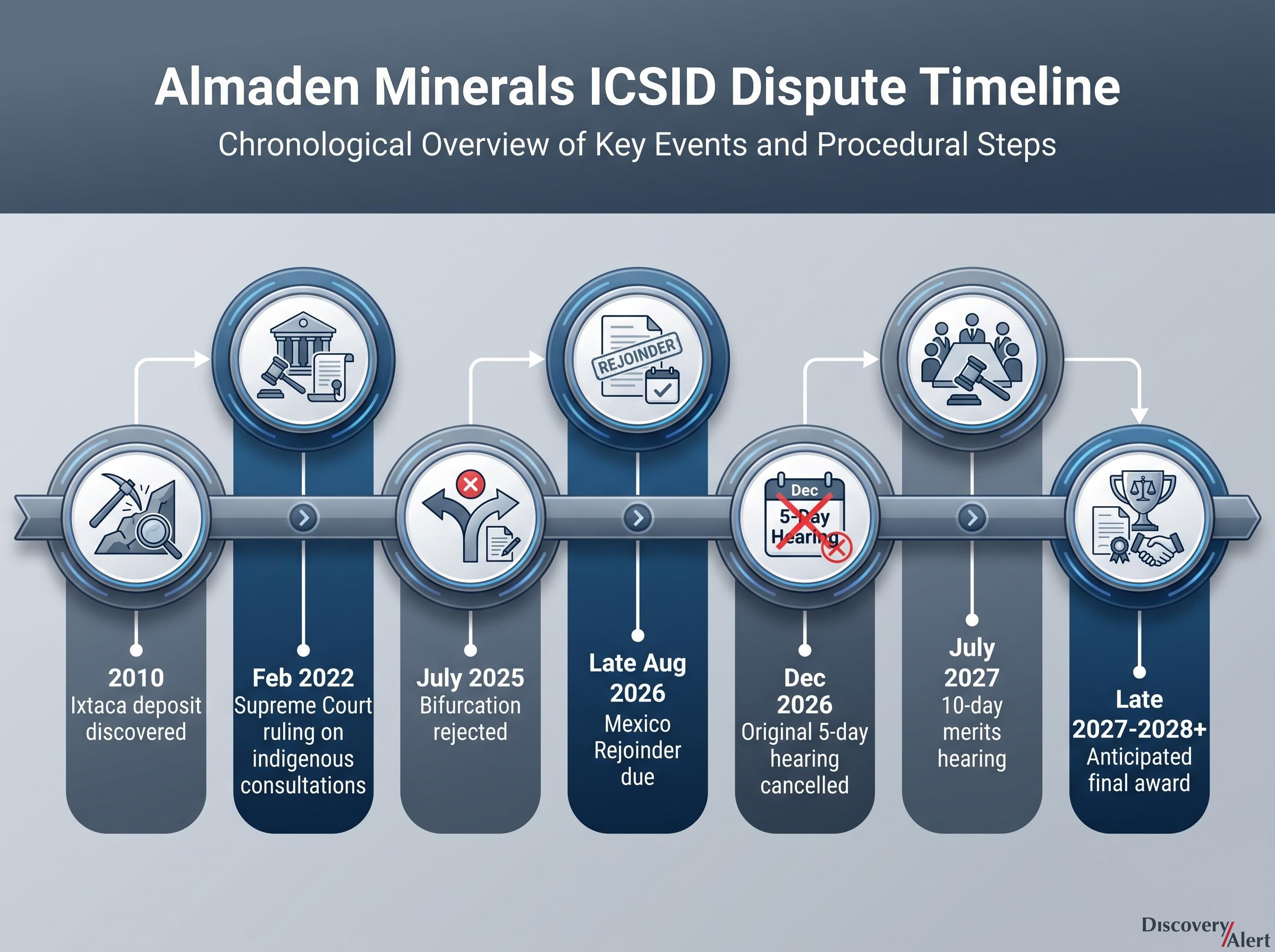
Investors monitoring Almaden Minerals’ share price, litigation exposure, or Mexico’s sovereign risk profile should treat these dates as the procedural gates most likely to produce actionable developments.
This case operates on two levels simultaneously. For Almaden and Almadex shareholders, it is a company-specific litigation event with a US$2.68 billion claim that could materially alter the companies’ financial trajectory. For the broader mining investment community, it is a systemic question: do CPTPP investor protections produce enforceable remedies when a sovereign government cancels resource concessions?
The runway ahead is long. A July 2027 hearing and a potential 2028 award are structural features of complex ICSID mining expropriation proceedings, not warning signs. The next publicly observable indicator arrives with Mexico’s Rejoinder, due late August 2026, which will signal how the sovereign intends to contest the merits of what has become one of the most closely watched investor-state disputes in the mining sector.
ICSID Case No. ARB/24/23 remains active and ongoing.
This article is for informational purposes only and should not be considered financial advice. Investors should conduct their own research and consult with financial professionals before making investment decisions. The damages figures cited reflect claimant valuations and remain subject to tribunal determination. Past performance does not guarantee future results, and the outcome of arbitration proceedings is inherently uncertain.
—
The Almaden Minerals arbitration is an investor-state dispute filed under the CPTPP investment chapter, in which Almaden Minerals and Almadex Minerals are claiming approximately US$2.68 billion from Mexico over the cancellation of mining concessions at the Ixtaca gold-silver project in Puebla State.
Tribunal availability constraints made the original December 2026 hearing window unworkable, and the panel rescheduled to July 2027, the earliest date it could accommodate a block of up to ten days for the full merits proceeding.
The claim escalated across three stages as updated metal prices, interest rates, and economic inputs were applied, with the current figure of US$2.68 billion reflecting an independent expert valuation completed in May 2026 rather than any change in the underlying legal theory.
Almaden has secured approximately US$9.5 million in non-recourse funding, meaning the funder bears the financial risk and Almaden is not required to repay the facility if the case fails, so the company's resources are not drained by legal costs during the multi-year proceeding.
The most significant near-term milestone is Mexico's Rejoinder, due in late August 2026, which will reveal the sovereign's merits defence and response to the US$2.68 billion quantum, followed by the ten-day July 2027 hearing and a potential final award in late 2027 or into 2028.


