
Aramco Targets Europe With Deeper-Than-Expected Crude Price Cut
Aug 17, 2026


When the Strait of Hormuz effectively closed in early March 2026, India discovered that roughly 90% of its LPG imports could no longer reach its ports. For a country that depends on overseas supply for nearly two-thirds of its cooking fuel, the disruption was immediate and severe. Five months later, on 13 August 2026, India’s Petroleum and Natural Gas Ministry responded with a first-of-its-kind measure: facility-specific LPG production quotas assigned to 21 refineries and upstream companies, converting the improvised emergency response into a permanent national contingency architecture. The order names individual facilities, assigns daily output targets, and establishes a biannual review mechanism designed to expand domestic capacity over time. What follows covers how the Hormuz crisis exposed India’s structural exposure, which companies now carry binding production obligations, how the framework is designed to function, and what it signals for global LPG trade flows and Gulf exporters.
The Strait of Hormuz disruption hit India’s LPG supply chain within days. With approximately 90% of the country’s LPG imports routed through the strait, primarily from Saudi Arabia and other Gulf suppliers, the effective closure severed the dominant supply artery for a fuel that reaches more than 310 million Indian households.
The Hormuz attack sequence that triggered India’s emergency response unfolded against a backdrop of escalating confrontations, with the UAE formally accusing Iran following multiple incidents in the strait within a single week, establishing the geopolitical conditions that made ad hoc supply management impossible to sustain.
The government’s response moved along three tracks simultaneously:
The production response was substantial.

Domestic LPG output climbed from approximately 35,000 tonnes per day before the crisis to a peak of approximately 55,000 tonnes per day during the disruption, a roughly 57% increase driven entirely by emergency measures.
Those emergency measures were progressively withdrawn from mid-June 2026 onward as supply conditions stabilised. What remained was a question: could India afford to rely on ad hoc mobilisation the next time a chokepoint closed?
The Hormuz disruption did not create India’s LPG vulnerability. It exposed a structural imbalance that had accumulated over years of demand growth outpacing domestic production capacity.
According to ETEnergyWorld reporting, India’s total LPG consumption reached 33.2 million tonnes during fiscal year 2025-26, equivalent to approximately 91,000 tonnes per day. Domestic production covered 13.1 million tonnes of that total. Imports accounted for the remaining 21.3 million tonnes, placing import dependence at over 64%.
| Category | Volume (million tonnes) | Share of total consumption |
|---|---|---|
| Total consumption | 33.2 | 100% |
| Domestic production | 13.1 | ~36% |
| Imports | 21.3 | ~64% |
India is one of the world’s largest LPG importers. The gap between consumption and domestic output widened steadily as demand grew, particularly following government programmes that expanded household LPG access across rural India. Public reporting broadly corroborates import dependence in the range of 60-65%.
The concentration risk sits in the routing. Approximately 90% of India’s LPG imports transit the Strait of Hormuz, a narrow waterway separating Iran from the Arabian Peninsula. The remaining share is sourced from the United States and other non-Gulf suppliers, providing limited redundancy.
US LPG supply diversification represents the demand-side complement to the production framework: while the 13 August order expands India’s domestic contingency output, a separate long-term procurement agreement with American suppliers adds a non-Gulf import corridor that further reduces the structural exposure the Hormuz closure exposed.
This means that a single geopolitical event in West Asia can sever the supply line for a fuel that directly affects Indian household cooking costs and inflation. The March 2026 disruption demonstrated this mechanism in practice, not in theory.
The ministerial order dated 13 August 2026 assigns facility-specific LPG output quotas to 21 refineries and upstream companies. This represents the first time India has fixed facility-wise production targets for LPG.
This is the first facility-specific LPG production target framework in India’s history, converting an ad hoc emergency response into a standing national contingency architecture.
The quotas are contingency targets, designed to activate when domestic supply comes under pressure rather than operating as a continuous production mandate in normal conditions. The combined contingency production potential across all covered entities is 63,810 tonnes per day.
Three governance features define the framework’s architecture:
The biannual review dates are drawn directly from the 13 August ministry order and do not appear prominently in press summaries of the framework. This revision mechanism is what distinguishes the order from a one-off emergency decree: it is designed to grow.
The allocations embedded in the 13 August order reveal deliberate policy choices about which facilities India considers its primary domestic supply levers.
The PPAC refinery capacity data, published by India’s Ministry of Petroleum and Natural Gas, provides the official facility-level production benchmarks against which the new contingency quotas were calibrated, including the Q1 FY 2026-27 LPG profile figures that underpin the ministry’s allocation methodology.
| Entity | Quota (tonnes/day) | Notes |
|---|---|---|
| Reliance Industries, DTA Jamnagar refinery (33 mt/year capacity) | 18,000 | Largest single allocation |
| Nayara Energy, Vadinar refinery | 4,480 | |
| 18 public-sector refineries (IOC, BPCL, HPCL and others) | 31,470 | Combined allocation |
| ONGC, GAIL and other upstream producers | 6,460 | Combined allocation |
| Reliance Industries, export-oriented Jamnagar refinery (35.2 mt/year capacity) | None | No quota assigned |
Reliance Industries’ DTA Jamnagar refinery carries the single largest individual allocation at 18,000 tonnes per day, accounting for more than 28% of the total contingency ceiling.
The exclusion of Reliance’s export-oriented Jamnagar refinery is notable. Despite being one of the world’s largest refining complexes at 35.2 million tonnes per year of capacity, it carries no quota under the order. The government has preserved that facility’s commercial export orientation while mobilising the domestically focused DTA refinery as the primary supply lever.
Public-sector refineries collectively shoulder the largest share at 31,470 tonnes per day, spread across 18 facilities operated by IOC, BPCL, HPCL, and others. Upstream producers including ONGC and GAIL contribute a further 6,460 tonnes per day.
The 13 August order does not treat the quota allocations as hard caps. It explicitly encourages companies to pursue technically and economically viable methods to produce above their assigned levels.
Two specific technical pathways are cited in the ministry order, as reported by ETEnergyWorld:
These technical details are drawn from the order itself rather than from widely reported press summaries, and represent the government’s signal that the framework is designed to grow over time through refinery investment.
The scale of the ambition is significant. The combined contingency ceiling of 63,810 tonnes per day already represents more than double India’s FY2025-26 daily domestic production rate of approximately 35,890 tonnes per day (annualised from 13.1 million tonnes).
Full activation of the contingency framework would cover approximately 70% of India’s daily national LPG consumption of roughly 91,000 tonnes per day, up from the 36% covered by normal domestic output.
The gap between current production and the contingency ceiling is where refinery capital expenditure decisions at Reliance, Nayara, and public-sector operators will determine whether the framework’s theoretical capacity becomes operational reality.
India’s domestic policy carries external weight because of the country’s scale. As one of the world’s largest LPG importers, any structural shift in India’s import requirements alters demand assumptions across the global LPG supply chain.
During the crisis period, India’s emergency domestic production surge materially reduced spot LPG purchases. The standing framework now institutionalises that surge capacity.
The arithmetic is direct. If India’s full contingency capacity of 63,810 tonnes per day were activated against daily consumption of approximately 91,000 tonnes per day, the residual daily import requirement would fall from roughly 57,000 tonnes to approximately 27,000 tonnes, a reduction of more than 50%.
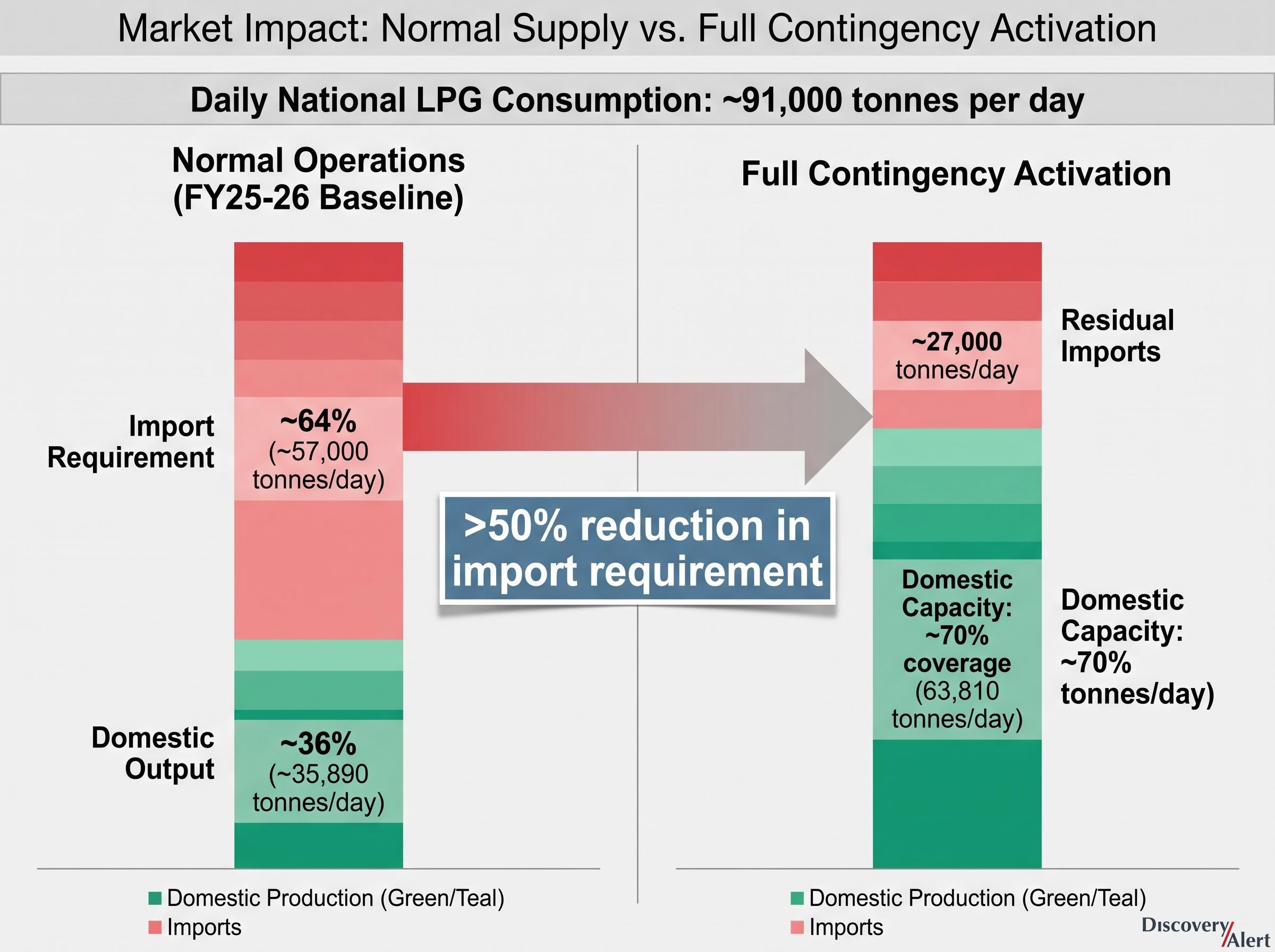
Three categories of market participants face the most direct implications:
The crisis accelerated a divergence already visible before March 2026, splitting the region into energy haves and have-nots based on the speed and depth of each country’s pre-existing diversification investments, a divide that India’s new contingency framework is explicitly designed to widen in its own favour.
These implications represent market-impact analysis consistent with the documented data rather than confirmed projections. The framework’s biannual review mechanism means India’s contingency capacity is designed to expand progressively, compounding the long-term structural shift for Gulf suppliers.
The 13 August order marks a structural turning point: India has converted an improvised crisis response into a pre-planned, facility-specific contingency architecture with a standing legal basis. The framework binds named corporate entities, including Reliance Industries, Nayara Energy, IOC, BPCL, HPCL, ONGC, and GAIL, to specific production obligations that can be activated during future supply disruptions. For global LPG markets, it signals that India’s import dependency, while still substantial, now has a formal ceiling that will tighten with each biannual review.
India’s broader energy security build-out extends the logic of the LPG contingency framework across multiple fuel types: the same import dependency arithmetic that made household cooking fuel a vulnerability also applies to crude oil, natural gas, and coal, driving a multi-sector infrastructure programme designed to compress the country’s overall exposure to geopolitical supply disruptions.
Readers seeking further detail on how individual refinery allocations interact with existing capital expenditure programmes should monitor earnings disclosures and ministerial guidance from January 2027, when the first scheduled biannual review is due.
This article is for informational purposes only and should not be considered financial advice. Investors should conduct their own research and consult with financial professionals before making investment decisions.
The framework is a ministerial order dated 13 August 2026 that assigns facility-specific LPG output quotas to 21 refineries and upstream companies, creating India's first standing national contingency architecture for domestic LPG production with a combined ceiling of 63,810 tonnes per day.
The quotas were introduced after the March 2026 Strait of Hormuz disruption severed approximately 90% of India's LPG imports, exposing a structural vulnerability in a country where imports account for over 64% of total LPG consumption of 33.2 million tonnes per year.
The order binds Reliance Industries (DTA Jamnagar refinery, 18,000 tonnes per day), Nayara Energy (Vadinar refinery, 4,480 tonnes per day), 18 public-sector refineries including IOC, BPCL, and HPCL (combined 31,470 tonnes per day), and upstream producers including ONGC and GAIL (combined 6,460 tonnes per day).
If all 63,810 tonnes per day of contingency capacity were activated against daily consumption of roughly 91,000 tonnes, India's residual daily import requirement could fall from approximately 57,000 tonnes to around 27,000 tonnes, a reduction of more than 50%.
The framework includes a biannual review mechanism, with scheduled revision dates of 1 January and 1 July each year, allowing the government to incorporate new facilities, additional upstream capacity, and technology-driven enhancements over time.


