
Saudi Aramco’s Exports Hold, but War-Risk Costs Tell a Darker Story
Aug 17, 2026


A sustained disruption to the Strait of Hormuz could push vulnerable economies’ oil import costs up by $20 billion per year, according to UN Trade and Development (UNCTAD) estimates. For African nations sitting at the end of long, Gulf-dependent supply chains, that figure carries immediate fiscal and operational weight.
The Strait of Hormuz remains the world’s single most consequential oil chokepoint, carrying roughly one-fifth of global petroleum supply. As tensions in the region persist into the second half of 2026, African import-dependent economies, particularly landlocked and island states, face compounding exposure through higher freight costs, elevated war-risk insurance premiums, and potential physical supply disruptions. At the same time, the continent’s major crude exporters sit on the opposite side of the ledger, with upstream revenues responding directly to higher global benchmarks.
What follows maps exactly who is most exposed and who stands to gain, using UNCTAD dependency data, with specific analysis of the mechanisms that amplify or concentrate risk and practical implications for energy, mining, and infrastructure portfolios with African exposure.
The Strait of Hormuz sits between the Persian Gulf and the Gulf of Oman, thousands of kilometres from the nearest African port. The distance is irrelevant. What connects a tanker insurance spike in the Gulf of Oman to diesel prices in Lusaka is a three-stage transmission chain that compresses geography into cost.
Physical fuel shortages remain the tail risk. The more immediate and persistent pressure is cost-driven, landing on currencies, inflation, and operating margins across African supply chains well before shelves run dry.
The Brent price response to Hormuz tension has already been measurable in August 2026, with benchmark crude rising 6% and US gasoline hitting $4.08 per gallon — movements that immediately recalibrate the import cost calculations for every Gulf-dependent African buyer.
UNCTAD estimates that a sustained Strait of Hormuz disruption could increase vulnerable economies’ oil import costs by up to $20 billion per year.
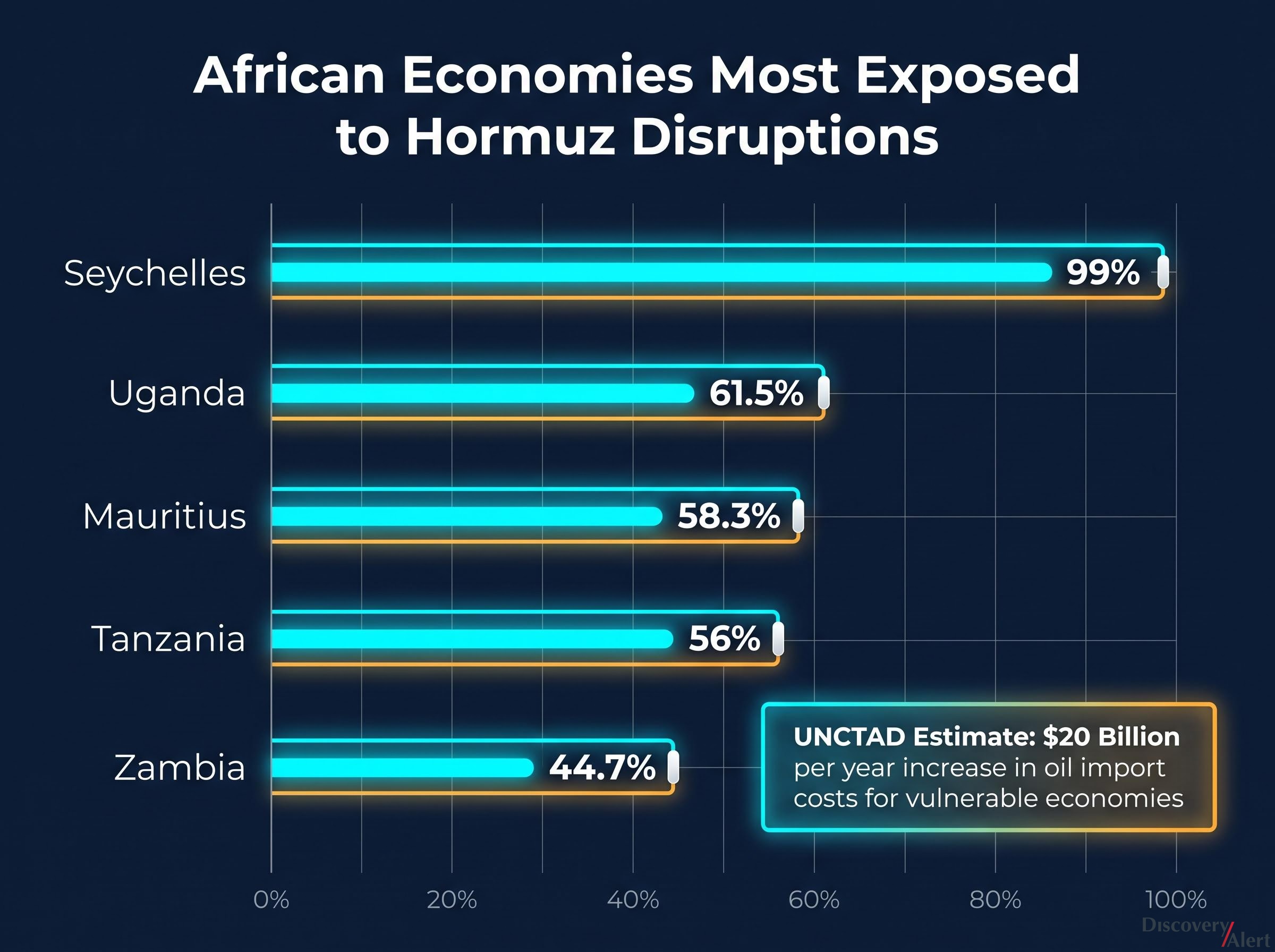
Seychelles sits at the extreme end of the exposure spectrum. UNCTAD data show the island state sources approximately 99% of its oil imports from the Hormuz region. As a tourism- and aviation-driven economy with no domestic hydrocarbon production, any spike in jet fuel, marine fuel, and LPG prices feeds rapidly into airfares, electricity costs, and household energy bills. There is almost no buffer.
Mauritius sources approximately 58.3% of its oil imports from suppliers whose cargoes transit the strait. Its combination of tourism and light manufacturing makes aviation fuel and power generation costs the critical transmission channels. Tanzania, at approximately 56%, faces a distinct structural problem: it is both a major fuel importer and a transit hub whose port at Dar es Salaam feeds fuel inland to five landlocked neighbours.
Mozambique has no operating oil refinery and imports virtually all refined petroleum products under a centralised system (IMOPETRO), with major volumes coming from Gulf suppliers including Oman and the UAE. Although the country is developing substantial offshore natural gas reserves, refined petroleum imports will dominate its transport sector in the near term.
| Country | Estimated Hormuz Import Share | Economy Type | Primary Transmission Channel |
|---|---|---|---|
| Seychelles | ~99% | Island importer | Aviation fuel, tourism costs, electricity |
| Mauritius | ~58.3% | Island importer | Manufacturing input costs, tourism |
| Tanzania | ~56% | Coastal hub/transit importer | Regional fuel distribution cascade |
| Mozambique | High (no refinery) | Coastal importer | Centralised import system, transport sector |
Tanzania’s exposure extends well beyond its own borders. Dar es Salaam is the primary fuel import gateway for Zambia, Malawi, parts of the DRC, Burundi, and Rwanda. Higher landed fuel prices at the port cascade inland via road and pipeline transit routes, amplifying logistics and inflation pressures across a wide geographic footprint. Tanzania’s Hormuz dependency is therefore a regional multiplier, not a bilateral exposure.
UNCTAD’s percentage figures are useful starting points, but they actually understate vulnerability for landlocked economies. The raw import share does not capture the cost compounding that occurs between port and end user.
Uganda carries the highest Hormuz dependency ratio in the landlocked group at approximately 61.5%. Zambia follows at approximately 44.7%, with its primary supply channel running through the Dar es Salaam transit route. Malawi is also identified among elevated-exposure markets.
The step-by-step cost compounding works as follows:
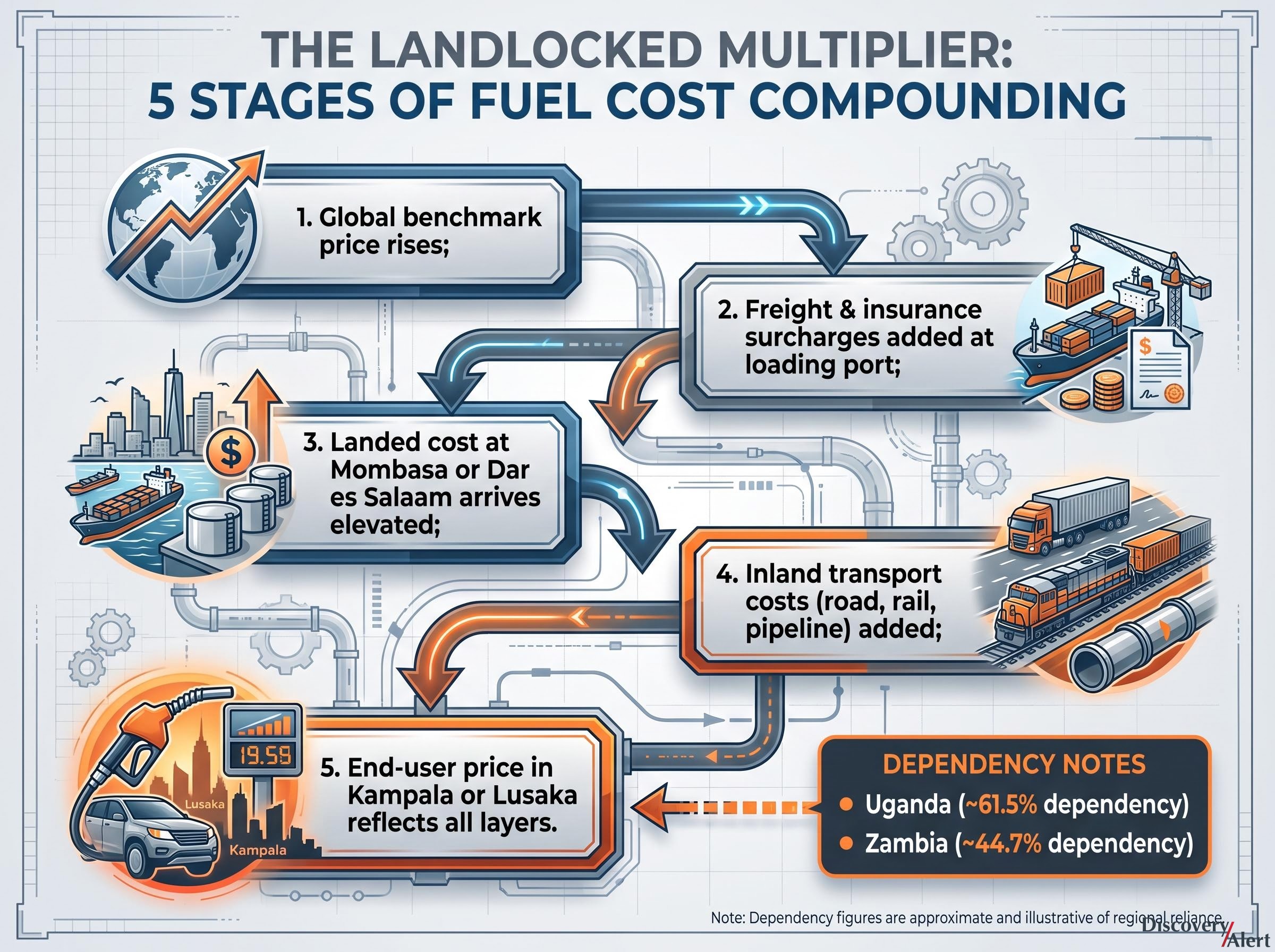
Each layer is additive. A 10% increase at the Gulf loading port does not translate to a 10% increase in Lusaka; it translates to something materially larger once freight, insurance, port handling, and inland haulage margins compound on top.
Global diesel supply tightening from non-Gulf sources compounds Hormuz exposure for African importers: a 92% collapse in Russian diesel exports reported in August 2026 removed a potential alternative supply stream that might otherwise have partially offset Gulf-origin shortfalls for East and Southern African buyers.
Percentage dependency ratios understate true exposure for inland economies. The landlocked multiplier means every dollar increase at the coast arrives as several dollars by the time it reaches the end user.
For mining and agriculture investors, this matters directly. Fuel is a core input cost for drilling, haulage, irrigation, and processing. Margin compression in these sectors arrives faster and hits harder in landlocked markets than in coastal consumer economies, because the cost base is structurally higher to begin with.
The other side of the Hormuz equation favours Africa’s crude exporters, and the leverage is substantial for some.
Nigeria, one of Africa’s largest crude producers, gains directly through higher export earnings and government revenue. Angola sits at the most concentrated end of the spectrum: crude oil accounts for more than 90% of its export revenue (this figure has not been independently verified), meaning price spikes tied to Hormuz supply fears translate almost directly into stronger foreign-exchange inflows and an improved fiscal balance.
Algeria and Libya both stand to gain from higher crude prices given their significant production and export capacity. In Libya’s case, however, internal political and security dynamics often constrain output, and higher prices can increase the stakes around control of oil infrastructure, potentially adding to domestic instability.
Libya’s production capacity and political uncertainty interact directly: a strategic onshore discovery announced in 2025 could materially increase the country’s export volumes, but internal competition for control of oil infrastructure means actual output trajectories remain highly uncertain regardless of what the geology supports.
Smaller producers, including the Republic of Congo, Equatorial Guinea, Gabon, and newly producing Senegal, would also benefit. For these states, improved oil receipts relative to overall budget size can ease debt-service pressures and support public investment.
According to available data, Angola’s crude oil accounts for more than 90% of its export revenue, though this figure has not been independently verified. The concentration underlines how directly Hormuz-driven price movements affect the country’s fiscal position.
| Country | Net Trade Position | Primary Benefit Mechanism | Key Risk Caveat |
|---|---|---|---|
| Nigeria | Net exporter | Higher upstream earnings and government revenue | Refined fuel import costs also rise |
| Angola | Net exporter | Direct fiscal uplift from crude price gains | Extreme revenue concentration risk |
| Algeria | Net exporter | Production and export revenue gains | Domestic fuel subsidy fiscal burden |
| Libya | Net exporter | Higher revenue per barrel exported | Political instability and output disruption |
| Congo | Net exporter | Budget-significant price upside | Limited production scale |
| Equatorial Guinea | Net exporter | Budget-significant price upside | Declining output trajectory |
| Gabon | Net exporter | Budget-significant price upside | Refined product import exposure |
| Senegal | Emerging exporter | Early-stage revenue from new production | Still a net importer of refined products |
Higher crude prices do not flow cleanly into national prosperity for every exporter. The split within these economies is real.
Nigeria and Angola both import significant refined petroleum products. Higher global crude prices raise their import bills even as upstream revenues climb, creating a fiscal gain on one side and a cost burden on the other. The net welfare impact depends on the gap between crude export earnings and refined-product import costs, and that gap narrows when global benchmarks spike sharply.
The economy-wide input-cost problem runs deeper. Transport, agriculture, and manufacturing in exporting countries all absorb higher diesel and petrol prices, generating inflationary pressure that can partially erode the real income gains from stronger export performance. Larger dollar inflows from crude may strengthen the nominal external position, but domestic price pressures complicate monetary and exchange-rate policy.
Governments in exporting countries, particularly Nigeria and Algeria, often maintain fuel subsidies or price controls to keep consumer costs below international market levels. Hormuz-driven price spikes put those commitments under fiscal and political stress simultaneously: the subsidy bill rises just as public expectations for relief intensify. The result is a policy bind that can force difficult choices between fiscal sustainability and social stability.
The UNCTAD data, combined with the transmission mechanisms outlined above, produce a three-tier investor framework for African exposure to persistent Hormuz risk.
UNCTAD’s $20 billion annual import-cost shock estimate underlines the macro stakes. For investors, the question is not whether Hormuz tension affects African portfolios, but which layer of exposure, import cost, upstream revenue, or supply-chain infrastructure, dominates the position.
The infrastructure argument may prove the most durable. Upstream revenue gains are cyclical; import-cost risk is structural. Assets that reduce the continent’s refined-product dependence on the Hormuz corridor sit at the intersection of geopolitical risk management and long-term infrastructure demand.
The Hormuz question does not produce a single answer for Africa. The continent spans import-dependent island states with near-total Gulf supply chain reliance, landlocked economies where cost compounding multiplies every port-level price increase, and crude-exporting nations where higher benchmarks lift revenues but complicate domestic economics.
Persistent instability, rather than a one-off incident, is the scenario that most clearly separates the winners from the vulnerable. Cost compounding over time strains reserves and fiscal positions in ways a brief disruption would not. The strategic value of diversified supply infrastructure and reduced Gulf-origin refined-product dependence is likely to rise as a geopolitical consideration for African policymakers and infrastructure investors alike.
For investors wanting to understand why Gulf supply chain dependency persists despite decades of diversification efforts, our full explainer on Hormuz dependency and long-term energy diversification examines how Asia’s experience with renewables growth, alternative supply routes, and strategic reserves has failed to eliminate chokepoint risk — a structural parallel that African policymakers and infrastructure investors are beginning to study.
This article is for informational purposes only and should not be considered financial advice. Investors should conduct their own research and consult with financial professionals before making investment decisions. Forward-looking observations regarding infrastructure value and fiscal stress scenarios are speculative and subject to change based on geopolitical developments and market conditions.
The Strait of Hormuz is the world's most critical oil chokepoint, carrying roughly one-fifth of global petroleum supply. Disruptions there raise benchmark crude prices worldwide and increase freight and insurance costs, directly pushing up fuel import bills for African nations dependent on Gulf-origin oil.
Seychelles is the most exposed, sourcing approximately 99% of its oil imports from the Hormuz region, followed by Uganda at around 61.5%, Tanzania at roughly 56%, and Mauritius at approximately 58.3%, with landlocked nations like Zambia also facing significant compounded cost burdens.
For landlocked economies, each layer of cost including global benchmark increases, freight surcharges, war-risk insurance, port handling, and inland road or pipeline transport stacks on top of the previous one, meaning a 10% price rise at a Gulf loading port translates into a materially larger increase by the time fuel reaches end users in Kampala or Lusaka.
Nigeria, Angola, Algeria, Libya, and smaller producers including Congo, Equatorial Guinea, Gabon, and Senegal all gain through higher export revenues, with Angola particularly exposed in a positive sense given crude oil accounts for more than 90% of its export earnings.
Investors should monitor sovereign and corporate credit in high-import-dependency markets like Tanzania, Uganda, and Zambia for balance-of-payments stress, assess upstream revenue upside in Nigerian and Angolan assets, and consider infrastructure positions in refining capacity and diversified import terminals that reduce reliance on Gulf-origin refined products.


