
Aramco Targets Europe With Deeper-Than-Expected Crude Price Cut
Aug 17, 2026


Three ADNOC-affiliated vessels have been struck in the Strait of Hormuz in under seven days. The UAE is calling it piracy. Iran has said nothing.
The attack on Friday, 15 August 2026, the third in a single week attributed to Iran, arrived at a point of acute vulnerability for global oil markets. The International Energy Agency (IEA) had just documented a supply recovery that brought worldwide output up by 4.1 million barrels per day in June, yet global production remains an estimated 9.4 million barrels per day below pre-war levels. The Strait of Hormuz, through which roughly 25% of all seaborne oil trade passes, is the corridor that recovery depends on.
What follows explains what happened, where the geopolitical blame is landing, why the strait’s geography makes disruption so consequential, and what the renewed attacks mean for oil markets still navigating a fragile supply rebound.
The timeline has compressed rapidly:
The UAE Foreign Ministry described the strikes as “acts of piracy” and a violation of freedom of navigation, demanding that Tehran cease targeting commercial shipping and fully restore access to the waterway.
Iran had not issued a response at the time of publication. The combination of a sovereign Gulf state’s public attribution and Tehran’s silence defines the diplomatic tension: the accusation is on record, and the absence of any denial leaves the question of further escalation entirely open.
The three attacks this week are not the beginning of this campaign. Approximately 15 ADNOC vessels have been targeted since the start of the Iran war, according to UAE and company officials.
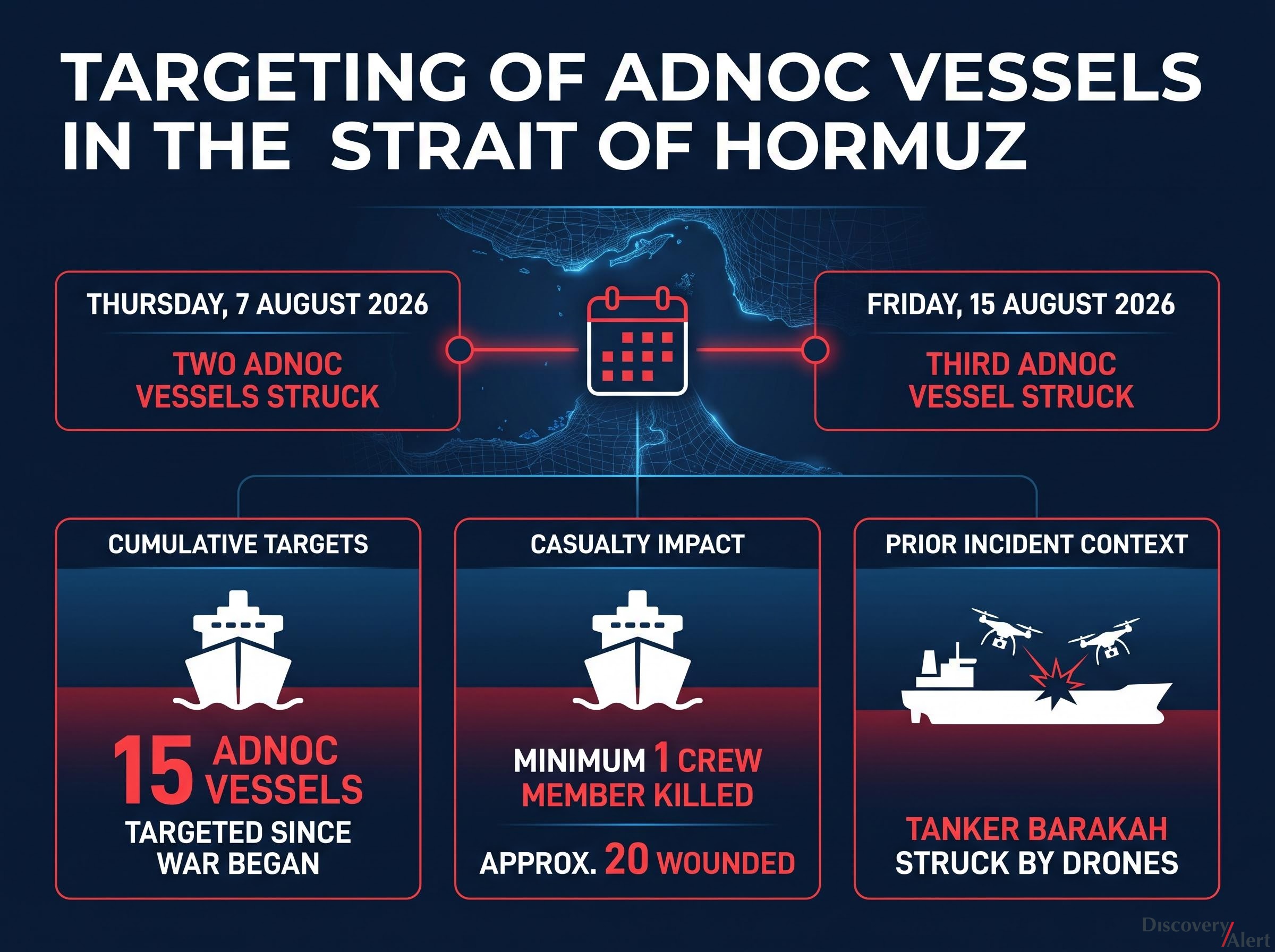
Earlier in the conflict, the ADNOC tanker Barakah was struck by drones while transiting Hormuz. No injuries were reported in that incident, but it established the pattern that has since intensified: repeated strikes on vessels linked to a state energy company operating in the world’s most critical oil corridor.
The cumulative human toll across the full series of attacks now stands at a minimum of one crew member killed and approximately 20 wounded. These figures reframe the Friday strike. This is not an isolated security incident but rather evidence of a sustained targeting campaign against a national oil company’s shipping fleet, carrying distinct implications for insurance pricing, operator confidence, and diplomatic escalation risk.
The Strait of Hormuz separates Iran from Oman and serves as the sole maritime outlet for the majority of oil exports from Saudi Arabia, the UAE, Kuwait, Iraq, and Qatar. Every tanker leaving the Persian Gulf for international markets passes through this corridor.
The scale of that dependence is difficult to overstate.
| Commodity Type | Daily Volume Through Hormuz (2025) | Share of Global Seaborne Trade |
|---|---|---|
| Crude oil | Approx. 15 million bpd | — |
| Refined products | Approx. 5 million bpd | — |
| Combined total | Approx. 20 million bpd | ~25% |
When earlier conflict-related disruptions hit, IEA analysis shows flows through Hormuz fell to a “trickle,” forcing Gulf producers to cut total oil output by at least 10 million barrels per day. Saudi Arabia’s East-West pipeline and the Abu Dhabi Crude Oil Pipeline offer partial diversion capacity, but neither can fully replace the strait’s throughput. In practical terms, there is no complete substitute. Sustained attacks that cause insurers and tanker operators to avoid the route translate almost directly into lower effective global supply.
Dual chokepoint pressure, the simultaneous restriction of Hormuz and other critical maritime corridors, has been compressing global oil flow routes into increasingly narrow alternatives, a structural dynamic that amplifies the consequences of any single disruption event.
By early June 2026, Hormuz throughput had improved enough to lift total Middle East oil flows from approximately 9.6 million barrels per day in May to roughly 12 million bpd. The recovery contributed to a worldwide supply increase of 4.1 million bpd, bringing total global output to 98.8 million bpd, according to the IEA’s July 2026 Oil Market Report.
The price signal confirmed the shift. North Sea Dated crude fell $31 per barrel during June, declining to $68 per barrel in early July 2026. For the first time in months, the market was beginning to price in easing risk at the chokepoint.
The recovery, however substantial, is incomplete. Global production remains an estimated 9.4 million bpd below pre-war levels. Middle Eastern output is still substantially below pre-conflict capacity.
The IEA projects a worldwide oil market supply deficit of approximately 1.8 million barrels per day during Q3 2026.

That deficit figure is the baseline against which any renewed disruption must be measured. The market had covered significant ground in June, but it was still operating with a pronounced shortfall, and the margin available to absorb fresh supply shocks was narrow before the first vessel was struck.
Strait of Hormuz attacks affect global supply through four specific transmission channels, each reinforcing the others:
Operator re-routing to the Cape of Good Hope adds roughly two to three weeks to voyage times and significantly increases freight costs, and Indian Oil’s documented shift away from Hormuz transit illustrates precisely how insurance-driven avoidance translates into reduced effective throughput even before a single tanker is physically blocked.
MARAD maritime advisories for the Persian Gulf and Strait of Hormuz have tracked Iranian vessel interdictions and drone strike incidents across 2025-2026, providing operators with the official U.S. government threat assessments that underpin war-risk insurance pricing and tanker operator routing decisions.
The IEA has been explicit that its forecast for continued output recovery was conditional on improved shipping access and rapid de-escalation of renewed hostilities. Prior projections of a supply surplus by 2027 were premised on continued improvement in Hormuz access, expectations that renewed attacks now place in doubt.
The situation remains unresolved. Four indicators will determine whether the Friday attack marks a further escalation or a temporary spike in an already elevated threat environment:
At the time of publication, Iran had not responded to the UAE’s accusations, making the first indicator already active and unresolved.
The renewed attacks are striking one of the world’s irreplaceable oil corridors at the precise moment a fragile, incomplete supply recovery is most exposed to disruption. Global production remains 9.4 million barrels per day below pre-war levels. The IEA projects a Q3 2026 supply deficit of approximately 1.8 million bpd. Roughly 25% of global seaborne oil trade passes through the waterway under attack.
The market’s path to balance, and any prospect of a surplus by 2027, runs directly through the Strait of Hormuz. So does every tanker that keeps the recovery on track.
The geopolitical risk premium in oil prices is not a fixed variable but a dynamic component that compresses and expands with event sequence, attribution certainty, and diplomatic response time, factors that are all simultaneously in flux following a week in which three state-affiliated vessels were struck and the accused party has not responded.
This article is for informational purposes only and should not be considered financial advice. Investors should conduct their own research and consult with financial professionals before making investment decisions. Forward-looking supply projections are subject to market conditions and geopolitical developments.
The Strait of Hormuz is a narrow waterway between Iran and Oman that serves as the sole maritime exit for oil exports from Saudi Arabia, the UAE, Kuwait, Iraq, and Qatar, carrying approximately 25% of all global seaborne oil trade, or around 20 million barrels per day.
Approximately 15 ADNOC vessels have been targeted since the start of the Iran war, with three strikes occurring in a single week in August 2026, resulting in a cumulative toll of at least one crew member killed and approximately 20 wounded.
Attacks on vessels transiting the strait drive up war-risk insurance premiums, prompt tanker operators to reroute or avoid the corridor entirely, and can force Gulf producers to cut exports, all of which reduce effective global supply and push oil prices higher.
The IEA projects a worldwide oil supply deficit of approximately 1.8 million barrels per day during Q3 2026, with global production still around 9.4 million bpd below pre-war levels, making uninterrupted Hormuz transit critical to any supply recovery.
Saudi Arabia's East-West pipeline and the Abu Dhabi Crude Oil Pipeline offer partial diversion capacity, but neither can fully replace the strait's throughput; rerouting via the Cape of Good Hope adds roughly two to three weeks to voyage times and significantly increases freight costs.


