
Saudi Aramco’s Exports Hold, but War-Risk Costs Tell a Darker Story
Aug 17, 2026


Two North Sea projects sit at the centre of the most consequential upstream regulatory decision the UK has faced in a decade. The Court of Session invalidated development consents for both Jackdaw and Rosebank in January 2025, and the public consultations that will determine whether either field receives fresh approval are closing this month. What follows from the government’s decision will draw the sharpest line yet between which categories of UK North Sea oil and gas assets can survive Labour’s climate framework and which cannot. This analysis maps the legal, environmental, and political distinctions that make Jackdaw materially more likely to proceed than Rosebank, and translates those distinctions into a working framework for investors positioned across UK upstream portfolios.
The January 2025 Court of Session ruling did not express a policy preference. It identified a legal deficiency. Both Jackdaw and Rosebank had received development consents from the previous Conservative government, and the court found that both consents were unlawful on a single, specific ground: the environmental impact assessments underpinning them had failed to account for downstream combustion emissions, the carbon released when the produced hydrocarbons are burned by end users.
The three conditions the court identified as deficient in the original consents were:
The core legal principle is binding: development consents for UK offshore projects are unlawful if they fail to account for downstream combustion emissions.
The ruling mandates new environmental impact assessments and fresh government approvals before either field can produce. This is a legal prerequisite, not a discretionary review. No minister can waive it. Physical construction was permitted to continue in the interim, which is why Jackdaw’s platform is now installed and undergoing inspections east of Aberdeen despite holding no valid production consent. Equinor, Rosebank’s operator, faces the same re-consent requirement. Public consultations on both projects close in August 2026, with the government’s decision expected to follow.
Equinor’s exposure to the UK re-consent process sits alongside a broader portfolio under active development, with Equinor’s exploration pipeline extending into Arctic Norway where regulatory approvals follow a materially different framework than the one now applied to North Sea tiebacks.
The DESNZ guidance on downstream emissions in EIAs, published in June 2025, formalised exactly what the court ruling demanded: North Sea operators must now quantify the carbon released when produced hydrocarbons are burned by end users, making Scope 3 combustion emissions a gating requirement for any fresh development consent.
The two projects share a legal problem. They do not share an environmental profile, a development structure, or a political risk weighting.
| Factor | Jackdaw | Rosebank |
|---|---|---|
| Resource type | Gas only | Oil (primarily) |
| Development type | Tieback to existing infrastructure | Greenfield with new offshore facilities |
| Location | Approximately 150 miles east of Aberdeen | Northwest of Shetland |
| Estimated reserves/scale | Smaller gas field; platform installed | Approximately 350 million barrels |
| Lifecycle carbon intensity | Lower (gas) | Higher (oil) |
Gas carries lower lifecycle carbon intensity per unit of energy than oil. That distinction is not marginal; it is the fulcrum on which the court’s emissions test turns. The Guardian’s environment editor Fiona Harvey noted on 11 August 2026 that permitting Jackdaw would be substantially less environmentally damaging than allowing Rosebank to proceed.
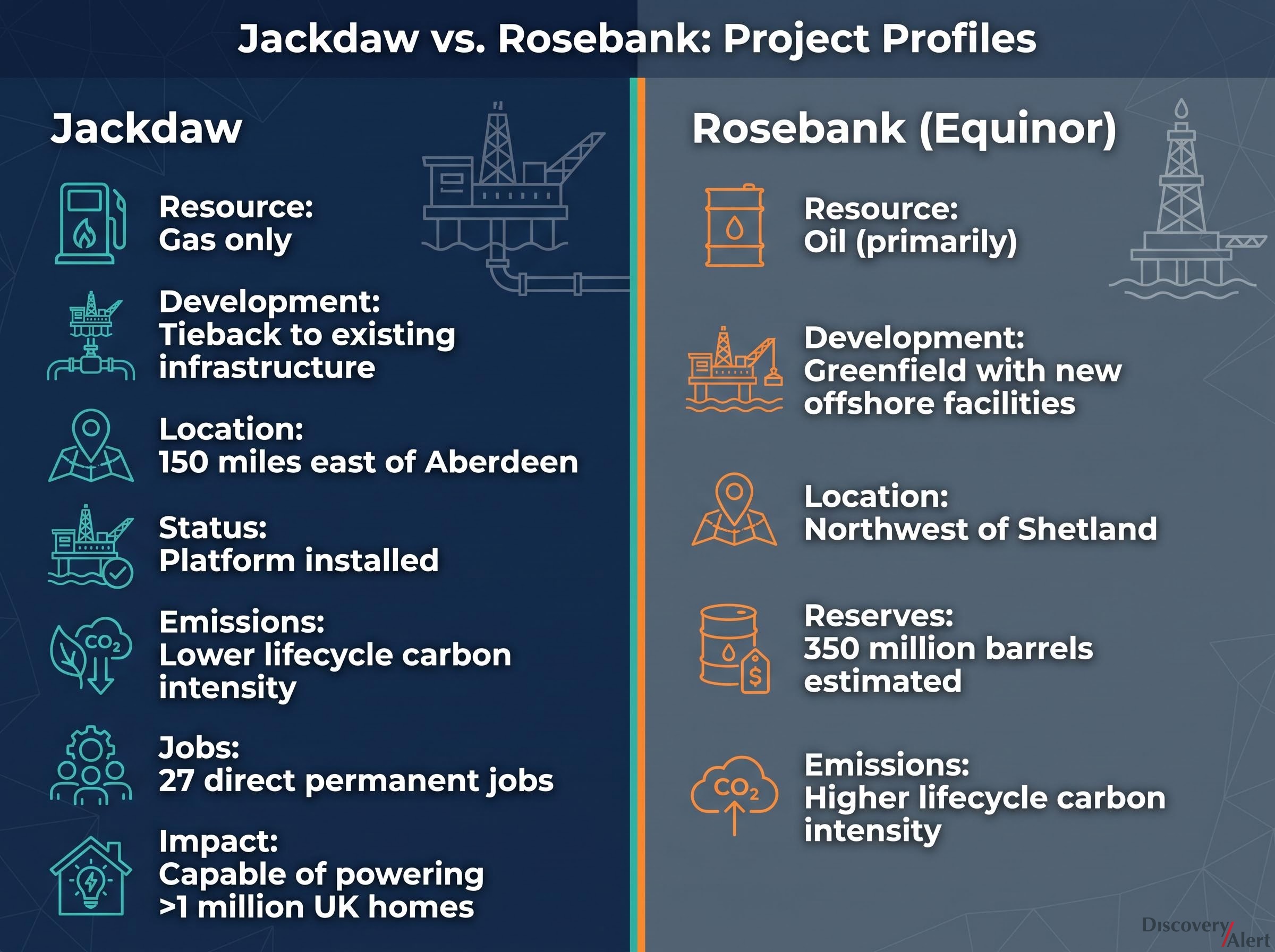
The three structural reasons Jackdaw presents a smaller regulatory target than Rosebank:
Jackdaw is estimated to generate approximately 27 direct permanent jobs. Rosebank, with an estimated reserve base of roughly 350 million barrels and new offshore facilities, carries a development footprint and emissions profile of an entirely different order.
A tieback is a subsea connection to infrastructure that already holds permits and is already operating. Rather than constructing a standalone offshore facility from scratch, the field’s production flows through existing pipelines, platforms, and processing capacity. The result is lower capital intensity, a shorter development timeline, and, critically for the re-consent process, a smaller incremental environmental footprint.
The court’s test centres on downstream combustion emissions. But the environmental impact assessment that must accompany any fresh consent also evaluates construction footprint, operational complexity, and cumulative environmental impact. Jackdaw’s tieback status reduces all three dimensions. Its platform is installed and undergoing inspections as of August 2026, meaning that a fresh EIA will characterise the project’s residual construction risk as substantially lower than a greenfield build still awaiting fabrication.
The sequence through which a tieback consent application differs from a greenfield application at each EIA stage:
Jackdaw’s gas-only output feeds directly into UK gas supply, meaning the government can frame its approval as import substitution, reducing reliance on liquefied natural gas cargoes. The field’s output has been characterised as capable of powering more than a million UK homes. This framing is politically usable precisely because domestic gas supply has a direct relationship with UK energy bills.
Rosebank’s oil, by contrast, is priced on global markets. Approving a large new oil field does not directly reduce UK consumer energy costs, which removes the most politically powerful argument from the government’s toolkit. The energy security narrative is available for Jackdaw in a way that it is not for Rosebank.
Labour’s 2024 manifesto committed to no new North Sea exploration licences. It did not commit to cancelling existing developments. The court ruling has opened a gap between those two positions: if the original consents were unlawful, do fresh consents count as new licences or as continuations of existing ones? The question is unresolved, and the answer the government provides will set a precedent that extends well beyond these two fields.
In late July 2026, Prime Minister Andy Burnham signalled a pragmatic stance toward North Sea extraction, while indicating he would defer a formal decision until public consultations had been completed.
Burnham has not publicly addressed the climate crisis since taking office. That silence is itself informative. It suggests a government that is aware of the political cost on both sides and unwilling to front-run the consultation process.
Three pressures pull in different directions:
The internal logic points toward a split decision. Approving Jackdaw satisfies the energy security obligation with a project that is environmentally defensible. Deferring or rejecting Rosebank preserves climate credibility. Whether that compromise holds politically is the open question.
The tension between climate commitments and upstream production approvals is not unique to the UK; emissions cap policy reversals in Canada illustrate how quickly governments can unwind regulatory constraints when energy security and economic pressures align, a precedent that sharpens the stakes of whatever Labour decides on Rosebank.
The consultation window closes in August 2026. Three plausible outcomes follow, each carrying a distinct signal for capital allocation.

| Scenario | Probability assessment | Investor signal | Portfolio implication |
|---|---|---|---|
| Jackdaw approved; Rosebank deferred or rejected | Most probable | Gas tiebacks with existing infrastructure can proceed under Labour | UK gas-weighted portfolios (especially tiebacks) look more resilient; large new oil projects remain exposed |
| Both rejected | Less probable | Courts plus climate politics are driving faster-than-expected UK upstream wind-down | Capital tilts toward basins with clearer regulatory trajectories: Norway, US Gulf of Mexico, Atlantic deepwater |
| Both approved | Least probable | Energy security prioritised over climate optics at substantial political cost | Near-term cash flows improve but future policy reversal risk rises materially |
The most probable outcome, Jackdaw approved with Rosebank deferred, would confirm a principle that investors can apply forward.
Lower-carbon gas tiebacks with existing infrastructure can still proceed under the current legal and political framework. Large new oil greenfield developments cannot be assumed to follow.
BP’s strategic pivot toward organic growth from existing discoveries reflects a broader industry calculation that the regulatory and political risk attached to greenfield oil projects in climate-active jurisdictions now exceeds the risk of working harder within already-consented acreage, a logic that closely mirrors the Jackdaw-versus-Rosebank distinction.
For the rejection scenario, UK upstream risk premiums rise materially and capital reallocation favours basins where regulatory trajectories are clearer. For the both-approved scenario, near-term cash flow improvement comes at the cost of elevated future policy reversal risk, as a government that approves Rosebank against its own climate positioning is more likely to tighten constraints on subsequent projects.
Policy reversal risk in hydrocarbons cuts in both directions: the Arctic National Wildlife Refuge case shows that a government can re-open territory that a prior administration closed, just as the UK court ruling shows that consents a prior government granted can be invalidated, meaning investors in long-cycle upstream projects now price reversal probability into both approval and rejection scenarios.
The court ruling, Labour’s manifesto, and the environmental distinctions between these two projects have together created a fault line between gas tiebacks and greenfield oil developments. That fault line will shape UK upstream risk assessments well beyond this specific consent cycle.
The August 2026 consultation close is the starting point of a decision sequence, not the end. Whatever the government decides, the legal precedent is already set: any future environmental impact assessment for a UK offshore project must account for downstream combustion emissions. The policy signal embedded in whichever decision follows will affect how the next generation of UK North Sea project proposals are designed, framed, and evaluated by operators and investors alike.
The question is no longer whether UK North Sea projects will face higher consent standards. It is which asset categories can meet them.
This article is for informational purposes only and should not be considered financial advice. Investors should conduct their own research and consult with financial professionals before making investment decisions.
These statements are speculative and subject to change based on market developments and government policy decisions. Past performance does not guarantee future results.
A tieback is a subsea connection that routes production from a new field through existing offshore infrastructure, rather than requiring a standalone facility to be built from scratch. For UK North Sea approvals, tieback projects like Jackdaw present a smaller incremental environmental footprint, which makes them materially easier to re-consent under the court-mandated emissions assessment framework.
The Court of Session ruled in January 2025 that both consents were unlawful because the environmental impact assessments failed to account for downstream combustion emissions, meaning the carbon released when the produced hydrocarbons are burned by end users. This ruling applies as a binding legal precedent to any future UK offshore development consent.
Jackdaw is a gas-only tieback with an already-installed platform and lower lifecycle carbon intensity, while Rosebank is a greenfield oil project with approximately 350 million barrels of estimated reserves and a significantly larger construction and emissions footprint. These differences mean Jackdaw presents a substantially smaller regulatory target under the new emissions assessment requirements.
The consultation close triggers a government decision sequence that will signal which asset categories can survive Labour's climate framework, with a Jackdaw approval and Rosebank rejection being the most probable outcome and confirming that gas tiebacks with existing infrastructure are more viable than large new greenfield oil developments. Investors holding UK upstream exposure should map their portfolio weighting across these two categories before the decision is announced.
Labour's 2024 manifesto committed to no new exploration licences but did not commit to cancelling existing developments, creating a legal ambiguity around whether fresh consents for previously approved projects like Jackdaw and Rosebank constitute new licences or continuations. The government's resolution of this question will set a precedent affecting the entire next generation of UK North Sea project proposals.


