
Saudi Aramco’s Exports Hold, but War-Risk Costs Tell a Darker Story
Aug 17, 2026


The UK North Sea has produced roughly 47.7 billion barrels of oil equivalent since the 1960s. Remaining proven and probable reserves stand at approximately 2.9 billion boe, implying a depletion rate of around 94%. Yet the public debate about new licences continues as though the basin were a viable cornerstone of national energy strategy. BP CEO Meg O’Neill has made the case directly to government that domestic fossil fuel production should be prioritised because 75% of UK energy still comes from hydrocarbons. That argument has political traction. The question is whether the underlying data supports the energy security and affordability outcomes being promised. What follows unpacks the reserve depletion figures, the production decline forecasts, the market mechanics that determine UK energy prices, and the investor risk implications, providing the analytical framework to evaluate North Sea energy security claims on their merits rather than their political framing.
The numbers leave little room for ambiguity. By the end of 2024, the UK Continental Shelf had produced 47.7 billion boe, according to the NSTA Reserves and Resources Report. What remains, approximately 2.9 billion boe of proven and probable reserves, represents roughly 6% of total recoverable volume.
The NSTA Reserves and Resources Report provides the primary regulatory accounting of cumulative production and remaining 2P reserves on the UK Continental Shelf, forming the authoritative baseline from which the 94% depletion figure and the near-term production decline projections are derived.

Three independent sources converge on the same conclusion:
Carbon Brief describes the North Sea as a “mature basin” with around 90% of its oil and gas “already drained dry.”
The range across sources sits at 90-94% depending on definitional approach, but the analytical distinction between 90 and 94 is immaterial. In every case, the basin is overwhelmingly depleted.
The reserves that remain are not simply smaller in volume. They are more technically challenging and higher-cost than those developed during the basin’s peak decades. Smaller fields, more complex geology, and deeper water all push up the per-barrel cost of extraction, a factor that matters as much for production rates as it does for project economics.
Steep decline is not a contested forecast. It is the consensus across regulatory and independent projections.
NSTA February 2026 data shows UK gas production falling sharply by 2030, even assuming new licences proceed. ECIU analysis of the same data places the decline at approximately 49% versus 2025 levels with new drilling. An alternative figure of 55% has appeared in some reports but remains unconfirmed against the primary NSTA and ECIU sources; the confirmed range sits at approximately 44-49%.
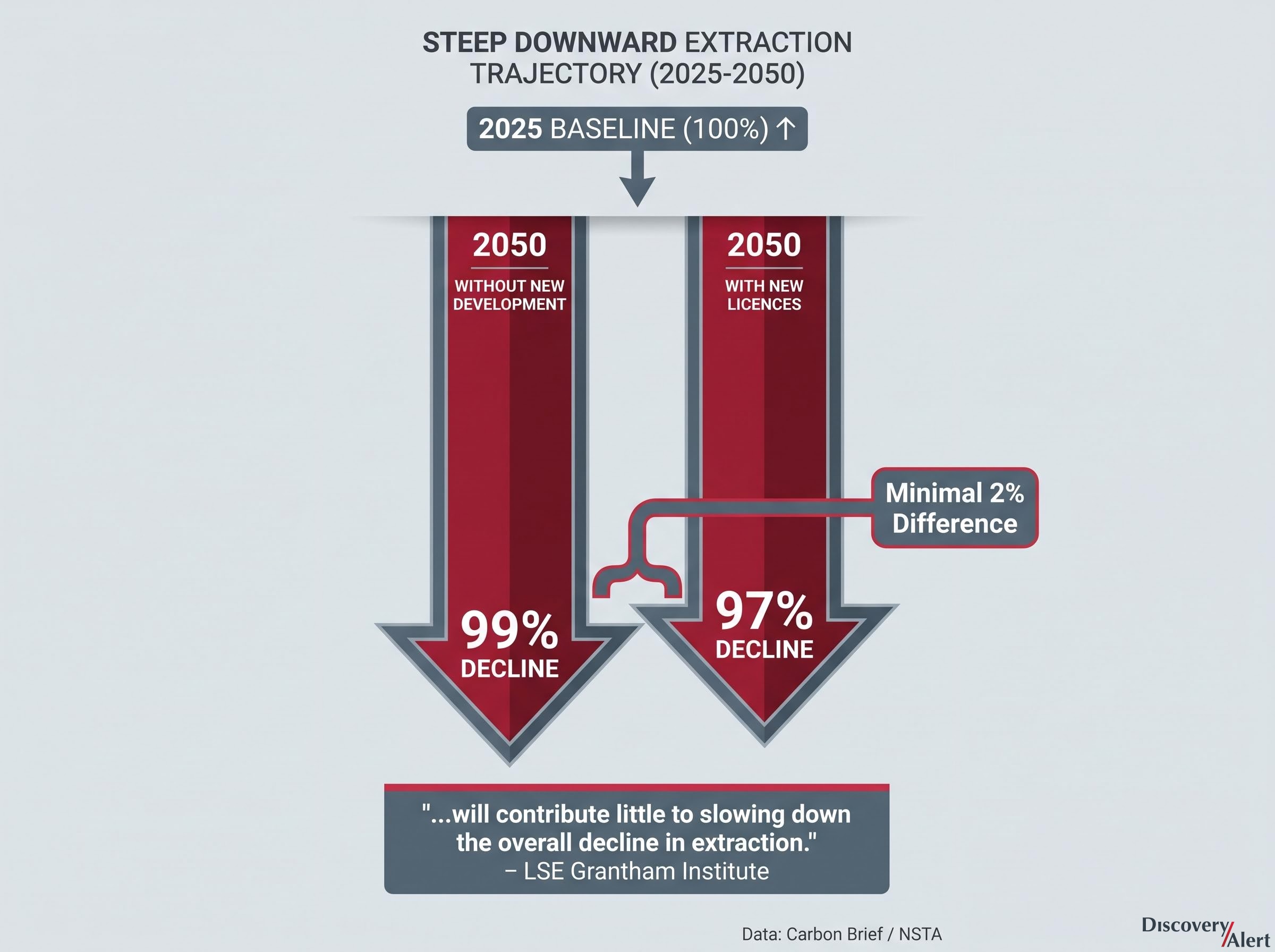
The longer-term picture is starker. Carbon Brief analysis of NSTA data shows gas production falling 99% below 2025 levels by 2050 without new development, and 97% with new licences. Oil and net gas production combined is projected to fall around 89% by 2050 versus recent levels.
| Metric | Without new development | With new licences | Source |
|---|---|---|---|
| Gas production decline by 2030 (vs 2025) | Steeper than 49% | Approximately 44-49% | NSTA (Feb 2026); ECIU (Mar 2026) |
| Gas production decline by 2050 (vs 2025) | 99% | 97% | Carbon Brief / NSTA |
| Oil and net gas decline by 2050 (vs recent levels) | Greater than 89% | Approximately 89% | Carbon Brief / NSTA |
The difference between 97% and 99% is the total contribution of new licensing to the 2050 gas production picture. The LSE Grantham Institute, reviewing the same NSTA data, concluded that new field developments “will contribute little to slowing down the overall decline in extraction.”
The LSE Grantham Institute concluded that new field developments, including both known undeveloped fields and future discoveries, “will contribute little to slowing down the overall decline in extraction.”
Under current trajectories, the UK will produce less than a third of its oil and gas demand through to 2050. New licences alter the gradient of the decline. They do not alter the destination.
The most publicly persuasive case for new North Sea licences rests on a simple intuition: more domestic supply means lower bills. The structure of the gas market does not support that intuition.
UK oil and gas do not trade in a sealed domestic market. They trade into an integrated North-West European market where prices are set by regional supply and demand, LNG pricing, and storage levels. A marginal increase in UK production does not lower the clearing price for UK consumers because UK output is small relative to the wider market that determines the price.
LNG market dynamics are central to why UK gas prices remain tethered to North-West European benchmarks rather than domestic output levels: when LNG supply tightens globally, import-dependent markets like the UK face price exposure regardless of how much gas is being extracted from the Continental Shelf.
This is not a theoretical objection. As recently as 2022, North Sea output met approximately 44% of UK gas demand and 67% of oil demand. Even at those production levels, domestic output did not insulate UK consumers from the 2021-2022 price surge. The mechanism by which more drilling would deliver lower bills does not exist within the current market structure.
Three institutions have reached the same conclusion independently:
The gap between the political claim and the economic reality is wide. Understanding why it exists is essential for investors and policy observers who need to distinguish genuine energy security rationale from messaging.
Meg O’Neill’s argument deserves fair treatment on its strongest terms. The UK sources 75% of its energy from fossil fuels. That dependency is real, and domestically sourced hydrocarbons reduce exposure to import disruptions in the near term. New licences can modestly slow the rise in import dependency during the 2020s and extend revenue streams for existing operators.
Those claims are partially supported by the data. The claims that go further are not.
BP’s growth strategy, centred on organic development from existing discovered resources rather than frontier exploration, reflects a wider industry recognition that the economics of late-life basins increasingly favour disciplined capital recycling over new licence commitments.
| Claim made by proponents | What the evidence supports |
|---|---|
| New licences will reduce import dependency | Modest slowing of import growth in the 2020s; cannot reverse the structural trend given depletion rates and decline forecasts |
| More drilling will lower consumer energy bills | LSE Grantham Institute finds “negligible impact” on bills; UK prices are set by the North-West European market, not domestic output |
| Domestic production strengthens physical supply security | Remaining reserves are too small to materially alter the UK’s import-dependent trajectory; ECIU characterises resilience claims as unfounded |
ECIU and the UK Energy Research Centre have characterised claims that expanded North Sea drilling would deliver meaningful resilience or affordability benefits as “unfounded.”
The analytical distinction matters. New licences are a marginal adjustment to the trajectory of a near-exhausted basin. The data supports that reading. The data does not support reading them as a structural answer to UK energy security.
The policy debate carries direct implications for how investors evaluate late-life North Sea assets. Three categories of risk are elevated:
UK energy production hit record lows in 2024, according to DESNZ statistics. That trajectory sharpens the capital allocation question: where does incremental investment deliver better risk-adjusted returns over a multi-year horizon?
Mature basin production plateaus are not unique to the North Sea: the Permian, the world’s most productive tight-oil province, is showing analogous depletion dynamics as its highest-productivity core areas become saturated, suggesting that late-cycle production management is becoming a global capital allocation challenge rather than a UK-specific policy problem.
Capital committed to late-life offshore projects competes directly with capital for renewables, grid reinforcement, and storage. The cost curves for transition infrastructure are generally improving. Policy alignment is stronger and more durable. The NSTA data and Labour’s energy agenda both position low-carbon infrastructure as central to UK energy security planning.
That does not mean late-life North Sea assets generate no near-term cashflow. Some do, and that cashflow has value for existing operators. The distinction is between near-term revenue extraction from a declining base and structural positioning for where the UK energy system is heading. For investors with multi-year horizons, the risk-reward profile of these two categories differs materially.
The energy transition timeline matters directly for how investors should weigh late-life North Sea cashflows: if low-carbon infrastructure deployment remains slower than headline investment figures suggest, the near-term revenue window for existing operators extends, but so does the period of import-price exposure for UK consumers.
The analysis reduces to three numbers that should anchor any serious evaluation of North Sea development claims:
The consumer price argument, the most politically potent claim, collapses against the market structure: extra North Sea output has a “negligible impact” on UK bills because prices are set regionally, not domestically.
There is a legitimate argument for orderly transition management, for winding down a mature basin in a way that supports existing operators and workers. That argument deserves honest treatment, separate from inflated energy security claims.
The data supports a clear-eyed differentiation. Late-life North Sea assets retain some near-term cashflow merit. They do not deliver structural energy security. ECIU analysis is direct on where that security will come from: renewables, storage, and demand reduction will do the “heavy lifting” for the UK’s energy future.
ECIU concludes that renewables, storage, and demand reduction will have to do the “heavy lifting” for future UK energy security, because declining North Sea production cannot.
This article is for informational purposes only and should not be considered financial advice. Investors should conduct their own research and consult with financial professionals before making investment decisions. Financial projections referenced in this analysis are subject to market conditions and various risk factors. Past performance does not guarantee future results.
The UK North Sea is approximately 90-94% depleted, having produced around 47.7 billion barrels of oil equivalent since the 1960s, with only about 2.9 billion boe of proven and probable reserves remaining.
UK oil and gas trade into an integrated North-West European market where prices are set by regional supply and demand, LNG pricing, and storage levels, meaning marginal increases in domestic output have negligible impact on what UK consumers pay.
According to NSTA and ECIU projections, UK gas production is expected to fall approximately 44-49% by 2030 compared to 2025 levels, even assuming new licences proceed.
Investors should weigh three elevated risk categories: regulatory and political risk from tightening licensing policy, cost-curve risk because remaining reserves are expensive to extract, and stranded-asset risk from forecast production declines combined with accelerating climate policy.
The LSE Grantham Institute, UK Energy Research Centre, and ECIU have all characterised claims that expanded North Sea drilling delivers meaningful energy resilience or affordability benefits as unfounded, noting that new field developments contribute little to slowing the overall decline in extraction.


