
Saudi Aramco’s Exports Hold, but War-Risk Costs Tell a Darker Story
Aug 17, 2026


Australia’s High Court heard its first climate case in May 2026. It has not yet spoken. Until it does, every major coal and gas project approval in the country carries an unresolved legal question at its core.
The Mount Pleasant case pits MACH Energy’s bid to reinstate a 22-year, 247-million-tonne coal mine expansion against a unanimous NSW Court of Appeal ruling that found the original approval unlawful. The central question: did regulators have to account for the local climate harms caused by burning exported coal overseas? The High Court will now decide whether that obligation is real, and how demanding it is.
What follows maps the legal journey from mine approval to apex court, explains the doctrinal stakes, and lays out what each possible ruling means for mining and energy investors managing approval risk across the Australian resource sector.
What began as a state planning commission decision in the Hunter Valley has, in less than four years, become a national legal flashpoint. Each procedural step ratcheted the stakes higher, pulling the case from administrative review into constitutional territory.

The timeline runs as follows:
Each step narrowed the exits. A state-level approval dispute is now the vehicle through which the High Court will define the legal weight of exported emissions across Australian planning law.
The Court of Appeal’s core finding can be stated plainly: the IPC was required to consider how Scope 3 emissions from the mine’s exported coal contribute to climate change and, critically, how that contribution translates into specific local environmental impacts in the Hunter Valley.
The statutory framework underpinning that finding sits in the NSW Environmental Planning and Assessment Act and the Mining SEPP. From those instruments, the court identified a two-part legal obligation:
“To the greatest extent practicable” is the standard the Court of Appeal applied, and it is the standard the High Court is now asked to endorse or reject.
The two-part test matters because it is not abstract. If upheld, it requires approval bodies to commission climate-impact modelling that traces a causal chain from exported coal through global emissions to identifiable local consequences. If rejected, the obligation narrows and that modelling burden falls away. Investors and legal counsel assessing whether existing project approvals carry exposure need to understand this test precisely, because it is the framework the High Court is evaluating.
The Mount Pleasant case did not arrive without precedent. It sits at the end of a jurisprudential arc that has been building across Australian courts for more than two decades, each decision expanding the scope of what approval bodies must consider when assessing climate consequences.
| Case Name | Jurisdiction | Year | Key Holding |
|---|---|---|---|
| Gray v Minister for Planning | NSW Land and Environment Court | 2006 | Environmental assessments must be broad and include climate consequences of coal combustion |
| Rocky Hill | NSW Land and Environment Court | 2019 | Scope 3 emissions, precautionary principle, and intergenerational equity must be considered in coal mine approvals |
| Xstrata Coal | Queensland | Various | Only the mine’s direct impacts required to be weighed; more restrictive approach to downstream emissions |
Gray established that environmental impact assessments could not stop at the mine gate. Rocky Hill confirmed that Scope 3 emissions and principles of intergenerational equity belonged inside the consent authority’s deliberation. The NSW Court of Appeal then clarified the mechanics: approval bodies retain discretion over which policies and guidelines they rely on, but they must still consider assessments of greenhouse gas emissions, including Scope 3, and whether conditions can minimise them.
Columbia Law School’s climate law analysis of the High Court proceedings situates the Mount Pleasant case within the broader arc of Australian climate jurisprudence, tracing how the Gray v Minister for Planning precedent from 2006 and the Rocky Hill decision in 2019 progressively expanded what consent authorities must examine when evaluating coal project approvals.
Queensland’s Xstrata Coal decision pulls in the opposite direction. There, only direct mine impacts needed to be weighed, illustrating a more restrictive approach that has persisted as a competing strand of authority. The divergence between NSW and Queensland is not academic. For investors managing national portfolios, this patchwork of precedents is itself a risk. The High Court’s ruling will either unify or further fragment that landscape, and the answer has direct implications for legal due diligence across every jurisdiction.
The divergence between NSW and Queensland is not merely jurisprudential: Queensland’s coal royalty regime imposes a separate and distinct financial architecture on thermal coal producers, creating a layered compliance environment that investors managing national portfolios must navigate alongside the emerging Scope 3 legal obligations.
The High Court’s judgment will land in one of three broad zones. Each produces a distinct legal and commercial environment, and the consequences flow logically from the ruling’s internal logic rather than from speculation about market reaction.
If the High Court confirms that regulators must substantively assess local climate impacts arising from Scope 3 emissions, several consequences follow:
This is the scenario in which the compliance bar rises materially. The cost is not just modelling fees; it is the structural repricing of approval certainty for every fossil fuel expansion in the pipeline.
If MACH Energy succeeds and the High Court narrows the obligation, the immediate pressure on existing approvals eases:
This is a reprieve, not a full reset. The broader forces driving climate-related legal challenges do not disappear because one High Court appeal succeeds. Investors would gain near-term clarity but should not assume downstream emissions will drop out of contention in future legislative reforms or test cases.
The High Court could dispose of the case on narrower grounds, focusing on reasoning adequacy or a specific statutory interpretation, without resolving the national standard on Scope 3 obligations.
For investors, this is the worst of both worlds: ongoing uncertainty without the clarity that would allow confident positioning in either direction.
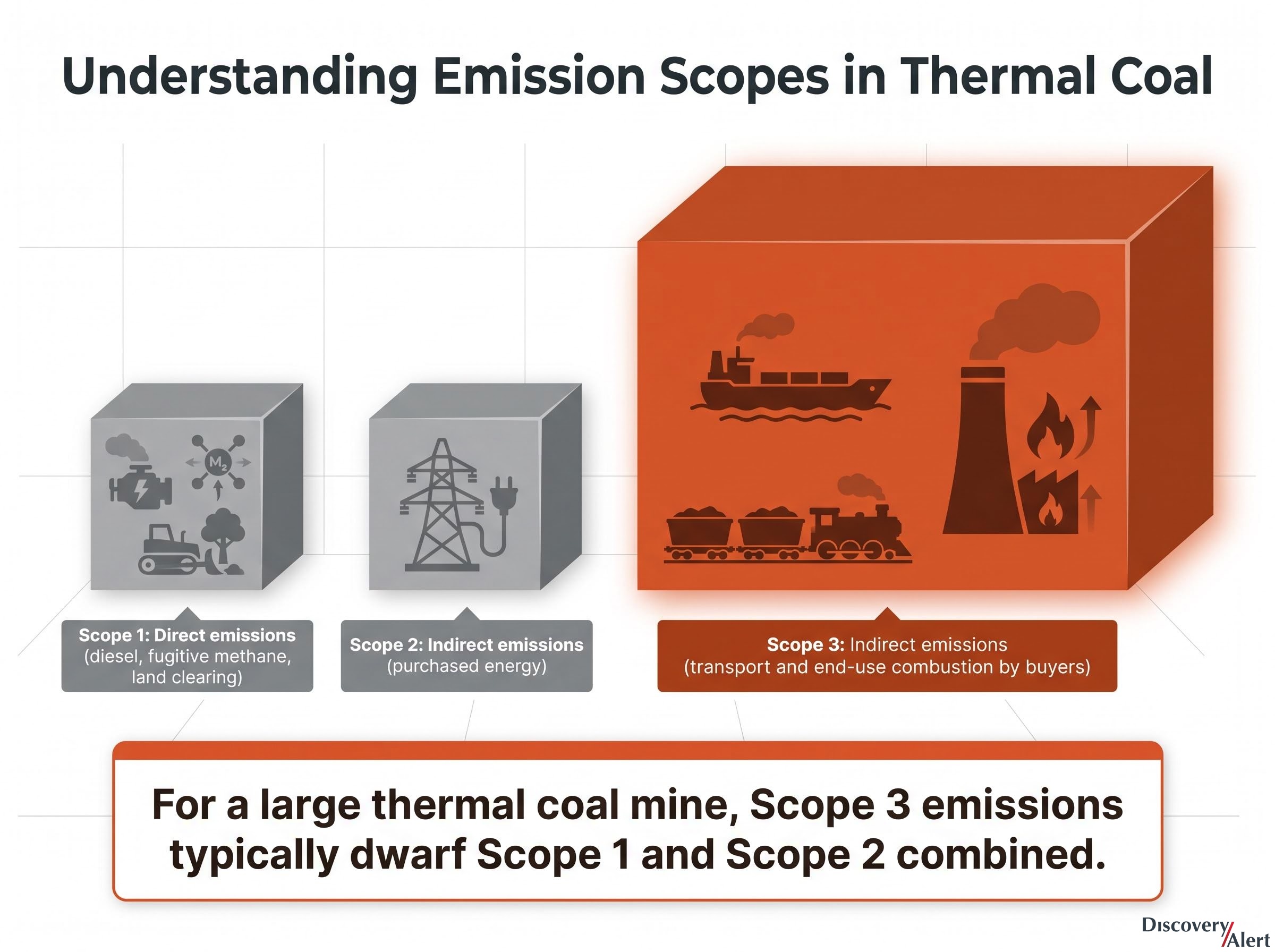
Scope 3 emissions are the greenhouse gases released when coal is transported and burned by end-users, often in power stations and steel mills overseas. They are distinct from the two other recognised emission categories:
For a large thermal coal mine, Scope 3 emissions typically dwarf Scope 1 and Scope 2 combined. That scale is why they have become the legal pivot point.
The Clean Energy Regulator’s emissions and energy types guidance confirms that while Scope 1 and Scope 2 emissions carry mandatory reporting obligations under the National Greenhouse and Energy Reporting Scheme, Scope 3 emissions from end-use combustion do not, a regulatory asymmetry that makes the High Court’s Mount Pleasant ruling all the more consequential for how downstream emissions are treated in planning law.
The conceptual difficulty the High Court is navigating is genuine. The physical harm, climate change, is global and diffuse. The causal chain from a Hunter Valley mine to a heatwave in the same region runs through international shipping, foreign power generation, atmospheric chemistry, and regional weather systems. The emitter, the overseas buyer, sits outside Australian jurisdiction. Courts have struggled with whether domestic approval law can or should assign responsibility for consequences that are so geographically and causally distant from the mine site.
The Court of Appeal answered that question affirmatively, holding that those downstream emissions must be treated as contributing to identifiable local harms: heatwaves, bushfires, flooding, and agricultural losses in the Hunter Valley.
The Scope 3 causal chain the Court of Appeal traced, from Hunter Valley extraction through international shipping to overseas combustion, runs directly through the steel sector, and work on carbon capture in Asian steel supply chains illustrates how some of the world’s largest coal consumers are beginning to internalise precisely the downstream emission responsibility that Australian courts are now assigning back to the mine gate.
The Mount Pleasant case makes clear that Scope 3 is moving from voluntary ESG disclosure territory into the domain of binding legal obligation, and that shift changes how it must be priced and managed across resource portfolios.
The pending judgment is itself a material exposure. Funds and lenders that wait for a ruling before acting will be reactive rather than positioned, and the compliance adjustments required under Scenario A are not trivial to implement at speed.
DAMSHEG has argued that the six-year interim extension effectively anticipates the High Court’s outcome, providing MACH Energy a continued operational pathway even if it does not prevail. That argument signals how community groups will continue to contest approvals regardless of the ruling’s timing, reinforcing the need for proactive rather than reactive positioning.
The High Court is deciding whether exported emissions remain someone else’s legal problem or become a core element of domestic project responsibility. That framing will govern coal mine approval rules in Australia for decades.
Regardless of the ruling, the structural forces driving climate litigation are not contingent on one case. Community group activism, evolving federal climate obligations, and ESG investor pressure will persist. Protesters gathered outside the High Court in Canberra during the May 2026 hearing, a visible reminder that the social and political energy behind these challenges is sustained and growing.
Mount Pleasant does not resolve every risk. It sets the legal floor from which all future coal and fossil fuel project approvals in Australia will be measured. Investors who understand that generational significance will allocate analytical and legal resources accordingly before judgment; those who treat it as a single-project issue risk being caught underprepared when the ruling reshapes the approval landscape.
Australian mining industry growth forecasts through 2030 were modelled against a regulatory baseline that predates the High Court’s determination, meaning any upside scenario in those projections carries an embedded assumption about approval certainty that the Mount Pleasant ruling may materially revise.
This article is for informational purposes only and should not be considered financial advice. Investors should conduct their own research and consult with financial professionals before making investment decisions. The scenarios described are speculative and subject to change based on the High Court’s determination and subsequent market developments.
Scope 3 emissions are greenhouse gases released when coal is transported and burned by end-users overseas, typically in power stations and steel mills. For large thermal coal mines they dwarf Scope 1 and Scope 2 emissions combined, and the Mount Pleasant High Court case will determine whether Australian regulators must treat these downstream emissions as a mandatory consideration in domestic project approvals.
The NSW Court of Appeal unanimously ruled that the Independent Planning Commission's 2022 approval of MACH Energy's Mount Pleasant expansion was unlawful because it failed to consider how Scope 3 emissions from exported coal contribute to local climate harms in the Hunter Valley, and whether consent conditions should minimise those emissions to the greatest extent practicable.
If the High Court upholds the Court of Appeal, existing approvals that lack rigorous Scope 3 analysis become more exposed to legal challenge in NSW and carry persuasive influence in other jurisdictions, lengthening approval timelines and repricing approval certainty for fossil fuel expansions nationally.
Investors should identify portfolio assets whose approvals rely on limited or pre-2025 treatment of Scope 3 emissions, model project economics under a strict Scope 3 obligation, monitor how regulators handle new applications while the case is reserved, and reflect the probability of a disruptive precedent into hurdle rates and covenants.
The 2006 Gray v Minister for Planning decision established that environmental assessments must include climate consequences of coal combustion, and the 2019 Rocky Hill ruling confirmed that Scope 3 emissions and intergenerational equity must feature in consent authority deliberations, with the NSW Court of Appeal then clarifying the mechanics that the High Court is now asked to endorse or reject.


