
Saudi Aramco’s Exports Hold, but War-Risk Costs Tell a Darker Story
Aug 17, 2026


Indonesia’s 2027 budget (RAPBN 2027), presented in August 2026, has already set one major policy in motion before the formal fiscal framework was even announced. The B50 biodiesel blending mandate became law on 1 July 2026, converting palm-oil feedstock into a regulated industrial input overnight. The rest of the budget is now catching up, reshaping the investment calculus across mining, EV battery supply chains, renewables, coal exports, and state-owned enterprise portfolios simultaneously.
Analysts at Alphagate Capital and SGMC Capital have named specific listed companies on both sides of the ledger. What follows maps out which Indonesian equities stand to benefit under the 2027 fiscal framework and which face genuine structural pressure, organised by sector with the policy mechanics driving each call.
The single most important clarification for Indonesian mining equities came from the budget’s confirmation that the new state export oversight body will monitor, not control, export volumes or pricing. That distinction removed the central regulatory risk that had weighed on mining valuations: the possibility of direct state intervention in commodity flows.
With that overhang lifted, the budget’s parallel crackdown on illegal mining operations becomes a direct margin driver for compliant, listed producers. Companies that previously competed against unrecorded output now operate on a cleaner playing field, and the valuation multiple benefit compounds on top of any underlying commodity tailwind.
Indonesia’s commodity policy pivot toward downstream processing and domestic value-add has already structurally repriced nickel, and the 2027 budget accelerates the same logic across tin, battery materials, and palm-oil feedstock, shifting the investment framework from commodity price exposure toward policy-regulated demand floors.
Henry Wibowo, director and co-founder of Alphagate Capital in Jakarta, identified the regulatory improvements as supportive for compliant listed miners regardless of broader commodity exposure.
The specifically named beneficiaries:
The demand anchor is specific: 1 million domestically assembled electric motorcycles. That government production target, backed by tax incentives for domestically manufactured electric two- and four-wheelers, creates a policy-guaranteed floor for Indonesia’s EV supply chain that is structurally different from a commodity price tailwind.
The incentive design matters. Tax breaks prioritise high-value domestic production over raw ore exports, directing capital toward manufacturers and integrators plugged into the local assembly chain rather than upstream commodity extractors. The policy implementation timeline is tied to the 2027 budget cycle and extends beyond it.
The companies positioned to capture that mandated demand:
Unlike commodity cycle plays, a government-mandated production target with attached tax support provides a more durable basis for earnings forecasts, making these names less dependent on global cycle timing.
The EV demand drivers underpinning Indonesia’s one million electric motorcycle target extend well beyond a single policy cycle, with lithium and battery material consumption set to compound across electric vehicles, AI energy storage, and robotics applications, making Indonesia’s domestic incentive structure a participation mechanism in a multi-decade demand story.
The B50 blending mandate is not a proposal. It took effect on 1 July 2026, upgrading the previous B40 requirement to a 50% palm-based biodiesel blending rate applied nationwide. That converts palm-oil feedstock from an agricultural commodity subject to global price swings into a policy-guaranteed revenue stream for plantation operators.
The Ministry of Energy and Mineral Resources confirmed a three-month transition period following the July 2026 launch, with ANTARA News reporting on the B50 rollout timeline indicating full nationwide distribution is targeted by 1 October 2026, a schedule that gives plantation operators a clear demand ramp visible within the current fiscal year.
Mohit Mirpuri, partner at SGMC Capital Pte, identified the government’s emphasis on reducing dependence on expensive imported fossil fuels as a positive driver for both the biodiesel mandate and the broader energy self-sufficiency agenda.
The budget’s energy independence goals extend beyond biodiesel. Geothermal and other renewable projects are prioritised under national self-sufficiency targets, creating project pipeline and financing tailwinds for listed renewables operators.
| Sub-sector | Named Beneficiaries |
|---|---|
| Biodiesel Plantations | PT Astra Agro Lestari, PT Eagle High Plantations, PT Salim Ivomas Pratama, PT Sinar Mas Agro Resources and Technology |
| Renewables | PT Barito Renewables Energy, PT Pertamina Geothermal Energy, PT TBS Energi Utama |
For investors building Indonesia-exposed portfolios, the B50 mandate materially changes the demand volatility profile of plantation stocks by anchoring a regulated consumption floor beneath palm-oil volumes.
The proposed Strategic Mineral and Commodity Exchange is a mechanism that has received less attention than the budget’s headline policies, but it carries specific pricing risk for Indonesia’s coal exporters. The exchange is designed to establish Indonesian domestic reference prices for key export commodities, with a planned launch of 1 January 2027.
The risk is pricing exposure, not production caps. Indonesian coal producers have largely avoided the most restrictive government resource policies, including production limits and sharply elevated royalties. The exchange introduces a different problem: if domestic reference prices are applied to international transactions, overseas buyers may view Indonesian coal as less commercially attractive compared to alternative supply sources.
Global thermal coal demand remaining stable at record-high levels complicates the pricing picture for Indonesian exporters: strong seaborne demand ordinarily supports export revenue quality, but the commodity exchange mechanism introduces a domestic reference price layer that could erode the margin benefit even as underlying demand stays firm.
The coal names most exposed:
For investors holding Indonesian coal positions, the exchange mechanism introduces a structural pricing overhang that is separate from global thermal coal supply-demand dynamics and needs to be monitored on its own timeline.
Danantara (Badan Pengelola Investasi Daya Anagata Nusantara) is the government investment management institution coordinating President Prabowo’s drive to force profitability across Indonesia’s sprawling state-owned enterprise portfolio. It is not a regulator. It is the body overseeing SOE asset consolidation, mergers, divestments, and restructurings as an active portfolio manager with a mandate to eliminate underperformers.
The consolidation scope is significant: approximately 1,068 state-owned enterprises are targeted for reduction to roughly 221 core entities. The process has already closed or consolidated hundreds of entities and is expected to continue through 2026-2029.
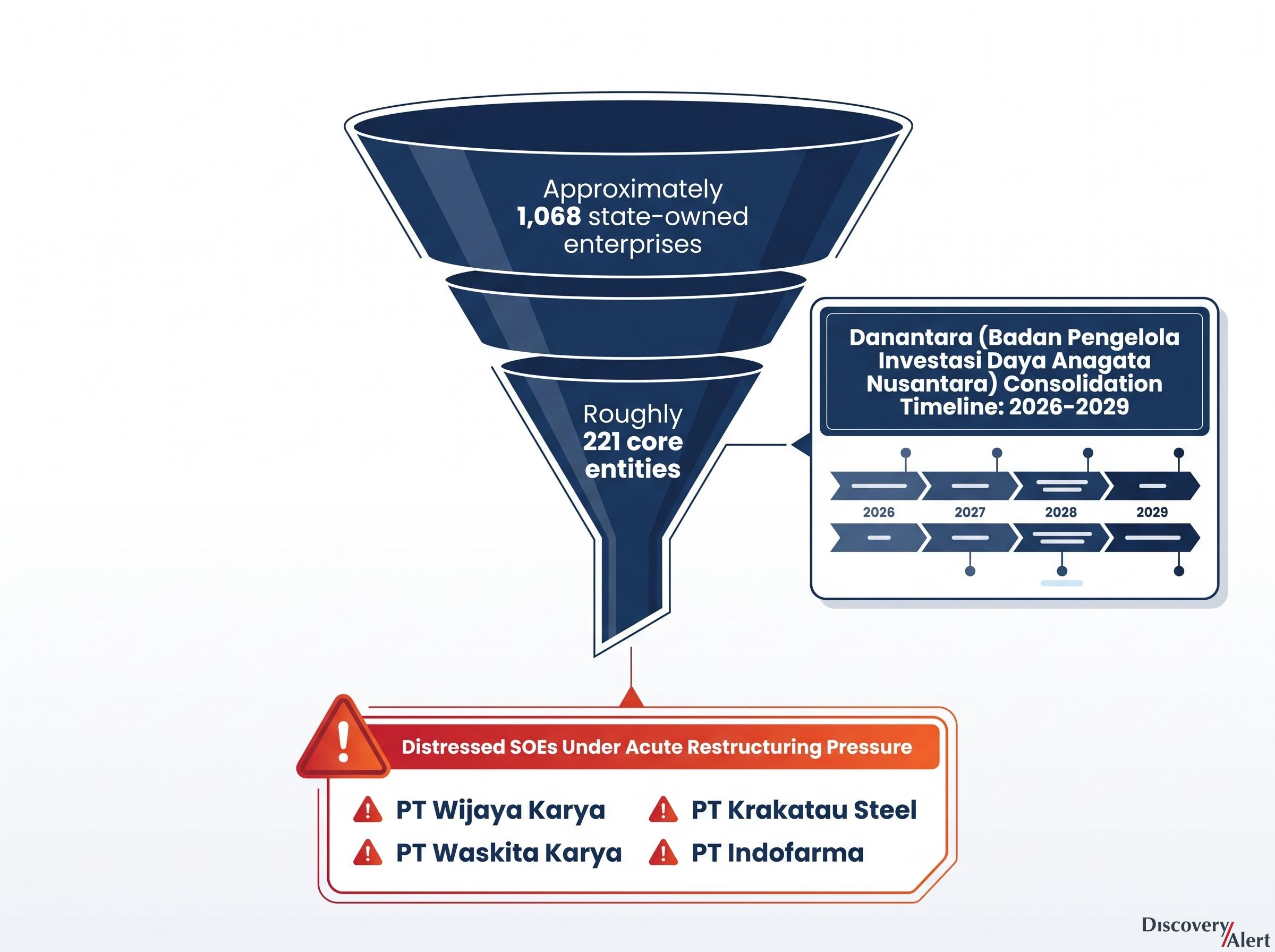
Four listed SOEs face the most immediate restructuring risk, and all four are already in deep financial distress. The budget accelerates rather than initiates their pressure.
This is the most underappreciated risk bucket in the Indonesian budget story. Investors holding minority positions in distressed SOEs face a government-managed process that prioritises national outcomes over minority shareholder returns.
The distance between announced budget policy and actual corporate cash flow impact is where most Indonesian macro trades fail. Policy execution, not policy announcement, separates thesis from earnings.
The gap between announced policy and tangible corporate benefit is the primary investment risk for all winner categories under the 2027 budget.
Three execution checkpoints warrant specific monitoring:
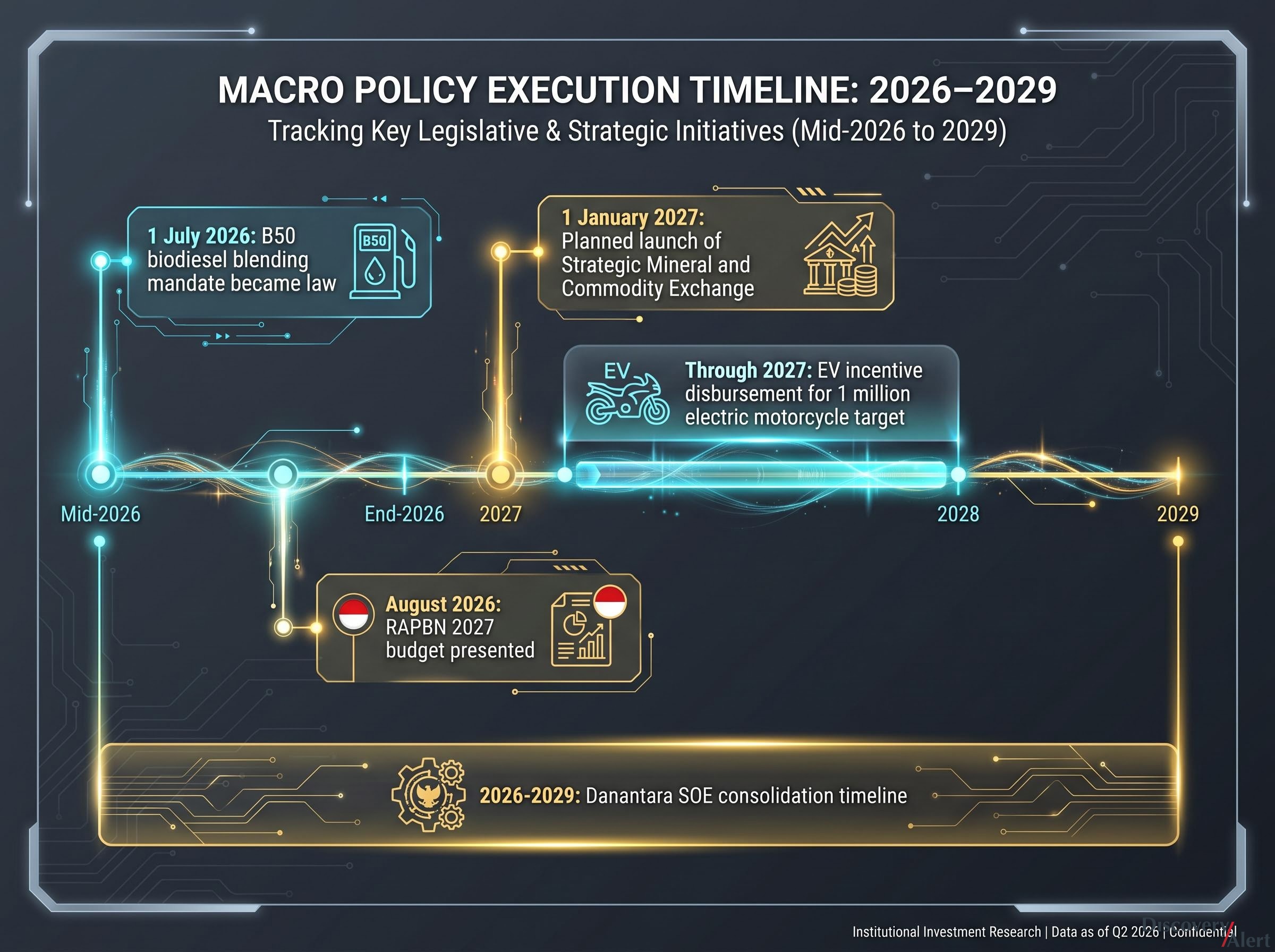
The B50 biodiesel mandate (effective since July 2026) is the one policy track already producing revenue impact. The other two remain live variables through 2027 and beyond.
The 2027 fiscal framework creates a clear structural split. Compliant listed miners, domestic EV manufacturers, biodiesel plantation operators, and geothermal producers sit on the policy-supported side. Coal exporters facing exchange pricing risk and distressed SOEs undergoing forced consolidation sit on the other.
Two names require nuanced positioning rather than binary classification. PT TBS Energi Utama straddles the EV and renewables tailwinds with compound policy support. PT Bumi Resources sits in both the mining winner and coal loser buckets, requiring investors to weigh regulatory clarity against pricing exposure.
Downstream manufacturing concentration risk is a live issue across Southeast Asian resource-linked portfolios, and CITA’s decision to place 40% of assets in aluminium processing illustrates both the potential returns from Indonesia’s domestic value-add policy direction and the single-sector exposure that investors need to stress-test when building positions around government industrial mandates.
| Category | Policy Direction | Named Companies |
|---|---|---|
| Listed Miners | Tailwind: regulatory clarity, anti-illegal-mining enforcement | PT Timah, PT Aneka Tambang, PT Bumi Resources* |
| EV/Battery Supply Chain | Tailwind: domestic production incentives, tax breaks | PT Indika Energy, PT Vktr Teknologi Mobilitas, PT TBS Energi Utama, PT Merdeka Battery Materials |
| Palm-Oil Biodiesel | Tailwind: B50 mandate (effective July 2026) | PT Astra Agro Lestari, PT Eagle High Plantations, PT Salim Ivomas Pratama, PT Sinar Mas Agro Resources and Technology |
| Renewables | Tailwind: energy self-sufficiency priority | PT Barito Renewables Energy, PT Pertamina Geothermal Energy, PT TBS Energi Utama |
| Coal Exporters | Headwind: commodity exchange price control risk | PT Bumi Resources*, PT Adaro Andalan, PT Bukit Asam |
| Distressed SOEs | Headwind: forced consolidation, restructuring, minority dilution risk | PT Wijaya Karya, PT Waskita Karya, PT Krakatau Steel, PT Indofarma |
*PT Bumi Resources has dual exposure across the mining winner and coal loser buckets.
The investor action from here is specific: monitor the three policy milestones, distinguish between compliant and non-compliant operators within each sector, and treat execution risk as a live variable through 2027.
This article is for informational purposes only and should not be considered financial advice. Investors should conduct their own research and consult with financial professionals before making investment decisions. These statements are speculative and subject to change based on market developments and company performance.
Danantara is Indonesia's government investment management institution tasked with consolidating approximately 1,068 state-owned enterprises down to around 221 core entities, with distressed SOEs like PT Wijaya Karya and PT Waskita Karya facing merger, liquidation, or equity dilution scenarios that prioritise national outcomes over minority shareholder returns.
Palm-oil plantation operators including PT Astra Agro Lestari, PT Eagle High Plantations, PT Salim Ivomas Pratama, and PT Sinar Mas Agro Resources and Technology are the primary beneficiaries, as the B50 mandate effective 1 July 2026 converts palm-oil feedstock into a policy-guaranteed revenue stream rather than an open-market commodity.
The Strategic Mineral and Commodity Exchange, planned to launch on 1 January 2027, would establish domestic reference prices for key export commodities, and if those benchmarks are applied to international transactions, overseas buyers may find Indonesian coal less commercially attractive compared to alternative supply sources, eroding export margins for PT Bumi Resources, PT Adaro Andalan, and PT Bukit Asam.
The Indonesian government has set a domestic assembly target of one million electric motorcycles backed by tax incentives for locally manufactured electric two- and four-wheelers, creating a policy-anchored demand floor that directly benefits PT Vktr Teknologi Mobilitas, PT Indika Energy, PT TBS Energi Utama, and PT Merdeka Battery Materials.
Investors should track the commodity exchange design finalisation around the 1 January 2027 launch date, the pace of EV tax incentive disbursement relative to the one million motorcycle production target, and specific Danantara corporate actions including merger and liquidation announcements affecting distressed SOEs.


