
Aramco Targets Europe With Deeper-Than-Expected Crude Price Cut
Aug 17, 2026


India’s parliament passed the Mines and Minerals (Development and Regulation) Amendment Bill, 2026 on 14 August 2026, Independence Day, a piece of timing that opposition state governments have seized upon as symbolic. The legislation inserts a new Section 9D into the MMDR Act, 1957, barring states from imposing taxes, cesses, or levies on mineral rights or mineral-bearing land unless authorised under conditions the central government prescribes. The move arrives less than two years after the Supreme Court affirmed states’ constitutional right to tax mineral-bearing land, and it effectively closes the fiscal space that ruling created. For mining companies and investors tracking regulatory risk across one of the world’s largest mineral economies, the bill reshapes the rules on state-level fiscal surprises, centralises control over mineral taxation, and opens a new front in India’s centre-state fiscal contest. What follows explains what the law prohibits, which states face the sharpest revenue exposure, why New Delhi believes the trade-off serves its competitiveness agenda, and what political and legal friction lies ahead.
Section 9D is the operative clause. It bars states from imposing any tax, cess, or levy on mineral rights or mineral-bearing land, whether calculated by quantity, value, royalty payable, or any other basis, unless the central government has prescribed the conditions under which such a charge is permissible. The breadth of the wording closes definitional workarounds that states might otherwise exploit.
The scope of the MMDR Amendment changes extends beyond the immediate prohibition on state-level cesses, touching royalty administration, auction frameworks, and the conditions under which centrally prescribed charges can be introduced, details that matter for companies assessing long-term project economics across different mineral categories.
Three immediate effects follow:
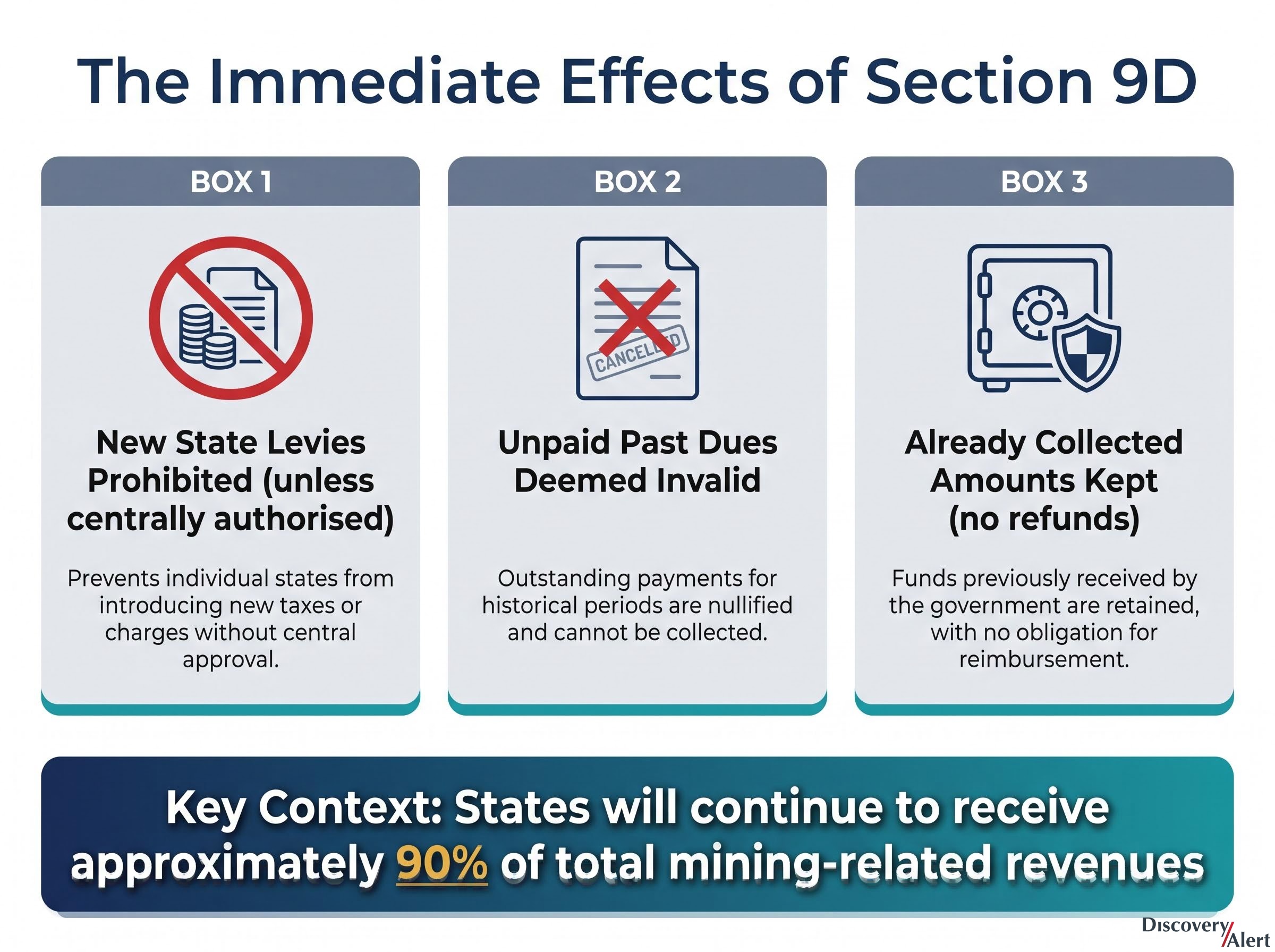
Federal authorities have stated that states will continue to receive approximately 90% of total mining-related revenues, including royalties, auction premiums, and other payments, under existing sharing arrangements, even after their autonomous taxing powers are constrained.
The central government’s position is that the law does not diminish states’ jurisdictional control over land or mineral resources. It centralises control over the rules governing mineral taxation while keeping most revenue flows directed toward the states, subject to a nationally defined ceiling.
Jharkhand is the sharpest test case. Mining accounted for 84.9% of the state’s own non-tax revenue in FY 2024-25, according to figures cited by Chief Minister Hemant Soren and corroborated by PRS Legislative Research and the state’s Economic Survey.
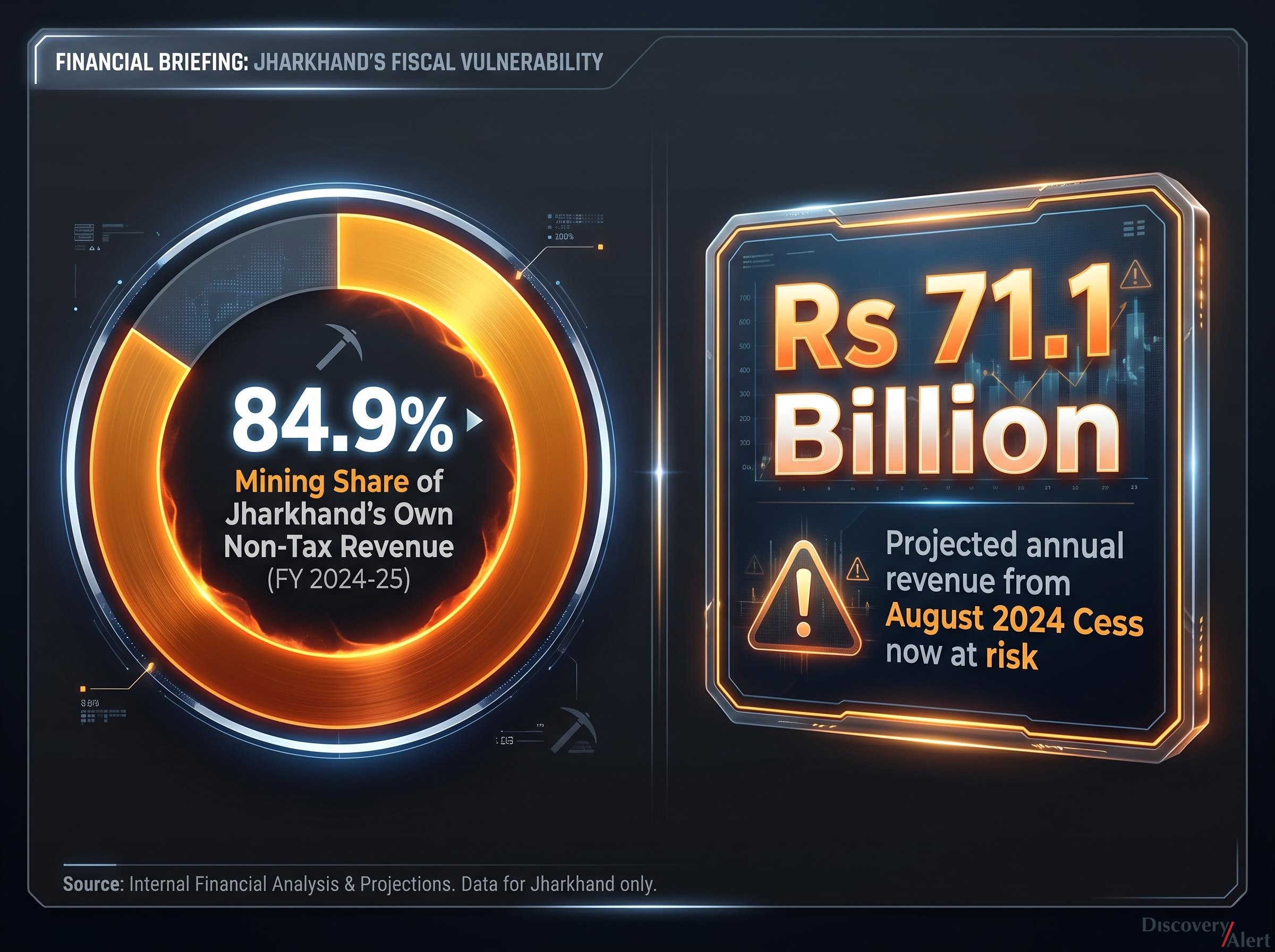
Within weeks of the Supreme Court’s July 2024 ruling affirming states’ taxing rights, Jharkhand enacted the Jharkhand Mineral Bearing Land Cess Act in August 2024, applying levies to coal, iron ore, bauxite, and other minerals. According to Chief Minister Soren’s 13 August 2026 letter to Prime Minister Modi, published on X the day before the bill passed, that cess was expected to generate approximately Rs 71.1 billion annually, funding development programmes, welfare schemes, and social security initiatives.
Chief Minister Soren’s letter warned that restricting states’ ability to levy mining charges would directly impair Jharkhand’s capacity to fund development programmes, welfare schemes, and social security initiatives.
The new federal law places those projected revenues in jeopardy.
| State | Mining Share of Non-Tax Revenue | Key Cess/Levy Enacted | Revenue at Risk |
|---|---|---|---|
| Jharkhand | 84.9% (FY 2024-25) | Mineral Bearing Land Cess Act (August 2024) | ~Rs 71.1 billion annually (per CM Soren) |
| Odisha | Structurally comparable exposure | State-level levies post-2024 ruling | Quantification pending |
| Chhattisgarh | Structurally comparable exposure | State-level levies post-2024 ruling | Quantification pending |
States with this level of fiscal dependence on mining have the strongest incentive to pursue legal challenges and apply political pressure, which is the friction variable investors need to price.
The conflict between New Delhi and the mineral-rich states is structural, not merely political. India’s mining fiscal architecture distributes revenue through a layered system, and the July 2024 Supreme Court ruling added a new layer that the central government has now moved to remove.
The PRS Legislative Research analysis of the MMDR Amendment Bill details how the legislation engages Entry 54 of the Union List alongside Entries 23 and 50 of the State List, the constitutional provisions whose interaction has historically defined the boundaries of central and state authority over mineral taxation.
The sequence runs as follows:
India’s coal block auction programme illustrates the broader pattern of centralised federal control over mineral resource allocation, with New Delhi setting the terms of block availability, reserve pricing, and end-use conditions while state governments participate primarily as revenue recipients rather than rule-setters.
The 25 July 2024 judgment held that states possess constitutional authority to impose taxes on mineral-bearing land, a power separate from the centrally governed royalty system. Jharkhand moved within weeks, enacting its Mineral Bearing Land Cess Act in August 2024. Other mineral-rich states followed or began drafting similar measures.
The patchwork of state-level charges that accumulated after the ruling is precisely what the central government characterised as creating an “excessive and uneven fiscal burden” on the mining sector. The MMDR Amendment Bill is, in practical terms, a parliamentary response to the Supreme Court’s position.
New Delhi’s logic rests on three pillars:
Federal authorities have argued that inconsistent and unregulated state-level taxation reduces the competitiveness of domestically sourced minerals and incentivises reliance on imported alternatives, linking the legislation directly to India’s import-substitution priorities.
The policy objective connects to India’s strategic goals in energy, infrastructure, and defence supply chains, where domestic mineral production is considered critical. The centre has emphasised that the law does not diminish states’ jurisdictional control over land or mineral resources, with revenue-sharing arrangements largely intact.
The critical minerals supply question sits at the centre of New Delhi’s competitiveness argument: whether centralising mineral taxation translates into faster project approvals and lower delivered costs for battery metals, rare earths, and strategic industrial inputs remains contested among analysts tracking India’s supply chain ambitions.
A structural caveat remains. Fiscal standardisation alone may prove insufficient if non-tax bottlenecks, including land acquisition, environmental clearances, and logistics infrastructure, remain unaddressed. Whether the law’s investment-attracting logic materialises depends on whether those parallel barriers are simultaneously lowered.
The new law directly contradicts the legal position states secured through the 25 July 2024 Supreme Court ruling, making constitutional litigation a realistic near-term prospect rather than a theoretical one. Chief Minister Soren’s 13 August 2026 open letter, published on X the day before the bill passed, is evidence that opposition is already organised and on the public record. Odisha and Chhattisgarh face structurally similar fiscal exposure, suggesting the opposition is likely to broaden.
The law’s treatment of past levies, invalidating unpaid dues while allowing states to retain already-collected amounts, limits refund demands but could generate case-by-case litigation over specific levies and arrears.
Three priorities should sit on investors’ monitoring lists:
| Risk Factor | Current Status | What to Watch |
|---|---|---|
| Constitutional challenge | Opposition states publicly organised; litigation expected | Filing timelines, interim orders, Supreme Court signalling |
| State fiscal compensation | No compensatory mechanism announced | Central transfer adjustments, Finance Commission recommendations |
| Non-tax bottlenecks | Land acquisition, clearances, logistics remain unaddressed | Parallel reform announcements, state-level implementation |
The political and legal variables identified here are precisely what will determine whether the law’s investment-attracting logic materialises or gets eroded by years of centre-state friction and judicial uncertainty.
India has moved from a fragmented state-by-state mineral tax regime toward a centrally governed framework. That structural shift holds regardless of how subsequent disputes resolve.
The tension is genuine. The centre’s competitiveness argument is coherent: a uniform fiscal regime should lower risk premiums and improve project economics. The fiscal exposure of states like Jharkhand, where mining generates 84.9% of own non-tax revenue, is equally real. The constitutional conflict with the July 2024 Supreme Court ruling ensures this story has further chapters.
For investors, the near-term picture offers reduced risk of sudden new state-level fiscal impositions. The medium-term picture carries elevated uncertainty around legal challenges, political negotiation, and the adequacy of reform beyond tax policy.
This article is for informational purposes only and should not be considered financial advice. Investors should conduct their own research and consult with financial professionals before making investment decisions.
The MMDR Amendment Bill 2026 inserts Section 9D into India's Mines and Minerals (Development and Regulation) Act, prohibiting states from imposing taxes, cesses, or levies on mineral rights or mineral-bearing land unless the central government has authorised such charges, effectively centralising control over India's mining tax framework.
Jharkhand faces the sharpest exposure, with mining accounting for 84.9% of the state's own non-tax revenue in FY 2024-25; the state's Mineral Bearing Land Cess Act, expected to generate approximately Rs 71.1 billion annually, is now placed in jeopardy by the new federal prohibition.
On 25 July 2024, India's Supreme Court affirmed that states possess constitutional authority to tax mineral-bearing land, a ruling that prompted mineral-rich states to enact their own levies; the MMDR Amendment Bill is a direct parliamentary response designed to close the fiscal space that ruling created.
Investors should track three key risk factors: constitutional legal challenges from opposition states grounded in the 2024 Supreme Court ruling, any compensatory central transfer adjustments announced for fiscally exposed states, and whether non-tax bottlenecks such as land acquisition and environmental clearances are addressed alongside the new fiscal framework.
Yes, federal authorities have stated that states will continue to receive approximately 90% of total mining-related revenues, including royalties and auction premiums, under existing sharing arrangements, even though their autonomous power to impose additional taxes or cesses is now constrained by central authorisation requirements.


