
Saudi Aramco’s Exports Hold, but War-Risk Costs Tell a Darker Story
Aug 17, 2026


Twenty-one consecutive months of gold purchases, culminating in a single month where China added approximately 20 tonnes to its reserves, represents one of the most consequential quiet repositioning stories in global finance.
China’s gold accumulation has moved from a peripheral footnote in commodity markets to a structurally significant force. The People’s Bank of China (PBoC) has run an uninterrupted buying programme from November 2024 through at least July 2026, a streak whose scale, duration, and deliberate price-responsive architecture signals something more durable than opportunistic central-bank portfolio trimming. This analysis traces the verified trajectory of China’s accumulation, examines the overlapping motivations driving it, and draws out what a sustained, long-run rebalancing of the world’s largest reserve portfolio means for gold markets and the dollar-denominated financial system.
The streak matters more than any single month’s number. The PBoC resumed public gold purchases in November 2024, after a pause stretching back to 2019, and the buying has not stopped since.
The programme unfolded in identifiable stages:

By July 2025, China’s official gold reserves stood at 73.96 million troy ounces, up 60,000 ounces from June, a modest addition that nonetheless extended the unbroken streak to nine months. That July figure was not a record month. It was a data point in a programme whose significance lies in its persistence.
The figures reported by the PBoC each month represent only what China chooses to disclose; official reserve data across central banks systematically understates actual accumulation because purchases routed through sovereign wealth funds, state commercial banks, and opaque institutional channels are excluded from headline totals, meaning the 21-month streak documented here likely understates the true scale of Chinese gold acquisition.
The larger addition came a year later.
In July 2026, the PBoC added approximately 0.64 million ounces (roughly 20 tonnes) to its gold reserves, bringing total holdings to 76.08 million fine troy ounces and marking the 21st consecutive month of additions.
That figure represents the largest single-month volume in the current programme. Yet even this peak month is modest relative to total reserves of approximately 2,300 tonnes, underscoring the programme’s measured, deliberate character. The PBoC is not surging. It is compounding.
PBoC official reserve disclosures published through state media in August 2026 confirmed that gold holdings reached 76.08 million fine troy ounces by end-July, with the central bank recording its 21st consecutive monthly addition to bullion reserves.
The variability in monthly purchase volumes, ranging from roughly 30,000 to 330,000 ounces across the programme, is not hesitation. It is a designed feature.
Documented PBoC behaviour shows a consistent pattern: purchases slow when gold prices spike and accelerate when prices correct. Chinese analyst commentary confirms this contrarian architecture, and official and semi-official Chinese economists have described the PBoC explicitly as a “long-term allocator building strategic reserves, not engaging in short-term speculation.”
The key features of this buying architecture include:
Chinese economists have described the PBoC as a “long-term allocator building strategic reserves, not engaging in short-term speculation.”
A central bank operating this way is planning in years. The price-responsive design extends the programme’s operational life, reduces cumulative acquisition cost, and avoids the self-reinforcing price pressure that aggressive trend-following would create. For market participants, this architecture has a direct implication: a price-responsive sovereign buyer provides a structural floor during corrections, altering how gold’s drawdown profile behaves in periods of sharp price weakness.
The financial rationale comes first. China holds a substantial portion of its reserves in US dollar-denominated assets, primarily Treasuries, agency debt, and dollar cash. Gold represents the most liquid non-dollar, non-counterparty reserve asset available at scale. A reserve manager seeking to reduce concentration in any single currency system has limited alternatives that offer gold’s combination of liquidity, universal acceptance, and zero counterparty risk.
The second layer is the renminbi internationalisation thesis. A gold-backed balance sheet signals credibility independent of dollar-system relationships. As Beijing pursues broader adoption of the renminbi in trade settlement and reserve allocation by other central banks, a rising gold allocation strengthens that case without requiring explicit confrontation with the dollar system.
The third layer is the one that moved from theoretical to concrete after 2022. Russia’s experience following its invasion of Ukraine demonstrated that sovereign reserve assets held in foreign currency systems carry jurisdictional risk that central banks had previously underweighted. US dollar cash balances and Treasury holdings became inaccessible through Western sanctions. Russia subsequently used gold sales to fund imports when dollar reserves were restricted, illustrating gold’s function as a spendable last-resort asset.
The Russia precedent demonstrated that dollar reserves carry counterparty and jurisdictional risk that gold does not. Physical gold held domestically cannot be frozen, restricted, or denied by any external party.
Sovereign custody risk sits beneath the surface of every reserve manager’s gold allocation decision: the question of where physical gold is held, and whether a foreign custodian can restrict access, became a live concern after Germany’s protracted repatriation effort from the Federal Reserve and the Bank of England revealed the political and logistical friction embedded in offshore storage arrangements.
These motivations are not mutually exclusive. Treating any single one as the complete explanation understates the programme’s depth:
The convergence of portfolio logic, currency ambition, and geopolitical insurance is precisely what makes this a durable programme rather than a cyclical trade. US national debt growing at approximately $2 trillion annually adds a fourth structural driver: long-run debasement pressure on dollar-denominated reserves that gold hedges by design.
Numbers make the structural gap concrete. By mid-2025, gold represented approximately 6.8% of China’s total foreign reserves. By November 2025, that share had risen to approximately 9.5%, according to World Gold Council and Chinese official sources.
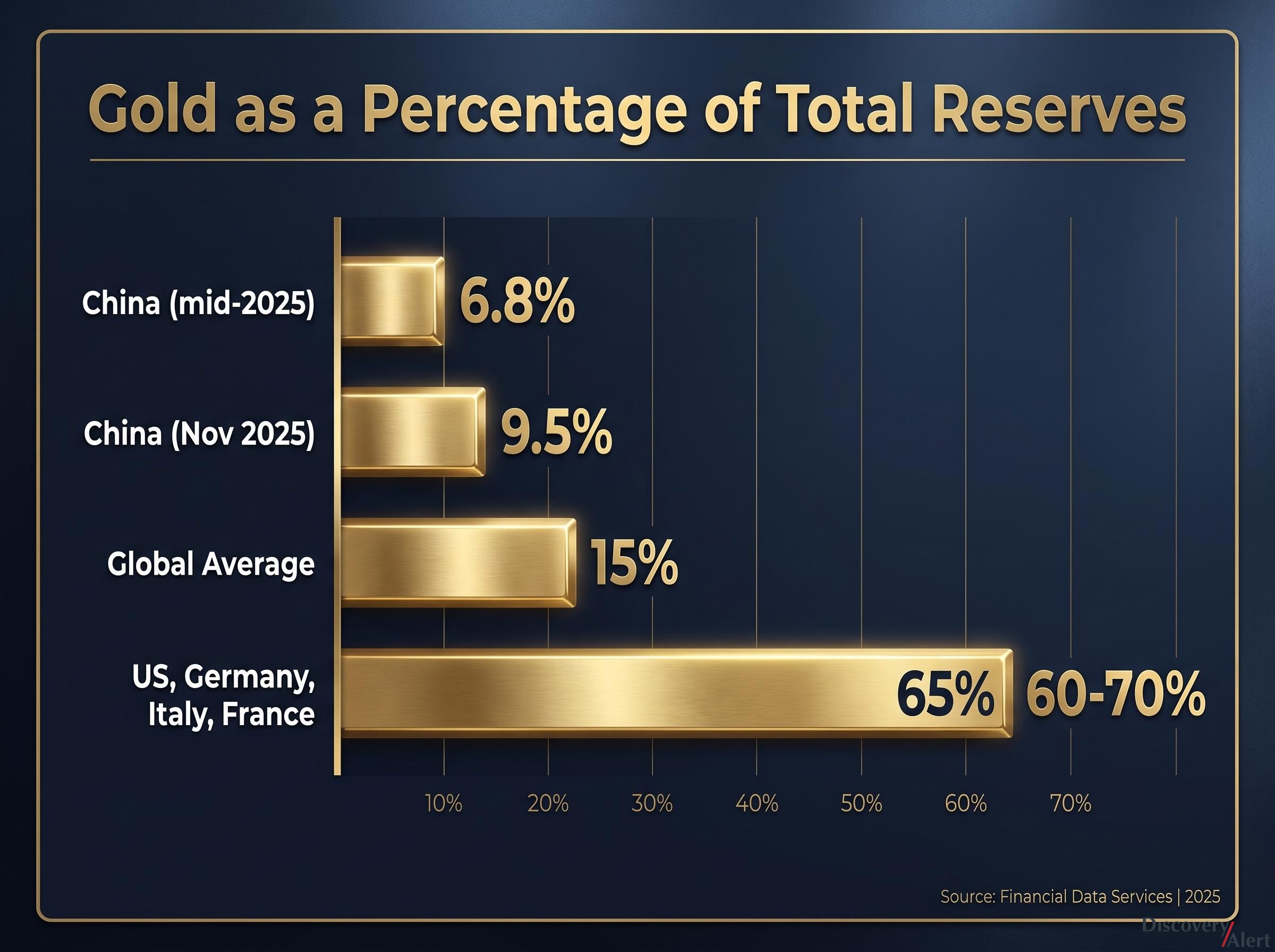
The global average sits at approximately 15%. The United States, Germany, Italy, and France hold gold at approximately 60-70% of total reserves.
World Gold Council central bank gold statistics confirm that the global average gold allocation sits at approximately 15% of total reserves, a benchmark that places China’s current sub-10% allocation well below both the global norm and the 60-70% range maintained by major Western reserve holders.
| Country / Bloc | Gold Holdings (Approx.) | Gold as % of Reserves | Notes |
|---|---|---|---|
| China (mid-2025) | ~2,300 tonnes | ~6.8% | Nine consecutive months of buying |
| China (Nov 2025) | Rising | ~9.5% | Continued accumulation |
| Global Average | Varies | ~15% | World Gold Council figure |
| US, Germany, Italy, France | Varies | ~60-70% | Western peer group range |
The gap is not a deficiency to be criticised. It is structural room to run.
If China were to move its gold allocation from approximately 9.5% toward the global average of 15%, the additional tonnes required would be substantial given the scale of China’s total reserve portfolio. This is illustrative, not a forecast, but it anchors the scale of potential demand. Even reaching half the distance to the global average would imply years of continued accumulation at the current programme’s pace, a demand volume that few other single buyers could replicate.
China’s buying is the largest single strand in a wider rewiring of how central banks globally think about reserve composition.
World Gold Council data for July 2025 showed multiple institutions simultaneously adding reserves:
Turkey’s appearance as a net buyer in July 2025 illustrates that distressed-seller dynamics are episodic rather than constant. Turkey has at times been a forced seller due to energy import financing needs, but the pattern is not continuous. Russia’s involuntary gold sales to fund imports when dollar reserves were frozen remain a well-established precedent for gold’s function as a spendable last-resort asset, though the timing of those sales has been episodic rather than steady.
The systemic implication is the one that matters most. As the world’s largest reserve manager runs a multi-year rebalancing programme, the marginal impact on gold’s supply-demand balance is structural, not cyclical. The programme does not reset each quarter.
Gold’s marginal buyer has shifted. The dominant source of incremental demand is no longer exchange-traded fund investors or speculative traders but sovereign reserve managers with decade-long investment horizons. That shift changes the market’s volatility profile.
The divergence between sovereign and retail demand is one of the most structurally significant features of recent gold markets: as ETF investors in Western markets reduced exposure through 2024, central banks absorbed the supply and then some, creating a demand base whose behaviour is fundamentally different from the momentum-driven flows that historically dominated gold price discovery.
For investors and market analysts, a sustained 21-month buying programme from the PBoC, operating within a wider central-bank accumulation trend, represents a qualitative shift in gold’s demand architecture.
Five reinforcing factors converge on the same conclusion:
The logic underpinning this programme has strengthened since its November 2024 restart. The Russia precedent remains vivid. Dollar-denominated reserve concentration remains high. The renminbi internationalisation project continues. None of the conditions that launched the programme have moderated.
For investors wanting to understand the longer arc of where this accumulation programme leads geopolitically and monetarily, our full explainer on China’s gold strategy and the dual-benchmark world examines how sustained reserve building connects to Beijing’s ambition of creating a parallel financial architecture in which gold-anchored settlement competes with the dollar-denominated system across trade, credit, and reserve allocation.
A structural reversal would require one of three conditions: a fundamental resolution of US-China geopolitical tensions that eliminated jurisdictional risk, a reform of the dollar system that removed the possibility of reserve asset restrictions, or China’s reserve portfolio already reaching global-average gold allocation.
None of these conditions is imminent. The programme’s price-responsive character makes it self-sustaining even through volatile price environments, buying less when gold is expensive, buying more when it corrects, and compounding across years.
China’s accumulation programme is a multi-year repositioning, not a trade. The 21-month streak with price-responsive design is the evidence that distinguishes it from cyclical central-bank buying. The allocation gap, still well below the global average and far below Western peers, leaves structural room for continued accumulation across years.
Sovereign reserve managers with decade-long horizons behave differently from fund flows and retail demand. Their presence changes the market’s drawdown profile, their buying architecture provides floors during corrections, and their cumulative demand compounds in ways that quarterly analysis tends to understate.
The question for markets is no longer whether China continues buying but at what pace. Even a deceleration from recent monthly volumes would leave the cumulative multi-year demand signal structurally intact.
This article is for informational purposes only and should not be considered financial advice. Investors should conduct their own research and consult with financial professionals before making investment decisions. These statements regarding the future trajectory of China’s gold programme are speculative and subject to change based on geopolitical developments and central-bank policy decisions.
China's gold buying programme refers to the People's Bank of China's uninterrupted monthly additions to its official gold reserves, which restarted in November 2024 and has now run for 21 consecutive months through July 2026, accumulating approximately 2,300 tonnes in total holdings.
China is buying gold to reduce concentration risk in dollar-denominated assets, support renminbi internationalisation credibility, and accumulate a reserve asset that cannot be frozen or restricted by foreign jurisdictions, a concern made concrete by Western sanctions on Russia's dollar reserves after 2022.
The PBoC uses a price-responsive, contrarian buying strategy, purchasing more aggressively when gold prices correct and slowing additions when prices spike, a design that reduces average acquisition cost and extends the programme's operational life across years.
China's gold allocation rose from approximately 6.8% of total reserves in mid-2025 to around 9.5% by November 2025, still well below the global average of 15% and far below the 60-70% range maintained by the United States, Germany, Italy, and France.
China's 21-month buying programme represents a structural shift in gold demand, with sovereign reserve managers replacing ETF investors and speculative traders as the dominant marginal buyers, creating a more stable demand base that provides a price floor during market corrections.


