
Saudi Aramco’s Exports Hold, but War-Risk Costs Tell a Darker Story
Aug 17, 2026


AbraSilver Resource Corp holds a distinction that no other developer-stage mining company in Argentina currently claims: federal RIGI approval, a designation otherwise shared with majors including Newmont, Barrick, Rio Tinto, Glencore, and BHP. Argentina’s RIGI regime (Law 27,742) is the country’s most ambitious attempt to reframe how institutional capital prices sovereign risk in one of the world’s most resource-rich but historically volatile mining jurisdictions. For investors, the question is whether this regulatory framework can credibly convert open-ended political risk into bounded legal exposure, and whether a junior developer can leverage that framework the same way a major can. This analysis unpacks what the Argentina RIGI framework actually delivers in legal and financial terms, how its phased incentive structure affects project finance modelling, and what AbraSilver’s USD $720 million financing strategy reveals about the practical investor calculus at the developer stage.
RIGI’s strongest promise is stability. For 30 years, qualifying projects receive locked-in rules on tax, customs, and foreign exchange, creating what legal commentary describes as a contract-like exposure rather than a general policy posture. The three categories of protection operate as follows:
Argentina’s official RIGI framework, established under Law 27,742 and published by the national government, sets out the full eligibility criteria, SPV structuring requirements, and phased incentive schedule that determine which projects qualify for 30-year stability guarantees across tax, customs, and foreign exchange.
RIGI is framed in legal and policy commentary as a “system of protection of vested rights,” where subsequent legislation cannot worsen conditions for the project’s Special Purpose Vehicle (SPV) without triggering compensation obligations or legal challenge avenues.
That framing matters. It means RIGI does not eliminate Argentine sovereign risk. It converts it from an unpredictable operating variable into a defined legal exposure with known parameters. The regime sits within Argentina’s constitutional framework, not above it. The state retains powers in areas outside the regime’s specific scope, and the effectiveness of protections ultimately depends on judicial enforcement and political adherence over a 30-year horizon. For investors and lenders pricing Argentine jurisdiction risk, the distinction between “risk eliminated” and “risk bounded and defined” has direct implications for discount rates and deal structuring.
The global project rush in critical minerals, accelerated by copper and silver price dynamics in 2026, is intensifying competition for construction finance between jurisdictions, making RIGI’s stability guarantees more differentiated as a capital-attraction mechanism than they would be in a lower-price environment.
RIGI’s benefits do not arrive all at once. They operate on a sequenced timeline of milestones, and this distinction is material for anyone building debt-service or streaming models around an Argentine mining project.
Import duty exemptions on capital equipment and inputs apply from the outset of the approved project, making them relevant to the construction phase. Export-duty elimination and FX liberalisation, however, are phased into the production years.
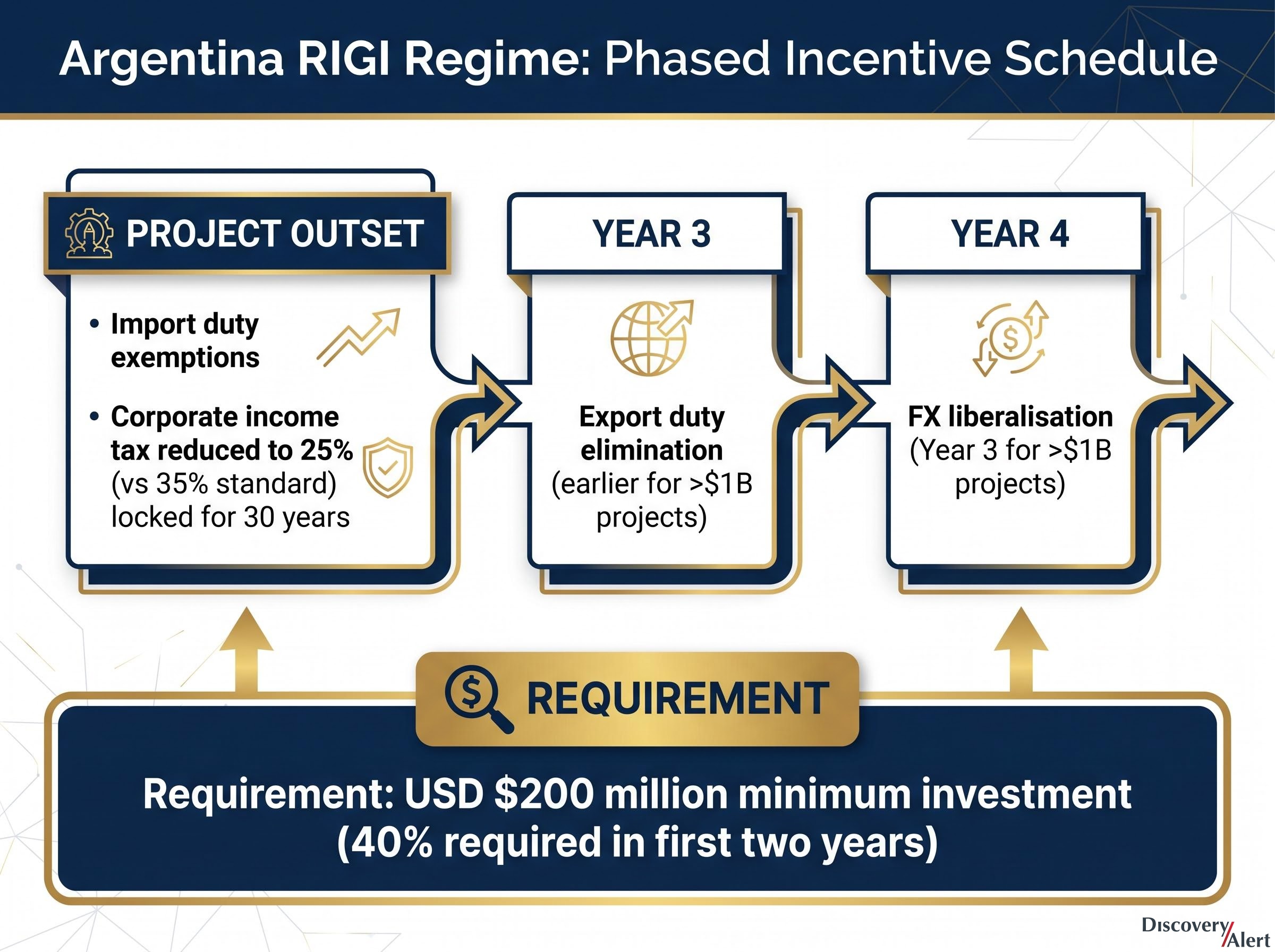
| Incentive Type | Applies From | Condition | Relevance to Finance Modelling |
|---|---|---|---|
| Import duty exemptions | Project outset | Capital equipment and inputs for SPV | Construction-phase cost reduction |
| Export duty elimination | Approximately year 3 | Standard timeline; earlier for projects exceeding USD $1 billion | Netback pricing improvement at early production |
| FX liberalisation | Year 4 (year 3 for projects over USD $1 billion) | Lifting of export-proceeds conversion obligation | Repatriation modelling and dividend cash flows |
| Corporate income tax reduction | Project approval | 25% rate locked for 30 years | After-tax cash-flow projections across mine life |
The minimum investment threshold is USD $200 million, with at least 40% of that amount required to be deployed in the first two years.
Import duty exemptions reduce capital costs during construction, when cash is flowing out and revenue has not yet begun. Export-duty elimination and FX liberalisation, by contrast, affect the production phase: they improve netback pricing and determine when export proceeds can be freely repatriated. For lenders structuring debt-service covenants, the year-3 and year-4 milestones are the key inflection points. They align reasonably well with the typical ramp-up cash-flow profile of a large mining project, where early-production revenue recognition begins to service construction-phase obligations.
RIGI’s eligibility criteria focus on project characteristics and SPV structure rather than corporate identity or balance sheet size. The conditions are:
Because these criteria attach to the project rather than the sponsor, a developer-stage junior with a sufficiently large, well-structured project can access the same stability guarantees as a multinational major. The initial two-year entry window for RIGI applications has already been extended once, giving developers currently in permitting additional time to structure their applications.
The core analytical insight for investors evaluating junior developers in Argentina: RIGI approval is a project-level credential, not a corporate-tier credential. This distinction reframes how due diligence should be conducted on developer-stage Argentine assets.
The Diablillos silver-gold project, located across the Salta and Catamarca provinces, has assembled a full regulatory approval stack: Salta provincial environmental approval (received April 2026), Catamarca provincial environmental approval (received June 2026), and federal RIGI approval (received February 2026). That combination positions the project as one of the most fully permitted development-stage assets in Argentina’s current pipeline.
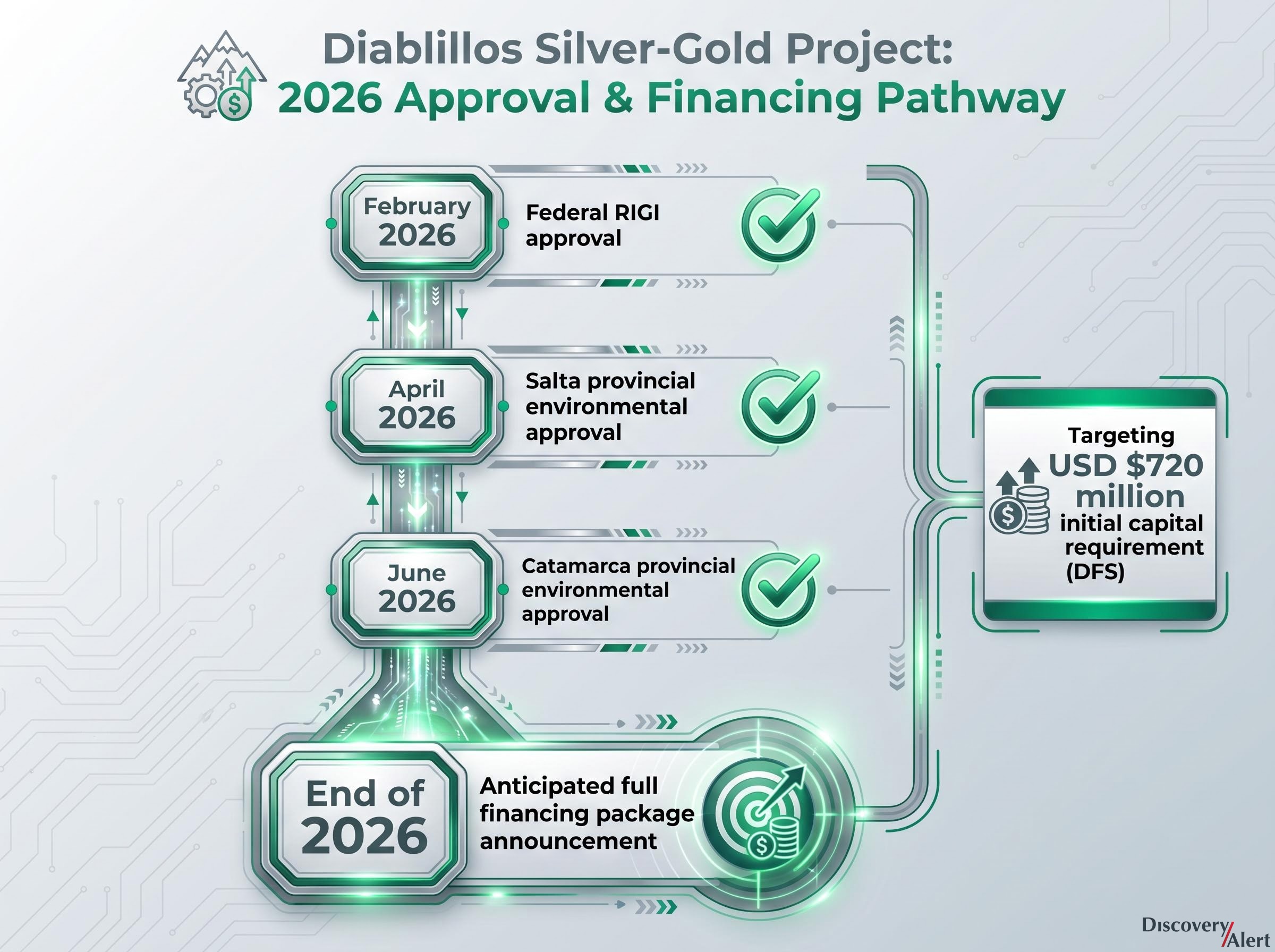
The Definitive Feasibility Study (DFS) established an initial capital requirement of USD $720 million. To fund it, AbraSilver is pursuing a three-instrument financing approach: term project finance debt, a silver or gold streaming arrangement, and additional equity. This diversified structure is consistent with standard mining project finance practice for projects of this scale and jurisdiction complexity.
The EXIM Bank financing restoration for Argentine mining and energy exports adds a further layer of institutional validation to the jurisdiction’s investability case, providing project sponsors with an additional potential source of construction-phase capital beyond commercial debt and streaming.
In July 2026, the company closed a CAD $50 million equity raise that was oversubscribed, with total investor demand exceeding the offering cap. The terms reveal deliberate balance-sheet positioning:
| Instrument | Role | Status | Function |
|---|---|---|---|
| Equity raise (CAD $50M) | Balance-sheet strengthening | Closed July 2026, oversubscribed | Negotiating leverage for construction financing |
| Project finance debt | Primary construction capital | Under active discussion | Term lending against RIGI-stabilised cash flows |
| Streaming arrangement | Non-dilutive capital | Under active discussion | Silver/gold stream against production profile |
| Additional equity | Residual funding | To be determined | Potential strategic or institutional participation |
The raise was priced at CAD $14.70 per share with less than 2% dilution. Pre-financing cash stood at approximately CAD $20 million; post-financing, approximately CAD $70 million. Kinross Gold exercised its contractual participation right to maintain its 4% stake, and Helion, a London-based fund and AbraSilver’s largest institutional shareholder, also participated. Helion holds over 10% of shares outstanding.
An oversubscribed equity raise at the developer stage, in a frontier jurisdiction, with less than 2% dilution: for investors assessing project risk, the demand profile itself is data.
A full financing package announcement is anticipated by end of 2026.
Kinross Gold’s decision to exercise its contractual participation right was not passive portfolio maintenance. A senior gold producer choosing to maintain exposure to a developer-stage Argentine asset, at a moment when it could have allowed its position to dilute, carries meaning beyond the 4% stake itself. It suggests ongoing strategic optionality, the kind of positioning a major maintains when a project remains within its forward planning horizon.
Helion’s continued participation as the largest institutional shareholder, holding over 10% of shares outstanding, signals conviction from a London-based fund with a global mining mandate. This is not a passive index allocation. It reflects an active decision to increase absolute exposure to a developer-stage project pursuing USD $720 million in construction finance within a complex jurisdiction.
When institutional demand exceeds the offering cap at a project-stage company operating in Argentina, the signal extends beyond the individual company. It suggests that the post-RIGI Argentine mining jurisdiction is attracting capital commitments from credible institutional actors, not just speculative positioning. The distinction matters: project-specific enthusiasm and broader Argentine investability sentiment are separate variables, but AbraSilver’s oversubscribed raise provides a data point on both.
Institutional capital allocation to mining at the developer stage reflects a structural thesis about long-cycle supply gaps, and the same logic that underpins large-scale portfolio commitments from specialist funds also explains why London-based mandates like Helion are willing to hold concentrated positions in frontier-jurisdiction projects ahead of construction finance close.
It should be noted that AbraSilver management describes the company as the only developer-stage RIGI holder; this claim has not been independently verified.
RIGI’s core value for investors is precision. It does not eliminate Argentine sovereign risk, but it converts that risk from an undefined, ongoing exposure into a bounded, legally parameterised one with known milestones and enforceable protections.
RIGI converts sovereign risk from an unpredictable operating variable into a defined legal exposure with known parameters. For investors, the question shifts from “will Argentina change the rules?” to “are the legal protections enforceable if it does?”
The residual risk variables that RIGI does not address remain material: judicial enforcement capacity over a 30-year horizon, political adherence across multiple administrations, and the distinction between legal entitlement and practical enforceability. These are not eliminated by RIGI; they are bounded by it.
Argentina’s critical minerals framework has attracted renewed international attention beyond RIGI itself, with bilateral agreements shaping how foreign capital, including U.S. institutional flows, is being routed into Argentine resource development at the sovereign level.
Investors evaluating any RIGI-approved project should structure their due diligence around these questions:
RIGI’s architecture is a credible and structurally sound mechanism for reframing Argentine mining jurisdiction risk. The Diablillos case illustrates what successful early execution looks like at the developer stage: full provincial and federal permits secured, a financing structure aligned with the regime’s phased incentive schedule, and institutional capital willing to commit at a stage where execution risk remains high.
Open questions remain. The full financing package announcement, anticipated by end of 2026, will be the next material signal. Lender and streamer commitment to the construction-phase capital stack will function as the definitive test of whether RIGI’s stability guarantees translate into tangible financing-market access for developer-stage projects. RIGI’s opt-in period has already been extended once; developers still in permitting who are evaluating the regime should factor timeline risk into their structuring decisions.
Investors following the Argentine mining sector should track AbraSilver’s year-end 2026 financing announcement as a live test case for RIGI’s practical effect on construction-finance market access for developer-stage projects.
This article is for informational purposes only and should not be considered financial advice. Investors should conduct their own research and consult with financial professionals before making investment decisions. Forward-looking statements regarding financing timelines, project economics, and regulatory outcomes are subject to change based on market developments and company performance.
Argentina's RIGI regime (Law 27,742) provides qualifying mining projects with 30-year stability guarantees across tax, customs, and foreign exchange rules, converting unpredictable sovereign risk into a bounded legal exposure with defined parameters and known enforcement mechanisms.
Projects must meet a minimum investment threshold of USD $200 million, with at least 40% of that amount required to be deployed within the first two years of the approved project.
Import duty exemptions apply from the construction phase outset, while export-duty elimination and foreign exchange liberalisation are phased in around years 3 and 4, meaning lenders must model debt-service covenants around those production-phase inflection points rather than assuming immediate full benefits.
RIGI eligibility attaches to the project and its SPV structure rather than the corporate sponsor's size or balance sheet, meaning a developer-stage junior with a sufficiently large and well-structured project can access the same 30-year stability guarantees as a multinational major.
AbraSilver closed a CAD $50 million raise in July 2026 that was oversubscribed with less than 2% dilution, with participation from Kinross Gold and London-based institutional fund Helion, suggesting that credible institutional capital is making active commitments to post-RIGI Argentine mining projects rather than purely speculative positions.


