
Saudi Aramco’s Exports Hold, but War-Risk Costs Tell a Darker Story
Aug 17, 2026


India’s mineral royalty revenues to states grew more than 301% between 2016-17 and 2021-22, climbing from approximately Rs 9,695.88 crore to a provisional Rs 38,840.48 crore. A bill that passed both houses of Parliament within 72 hours in August 2026 is now positioned to cap that trajectory permanently.
The MMDR Amendment Bill 2026 passed Lok Sabha on 12 August and Rajya Sabha on 13 August, awaiting Presidential assent as of 14 August 2026. Its core mechanism, a new Section 9D inserted into the Mines and Minerals (Development and Regulation) Act 1957, prohibits states from imposing any tax, cess or levy on mineral rights or mineral-bearing lands outside conditions prescribed by the Centre. It represents the most significant shift in India’s mineral fiscal architecture in decades, arriving precisely as the country attempts to mobilise private capital into critical minerals to reduce dependence on China.
This analysis unpacks what the bill actually does legally, why mineral-rich states stand to lose fiscal autonomy even without losing royalty inflows, what it means for investors carrying legacy state levy exposure, and whether fiscal standardisation alone can close the gap between India’s critical minerals ambitions and China’s entrenched supply chain dominance.
The bill’s central legal instrument is the insertion of Section 9D into the MMDR Act. The prohibition it creates is specific and broad simultaneously.
The MMDR Act 1957 consolidated framework establishes the constitutional basis under which the Centre holds primary regulatory authority over mines and mineral development, with states operating within the boundaries that framework defines, a relationship Section 9D now exploits to cap state levy discretion.
No tax, cess or other levy “by whatever name called” may be imposed by a state government on mineral rights or mineral-bearing lands, whether based on mineral quantity, mineral value, royalty payable or any other basis, except in accordance with conditions prescribed by the Central government.
That language does two things at once. It strips states of the authority to design, impose or raise mineral-related charges unilaterally. It also defers the determination of what states can charge to future central rules, meaning the bill does not set a national levy ceiling or rate. It creates the framework within which the Centre’s subordinate legislation will later determine the economics.
Amendments to Section 13 grant the Central government the rule-making power to specify those conditions and restrictions. The bill also introduces several companion provisions:
| Event | Date |
|---|---|
| Bill introduced in Lok Sabha | 10 August 2026 |
| Lok Sabha passage | 12 August 2026 |
| Rajya Sabha passage | 13 August 2026 |
| Status | Awaiting Presidential assent |
Investors and state governments are currently operating on incomplete readings of this bill. Knowing precisely what Section 9D does, and what it deliberately leaves to future rulemaking, is the prerequisite for any accurate assessment of fiscal exposure.
The MMDR Amendment mechanics behind Section 9D sit within a broader legal architecture that has been reshaped repeatedly since the MMDR Act’s 1957 origins, and tracing those layers clarifies why the Centre’s rule-making powers under Section 13 carry more practical weight than the bill’s headline prohibition.
The revenue numbers establish the stakes.
Royalty accruals from minerals flowing to states rose from approximately Rs 9,695.88 crore in 2016-17 to roughly Rs 38,840.48 crore (provisional) in 2021-22, a 301% increase over five years.

States with the greatest exposure include Odisha, Jharkhand, Chhattisgarh and Rajasthan, which host major iron ore, coal and bauxite deposits. Many of these states have embedded mineral revenue flows into medium-term fiscal planning, including infrastructure and social sector spending.
Coal offtake volumes hitting record levels in mid-2026 add a demand-side dimension to the royalty revenue story: states whose fiscal projections embed mineral royalty growth will find that projection more credible when extraction and dispatch activity is accelerating, but that same growth trajectory is now what the Centre is seeking to standardise and capture under a unified framework.
| State | Primary Minerals | Fiscal Exposure |
|---|---|---|
| Odisha | Iron ore, coal, bauxite | High |
| Jharkhand | Coal, iron ore | High |
| Chhattisgarh | Iron ore, coal | High |
| Rajasthan | Zinc, lead, limestone | Medium |
The central government’s stated position is that excessively high royalty obligations can suppress extraction, make operations unviable and force mine closures. That framing positions centralisation as a corrective. Monalisa Nanda of the NFPRC Foundation noted that standardised taxation could enhance investor confidence and potentially compensate for reduced state revenue through higher long-term investment volumes.
The picture is simultaneously more reassuring than critics suggest and more constraining than the government admits.
The bill cuts in two directions at once. Any state levy on mineral rights or mineral-bearing lands that was imposed but not paid or recovered before the amendment comes into force is deemed invalid. That constitutes a retroactive nullification of unpaid dues in favour of mining companies.
Amounts already deposited or recovered by states before commencement will not be refunded. Companies cannot claw back past payments, but pending demands are extinguished.
The prospective constraint is the more consequential mechanism. States lose the discretion to design new cesses or charges, or raise existing ones, outside conditions prescribed by the Centre. Their future revenue growth from add-on mineral levies is structurally capped, even if absolute royalty inflows remain stable in the short term.
The investor problem the bill solves is real and specific. Until now, mining companies faced a patchwork of state taxes and cesses that could change via state finance acts, generating large back-dated demands and litigation. Section 9D eliminates previously imposed but unpaid state levies, removing legacy liability and contingent risk from company balance sheets immediately upon commencement.
The risk premium attached to state-level regulatory surprise should fall, improving project net present values and hurdle-rate calculations. That is genuine progress.
It is also incomplete.
Section 9D creates the architecture; the Centre’s subordinate legislation will determine the economics. Three open questions will define whether this bill delivers fiscal competitiveness or merely fiscal tidiness:
Investors evaluating long-life projects in iron ore, coal and base metals should track draft and final rules under both Section 9D and Section 13 as the critical near-term catalysts. The comparator benchmark is not the pre-bill Indian regime; it is the total government take in Indonesia, Australia and African mining jurisdictions.
The Centre holds established constitutional authority over the regulation of mines and mineral development. That legal ground is firm. Implementation, however, requires state-level execution.
Projects are built on state territory. They require cooperation on land acquisition, local clearances, environmental management and public order. States that perceive the bill as a unilateral revenue encroachment retain non-legal tools to resist:
Legal authority does not guarantee smooth implementation. States that feel fiscally diminished have administrative levers the bill cannot reach.
Monalisa Nanda acknowledged that the Centre has historically held ultimate authority in this domain but noted the importance of demonstrating that higher investment volumes under the new regime could yield more total royalty revenue than the fragmented status quo. Without that demonstrated bargain, the risk is subtle resistance: slower clearances, more local disputes, less political support for projects that require active state facilitation.
For global investors, cooperative federalism risk is a practical project-level concern. Even legally resolved fiscal disputes can be replaced by harder local negotiations if state governments feel that the Centre has acted unilaterally at their expense.
The bill is framed as a fiscal standardisation measure, not a critical minerals bill. Its effect on graphite, nickel, lithium and cobalt is indirect, mediated through the investment climate rather than through any preferential treatment of those minerals.
Pranati Chestha Kohli, Public Affairs Head at Lohum, raised concerns about whether the bill effectively strengthens India’s strategic position in critical minerals, particularly given China’s continued dominance of the global mineral supply chain.
That concern reflects a structural gap the bill cannot close. China’s competitive strength rests on an integrated strategy: state-backed exploration, aggressive overseas acquisitions, refining and processing capacity, logistics control and downstream manufacturing. A single fiscal standardisation bill does not address any of those dimensions.
India’s rare earth magnet strategy, backed by a Rs 7,280 crore scheme targeting China’s dominance of permanent magnet production, illustrates the kind of downstream processing investment this bill is meant to catalyse upstream; the contrast between that targeted industrial policy and the MMDR Amendment’s indirect approach reveals how much work remains beyond fiscal standardisation alone.
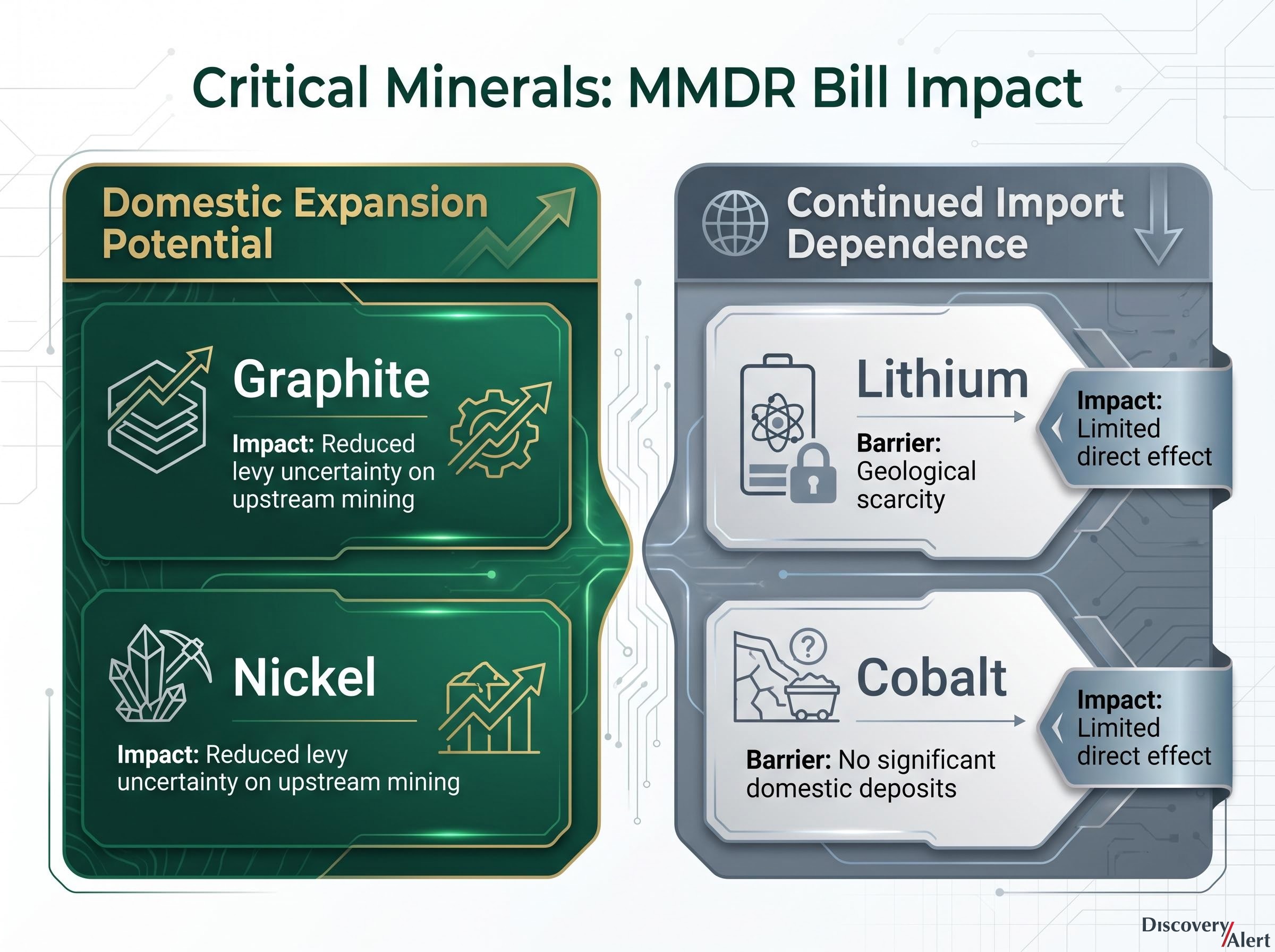
| Critical Mineral | Domestic Supply Outlook | Bill’s Direct Effect | Remaining Barriers |
|---|---|---|---|
| Graphite | Potential for expanded domestic production | Reduced levy uncertainty on upstream mining | Processing capacity, infrastructure |
| Nickel | Potential for expanded domestic production | Reduced levy uncertainty on upstream mining | Refining capacity, approval timelines |
| Lithium | Continued import dependence expected | Limited; supply chain remains international | Geological scarcity, processing gaps |
| Cobalt | Continued import dependence expected | Limited; supply chain remains international | No significant domestic deposits, recycling dependence |
Companies in battery materials and recycling need to assess this bill in its correct scope: it is a fiscal housekeeping measure with supply chain implications, not a comprehensive critical minerals strategy. Graphite and nickel producers stand to benefit most directly from improved domestic investment conditions. Lithium and cobalt supply chains will remain heavily dependent on international sourcing and recycling in the near term.
The bill resolves legacy state levy risk for investors, constrains state fiscal autonomy in ways that create political friction, and improves one necessary condition for critical minerals investment without addressing the structural ecosystem gaps. That is a meaningful but bounded reform.
Its eventual impact will be determined by three categories of decisions that have not yet been made, and investors should monitor them in sequence:
The complementary policy areas the bill does not address but that are required to complete India’s critical minerals ecosystem include:
Deepwater mineral exploration backed by the Rs 84,084 crore Samudra Manthan programme represents the frontier of India’s resource mobilisation agenda, one where the MMDR Act’s onshore royalty framework does not apply and where the Centre has chosen to deploy direct state investment rather than rely on fiscal standardisation to attract private capital.
The bill is a necessary condition. It is not a sufficient one. What the Centre writes into its rules, how states respond, and whether complementary policies follow will determine whether this legislative sprint produces lasting reform or merely a tidier version of the status quo.
This article is for informational purposes only and should not be considered financial advice. Investors should conduct their own research and consult with financial professionals before making investment decisions. Forward-looking assessments of legislative impact are subject to change based on regulatory developments and political conditions.
Section 9D is a new provision inserted into India's Mines and Minerals (Development and Regulation) Act 1957 by the MMDR Amendment Bill 2026; it prohibits state governments from imposing any tax, cess or levy on mineral rights or mineral-bearing lands except under conditions prescribed by the Central government.
The bill retroactively deems invalid any state mineral levy that was imposed but not yet paid or recovered before the amendment comes into force, effectively extinguishing pending demands on company balance sheets, though amounts already deposited by states before commencement will not be refunded.
Odisha, Jharkhand, Chhattisgarh and Rajasthan face the highest fiscal exposure because they host major iron ore, coal, bauxite, zinc and lead deposits and have historically embedded mineral royalty revenues into medium-term fiscal planning.
No; the bill is a fiscal standardisation measure that improves the general investment climate rather than targeting specific critical minerals, and its direct effect on lithium and cobalt supply chains is limited because India remains heavily import-dependent for those materials regardless of domestic levy rules.
Investors should track the draft and final rules issued by the Centre under Section 9D and Section 13, which will set the actual levy conditions and ceilings, as well as political and administrative responses from major mining states like Odisha and Jharkhand that could affect practical project timelines.


