
Kuniko Extends Silica Hill Gold-Silver System 100m Beyond Current Resource Model

Kuniko extends high-grade Silica Hill system by 100m with Phase 2 drilling
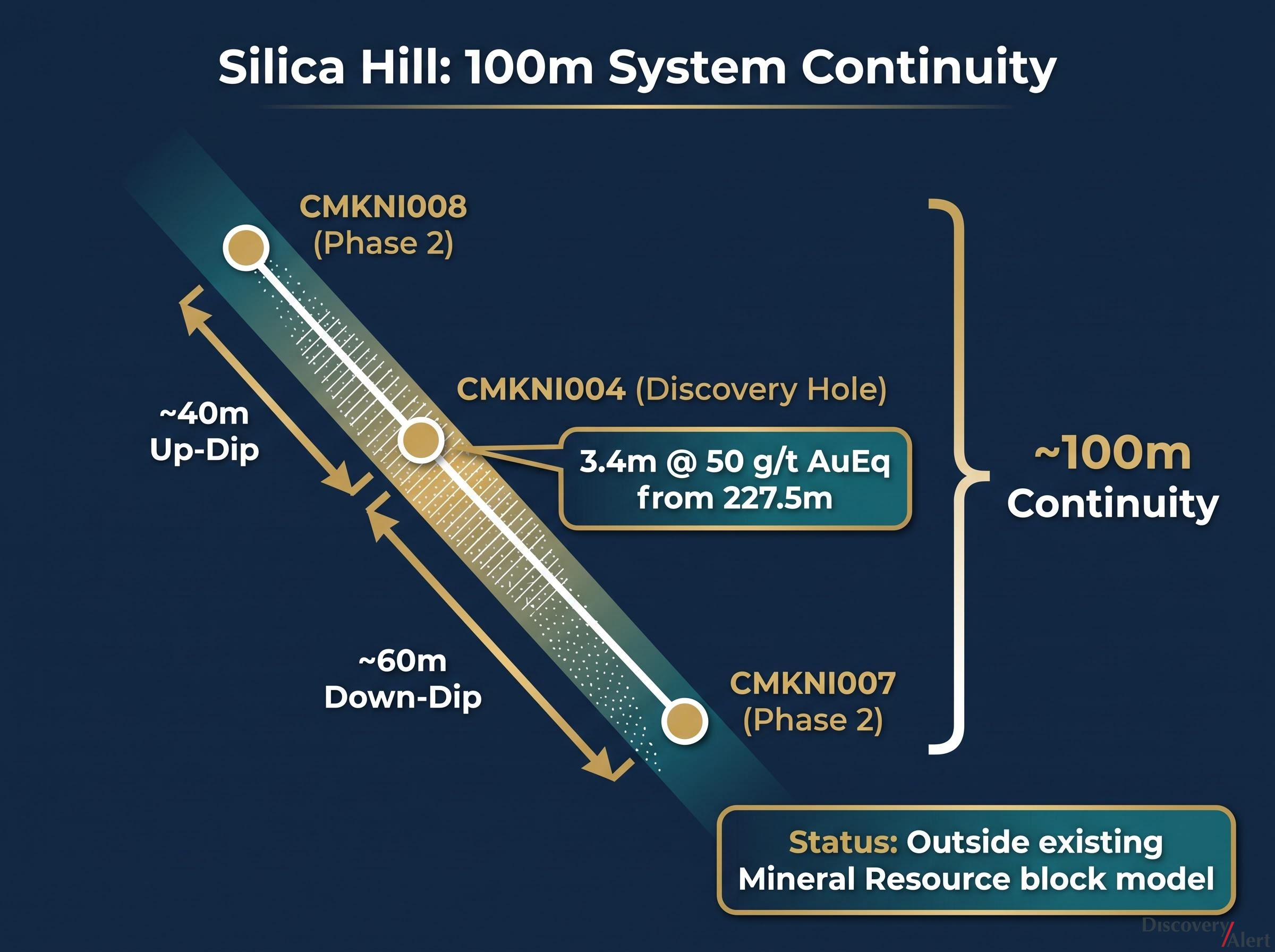
Kuniko Limited has completed two diamond holes totalling 724m at its Silica Hill prospect, extending the mineralised system first intersected in Phase 1 hole CMKNI004. The two new holes, CMKNI007 and CMKNI008, have demonstrated approximately 100m of up-dip to down-dip continuity of the high-grade system. Critically, all three holes sit outside the existing mineralised block model, highlighting potential for resource growth ahead of a planned Project Mineral Resource Estimate (MRE) update. Assays for the two Phase 2 holes are pending, with results expected in September.
The Commonwealth Project sits within the Lachlan Fold Belt in New South Wales, a Tier-1 mining jurisdiction hosting major operations including Cadia–Ridgeway, Northparkes and Cowal.
When big ASX news breaks, our subscribers know first
What the Phase 2 drilling has revealed
CMKNI007 drilled approximately 60m down-dip and CMKNI008 approximately 40m up-dip of the Phase 1 discovery hole CMKNI004. Both holes intersected alteration, disseminated sulphides and sulphide-bearing stringer and stockwork veining consistent with the mineralisation observed in CMKNI004. Both holes also crossed the interpreted reverse fault, supporting the geological model that mineralisation has been displaced downwards across the structure.
The mineralised system remains open up-dip, down-dip and laterally. Together with CMKNI004, the three holes define approximately 100m of up-dip to down-dip continuity within an area that lies outside the existing Mineral Resource block model, providing scope for further expansion with additional drilling.
The benchmark to beat — CMKNI004
Phase 2 drilling was designed to test the continuity of mineralisation intersected in CMKNI004. That hole returned 3.4m @ 50 g/t AuEq (4.1 g/t Au, 2,947 g/t Ag, 0.3% Pb and 0.6% Zn) from 227.5m, including a 0.5m massive sulphide vein @ 347 g/t AuEq (20,603 g/t Ag, 27 g/t Au, 1.5% Pb and 3.3% Zn). This high-grade intercept represents the target zone the Phase 2 holes aimed to extend.
It is important to note these are assay results from CMKNI004. Assays for CMKNI007 and CMKNI008 are not yet available.
Visual sulphide observations (assays pending)
Preliminary logging has identified multiple sulphide-bearing zones in both holes. In CMKNI007, an initial zone of sulphide-bearing veining was intersected at approximately 205–215m downhole, followed by a broader zone of sulphide-bearing stringer and stockwork veining from approximately 260–315m downhole within silica-sericite altered rhyolite porphyry. This zone transitioned into increasingly sphalerite-rich veining between approximately 295–345m downhole.
CMKNI008 intersected patchy sulphide mineralisation in the upper portions of the hole before entering a broader zone of sulphide-bearing stringer and stockwork veining from approximately 280–325m downhole, also hosted within silica-sericite altered rhyolite porphyry. This interval includes zones of increased sphalerite and galena veining.
| Hole ID | Interval (From–To m) | Est. Total Sulphide % | Dominant Observation |
|---|---|---|---|
| CMKNI007 | 205–215 | 2 | Disseminated and stringer sulphides within rhyolite porphyry |
| CMKNI007 | 240–250 | 1–2 | Patchy disseminated and stringer sulphides within rhyolite porphyry |
| CMKNI007 | 260–290 | 2–3 | Disseminated and stringer-stockwork sulphides within silica-sericite altered rhyolite porphyry |
| CMKNI007 | 290–310 | 3–5 | Increased sulphide-bearing stringer and stockwork veining within silica-sericite altered rhyolite porphyry |
| CMKNI007 | 310–320 | 2–3 | Increased sphalerite-galena stringer veining within altered rhyolite porphyry |
| CMKNI007 | 325–330 | 3–5 | Strong sulphide-bearing vein/stringer zone within altered rhyolite porphyry |
| CMKNI007 | 345–350 | 3–5 | Sphalerite-galena-rich veining within altered rhyolite porphyry |
| CMKNI008 | 280–295 | 3–5 | Disseminated and stringer-stockwork sulphides within silica-sericite altered rhyolite porphyry |
| CMKNI008 | 295–315 | 2 | Disseminated and stringer sulphides within silica-sericite altered rhyolite porphyry |
| CMKNI008 | 315–325 | 3–5 | Increased sphalerite-galena stringer veining within altered rhyolite porphyry |
| CMKNI008 | 335–340 | 2–3 | Sphalerite-bearing stringer veining within altered rhyolite porphyry |
Note: These are visual estimates only and are not a substitute for laboratory assays. Visual estimates provide no information regarding grades or deleterious physical properties relevant to economic assessment.
Understanding VMS and epithermal gold-silver systems
The Commonwealth Project hosts two genetically related deposit styles located within 200m of each other. Commonwealth Main and Commonwealth South represent a polymetallic volcanogenic massive sulphide (VMS) system characterised by high-grade gold, silver and zinc mineralisation, including massive sulphide lenses with strong base metal credits. Silica Hill hosts an epithermal stockwork vein system with high-grade silver mineralisation, featuring abundant silver sulphosalts and broad zones of disseminated and stringer sulphides.
The significance of drilling continuity outside the existing block model lies in resource growth potential. When mineralisation extends beyond the currently defined resource boundary without moving to a new exploration area, it can expand the resource footprint through infill drilling rather than requiring step-out discovery. This reduces technical risk and accelerates the pathway to resource expansion.
The Commonwealth Project sits within the Lachlan Fold Belt, a Tier-1 mining region hosting operations such as Cadia–Ridgeway (Newmont), Northparkes and Cowal (both Evolution Mining). The Project sits immediately along trend from Alkane’s Boda-Kaiser porphyry copper-gold deposit, which contains over 10 million ounces of gold equivalent.
Why this matters for the investment case
The Phase 2 drilling results position Kuniko for a near-term resource growth catalyst. All three holes at Silica Hill, CMKNI004, CMKNI007 and CMKNI008, lie outside the existing Mineral Resource block model. Demonstrating 100m of continuity in this area ahead of a planned Project MRE update provides a foundation for resource expansion without requiring new discovery.
CMKNI007 is planned to be PVC-cased to facilitate future downhole electromagnetic (DHEM) surveying. This technique can identify conductive sulphide mineralisation beyond the immediate drill intercepts, providing an additional vector for upside beyond what has been intersected to date.
Maja McGuire, Managing Director
“The first two holes of our Phase 2 drilling program have delivered an encouraging start at Silica Hill, with both holes intersecting the targeted zones of alteration, disseminated sulphides and stringer-vein mineralisation. Importantly, drilling has now demonstrated approximately 100m of continuity across CMKNI007, CMKNI004 and CMKNI008, with all three holes located outside the existing mineralised block model. This provides a compelling opportunity to expand the known Silica Hill mineralised footprint. With assays pending, the potential for these extensions to add scale and high-grade mineralisation to the Silica Hill system is an important near-term catalyst for Kuniko as we progress towards an updated Project MRE.”
The next major ASX story will hit our subscribers first
What’s next for Kuniko
Kuniko’s near-term exploration program is focused on multiple fronts across the Commonwealth Project:
- A further infill hole is currently drilling across upper portions of the Silica Hill system.
- Assays for CMKNI007 and CMKNI008 are expected in September.
- Drilling to test down-dip continuity at Main Shaft, where CMKNI001 previously returned 8.0m @ 8.6 g/t AuEq (3.3 g/t Au, 186 g/t Ag, 5.6% Zn, 2.2% Pb and 0.12% Cu) from 94.7m.
- Drilling to test extensions at Commonwealth South, where previous drilling returned 7.1m @ 9.7 g/t AuEq (8.4 g/t Au, 42 g/t Ag, 1.5% Zn and 0.7% Pb) from CMKNI006.
- Regional targeting is underway to define additional drill targets within approximately 1–2km of Commonwealth and Silica Hill, with selected prospects planned for drill testing in the near future.
- Following completion of drilling and receipt of all outstanding assays, Kuniko plans to complete an updated Project MRE.
The September assay results for CMKNI007 and CMKNI008, together with the planned Project MRE update, represent the key value inflection points for investors to monitor.
Don’t Miss the Next ASX Gold-Silver Discovery
Join 30,000+ investors receiving FREE breaking ASX mining news within minutes of release, complete with in-depth analysis. Discovery Alert delivers real-time alerts covering gold, copper, lithium and energy stocks the moment announcements hit the market. Click the “Free Alerts” button to stay ahead on the next potential breakout.