
Aramco Targets Europe With Deeper-Than-Expected Crude Price Cut
Aug 17, 2026


Newmont has committed up to US$30 million to earn a 75% interest in Headwater Gold’s Jupiter project, a district-scale epithermal gold target in Nevada’s Walker Lane belt. Announced on 13 August 2026, the staged earn-in agreement marks the third Nevada collaboration between the world’s largest publicly listed gold producer and the Canadian junior explorer, extending a partnership model already tested at Spring Peak and Lodestar. The deal gives Newmont option-like exposure to a 28 sq. km alteration system in Nye County that prior operators explored only intermittently over four decades, while Headwater retains operatorship, fee income, and a life-of-mine royalty without bearing the capital burden of grassroots drilling. What follows is a breakdown of the deal mechanics, the geological thesis behind Jupiter, and the forward milestones that will determine whether the agreement delivers on its promise.
Newmont’s path to 75% ownership at Jupiter unfolds across three discrete stages, each requiring a progressively larger capital commitment and each representing a point at which the major can walk away without further obligation.
The initial commitment is modest: US$2.5 million in exploration spending over the first 24 months, plus a US$250,000 reimbursement to Headwater for prior expenditures on the property. From there, Newmont may earn 51% by funding a total of US$10 million in exploration within 48 months. A second stage allows Newmont to increase its stake to 65% by spending an additional US$20 million over three years from Stage 2 commencement. The final step, to 75%, requires delivery of a prefeasibility study (PFS) outlining a minimum resource of 1.5 million ounces gold-equivalent (AuEq), along with the grant of a 2% net smelter return (NSR) royalty to Headwater.
The total earn-in value, approximately US$30 million (roughly C$42 million), is a ceiling, not a guaranteed outlay. Each stage functions as a purchased option: Newmont advances only if geological evidence warrants the next tranche of capital.
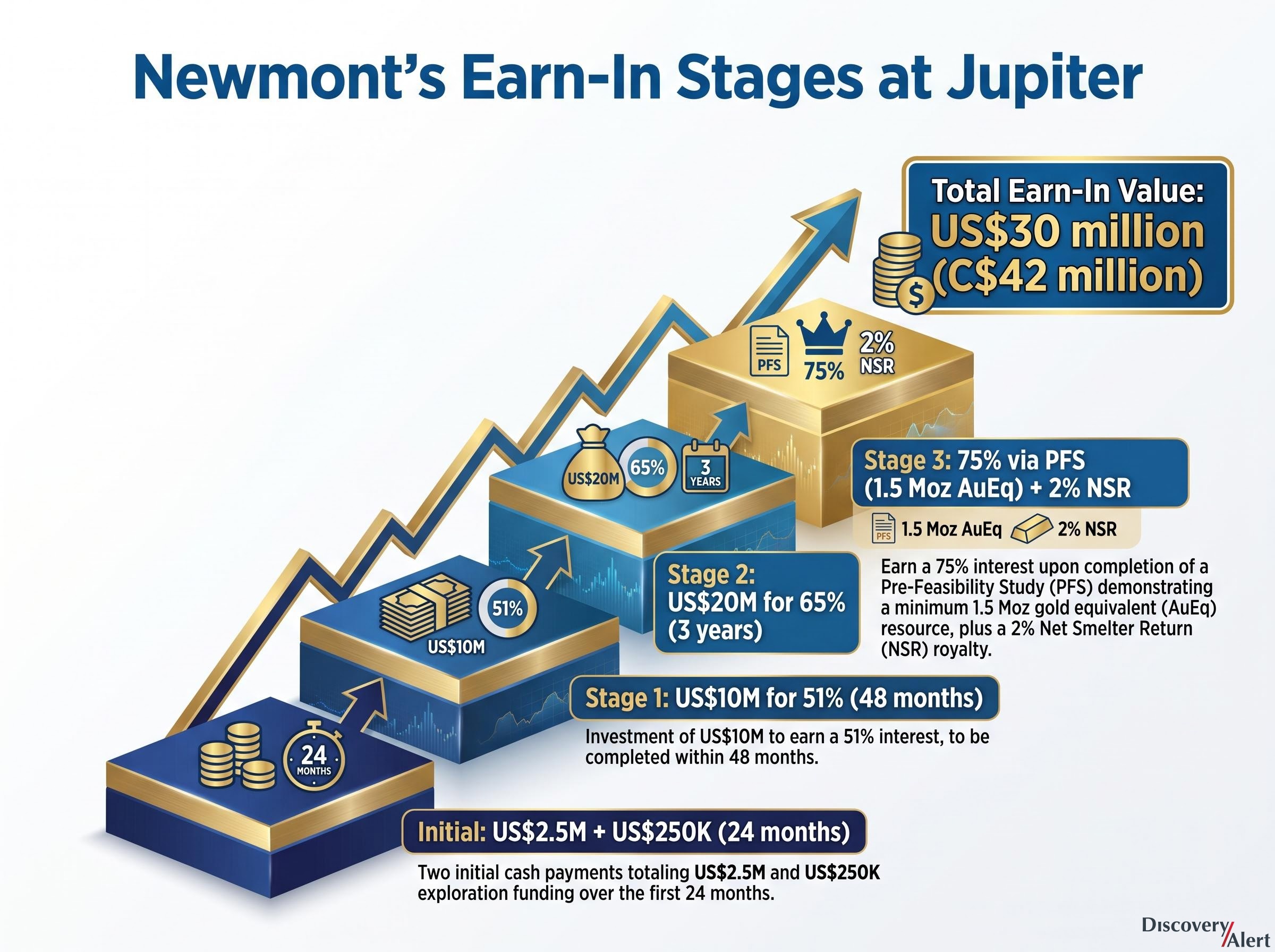
| Stage | Cumulative Spend | Ownership Earned | Timeframe | Key Condition |
|---|---|---|---|---|
| Initial commitment | US$2.5M + US$250K reimbursement | N/A (entry commitment) | 24 months | Minimum exploration spend |
| Stage 1 | US$10M total | 51% | 48 months | Cumulative exploration expenditure |
| Stage 2 | Additional US$20M | 65% | 3 years from Stage 2 start | Additional exploration expenditure |
| Stage 3 | PFS delivery | 75% | Upon PFS completion | PFS with ≥1.5 Moz AuEq + 2% NSR to Headwater |
The gateway to Newmont’s maximum 75% ownership is a PFS that outlines at least 1.5 million ounces of gold-equivalent resource, linking majority control to demonstrable geological value rather than expenditure alone.
In a full earn-through scenario, Headwater cedes majority ownership of Jupiter. The retained package, however, reframes that concession as a risk-adjusted gain for a junior with a market capitalisation of approximately C$46 million.
Headwater acts as operator throughout the earn-in, controlling drill targeting, field execution, and programme design. That operational control is paired with a 10% management fee on all Newmont-funded exploration expenditures, a recurring cash flow mechanism that supports corporate overhead without requiring share issuance. Shareholders also benefit from carried interest through each earn-in stage, meaning Headwater bears none of the direct exploration costs while the earn-in is active.
The prospect generator model underpins why Headwater can retain operatorship, collect a management fee, and carry no direct exploration cost: the junior assembles and advances projects to a point of major-company interest, then transfers the capital burden while preserving equity and royalty upside.
The backstop is the 2% NSR royalty, triggered when Newmont reaches 75%. That royalty persists for the life of mine, giving shareholders leveraged exposure to any eventual production regardless of Headwater’s minority equity position.
The four retained shareholder benefits are:
For a junior explorer that assembled Jupiter via 352 unpatented lode claims staked on Bureau of Land Management land in May 2026, this structure provides meaningful upside optionality without the treasury-depleting equity raises that typically accompany grassroots Nevada drilling programmes.
An epithermal gold system forms when hot fluids, heated by volcanic activity at relatively shallow depths, carry dissolved metals upward through fractures in the Earth’s crust, depositing gold and silver as the fluids cool near the surface. The signature of such systems is a broad halo of altered rock, often visible at surface, surrounding the zones where gold concentrated in economically meaningful quantities. The Walker Lane belt in Nevada, a structurally complex corridor running through western and central portions of the state, hosts multiple significant epithermal gold-silver deposits, making it one of the more prospective exploration environments for this deposit type globally.
Jupiter sits within that belt. The property spans approximately 28 sq. km in Nye County, roughly 370 km southeast of Carson City, and the mineralised zone at surface measures approximately 5 km by 8 km, a large alteration footprint by any standard.
BLM unpatented lode mining claims on federal land confer the right of possession and the right to develop and extract a valuable mineral deposit, with federal law capping individual lode claims at 1,500 feet in length and 600 feet in width, which means assembling a 28 sq. km project footprint like Jupiter requires staking hundreds of individual claim blocks across the ground.
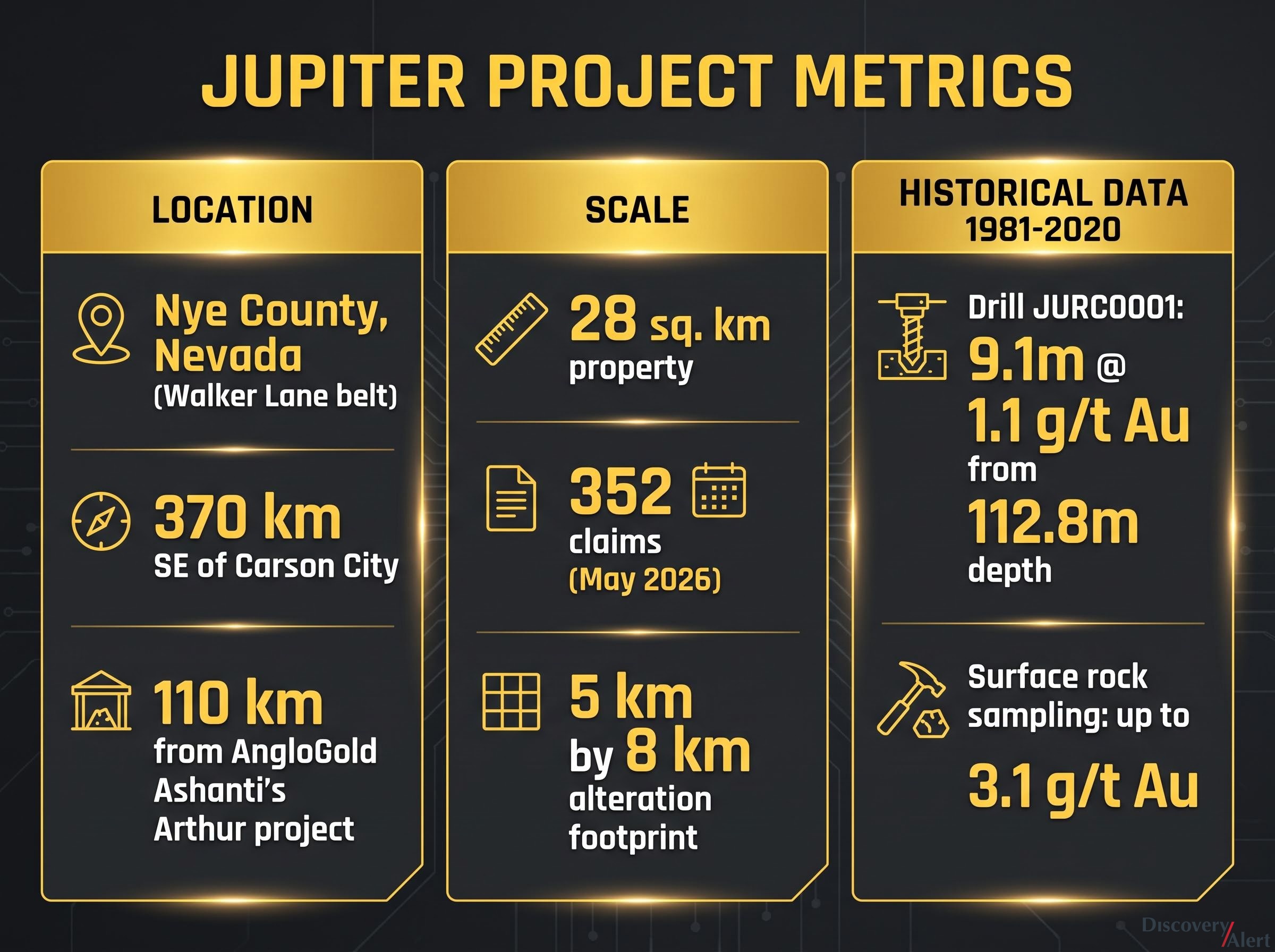
Historical exploration data points include:
Headwater has disclosed that it has not independently verified all prior results, a standard disclosure at this stage and an important consideration for investors evaluating the starting dataset.
Headwater CEO Caleb Stroup has indicated the company believes Jupiter could constitute a large, contiguous district-scale system that prior operators failed to evaluate at that broader scale.
The property is situated approximately 110 km from AngloGold Ashanti’s Arthur project (encompassing the Silicon-Merlin gold deposits), a regional analogue that underscores the broader epithermal potential in this part of Nevada’s Walker Lane.
Jupiter is not an isolated arrangement. It is the third Nevada project on which Newmont has partnered with Headwater, following Spring Peak and Lodestar, and the pattern carries its own signal.
Across Spring Peak and Lodestar, Newmont has already advanced nearly US$20 million toward earn-in expenditures. The Jupiter deal replicates the same structural template: staged ownership thresholds, management fees, and a PFS-linked pathway to 75%.
For Newmont, the earn-in model functions as a series of purchased options on discovery, scaling exposure in proportion to geological evidence rather than committing full development capital upfront. For Headwater, the repeat partnership behaviour is among the strongest external validations available to junior explorer shareholders. It indicates that Newmont’s technical teams have evaluated Headwater’s geological models across multiple projects and found them worth backing with real capital, not once but three times.
Institutional capital allocation to grassroots exploration has become more structured in the post-2020 cycle, with several major funds deploying capital specifically into early-stage programmes in proven mineral belts rather than waiting for resource definition, a shift that makes Newmont’s earn-in model at Jupiter consistent with broader industry capital flow trends.
The agreement signed today is an exploration commitment, not a production decision. The milestones that follow will determine whether Jupiter’s surface alteration footprint conceals a mineable epithermal system.
Catalysts to monitor:
Key risks:
Investors who understand which milestones matter at each stage of a staged earn-in are better positioned to interpret news flow from the project and avoid overreacting to single drill results in either direction.
For investors wanting to evaluate the assay announcements that will follow Jupiter’s initial drill programme, our full explainer on reading mining drill results covers how to interpret intercept widths, grade calculations, true width adjustments, and the difference between a headline intercept and a mineable ore zone.
The Jupiter agreement extends a structural logic that benefits both parties. Newmont gets option-like exposure to a district-scale discovery without committing full development capital upfront. Headwater gets a funded, carried exploration programme with retained operatorship, a 10% management fee, and a 2% life-of-mine NSR royalty, preserving upside for shareholders while transferring the capital burden of grassroots drilling to a major’s balance sheet.
The path from today’s announcement to a 1.5 million ounce AuEq resource, the threshold embedded in the agreement’s final stage, involves years of drilling and significant geological uncertainty. The agreement is an exploration earn-in, not a development commitment.
A junior gold explorer re-rating typically requires two conditions to align: a discovery catalyst that demonstrates resource scale, and a market environment in which gold equities are attracting institutional capital; the gap between those conditions explains why explorer market capitalisations often lag the implied value of their underlying projects even in bull gold markets.
The initial drill programme in late 2026 or early 2027 will be the first definitive test of whether Jupiter’s alteration footprint conceals a mineable epithermal system. Subsequent news releases are expected to detail programme scale and targeting rationale.
The real story at Jupiter will be told by the drill bit. Investors who understand the structural context of this partnership, its staged risk allocation, and its place within a broader pattern of Newmont-Headwater collaboration are better equipped to assess results as they emerge.
This article is for informational purposes only and should not be considered financial advice. Investors should conduct their own research and consult with financial professionals before making investment decisions. Forward-looking statements regarding exploration timelines, resource potential, and project outcomes are speculative and subject to change based on drilling results, market conditions, and various risk factors.
The Newmont Headwater Gold deal is a staged earn-in agreement announced on 13 August 2026, under which Newmont can spend up to US$30 million to earn a 75% interest in Headwater Gold's Jupiter epithermal gold project in Nye County, Nevada.
Newmont earns 51% by spending US$10 million within 48 months, advances to 65% with an additional US$20 million over three years, and reaches 75% by delivering a prefeasibility study outlining at least 1.5 million ounces of gold-equivalent resource plus granting Headwater a 2% NSR royalty.
Headwater retains operatorship of the project, a 10% management fee on all Newmont-funded exploration expenditures, carried interest through each earn-in stage, and a 2% net smelter return royalty for the life of mine once Newmont reaches 75%.
The Walker Lane belt is a structurally complex corridor in Nevada that hosts multiple significant epithermal gold-silver deposits, making it one of the most prospective environments globally for this deposit type, which forms when hot volcanic fluids deposit gold near the surface.
Investors should monitor the initial drill programme anticipated for late 2026 or early 2027, Newmont's actual spending pace relative to the US$2.5 million minimum commitment, and the verification of historical drilling and sampling results to refine the Jupiter geological model.


