
Aramco Targets Europe With Deeper-Than-Expected Crude Price Cut
Aug 17, 2026


On 13 August 2026, Comex copper futures hit all-time highs across the entire futures curve. Gold crossed $4,713 per troy ounce. Silver surged more than 7% in a single session. And three long-stalled copper development projects, on three different continents, simultaneously advanced toward production.
This was not a routine market day. It was the kind of session that crystallises a trend already months in the making: copper up roughly 17% year-to-date, LME prices in the $14,000-$14,500 per tonne range, and a critical minerals policy environment actively reshaping project economics across the globe. The convergence of record prices, corporate earnings beats, project restarts, and government funding commitments landed within the same 24-hour window, offering a rare opportunity to read the mining sector’s direction in real time.
What follows synthesises the price action, the structural drivers behind it, the project-level developments responding to it, and the policy moves accelerating alongside it, so investors can form a clear view of where capital and momentum are moving across the metals and mining complex right now.
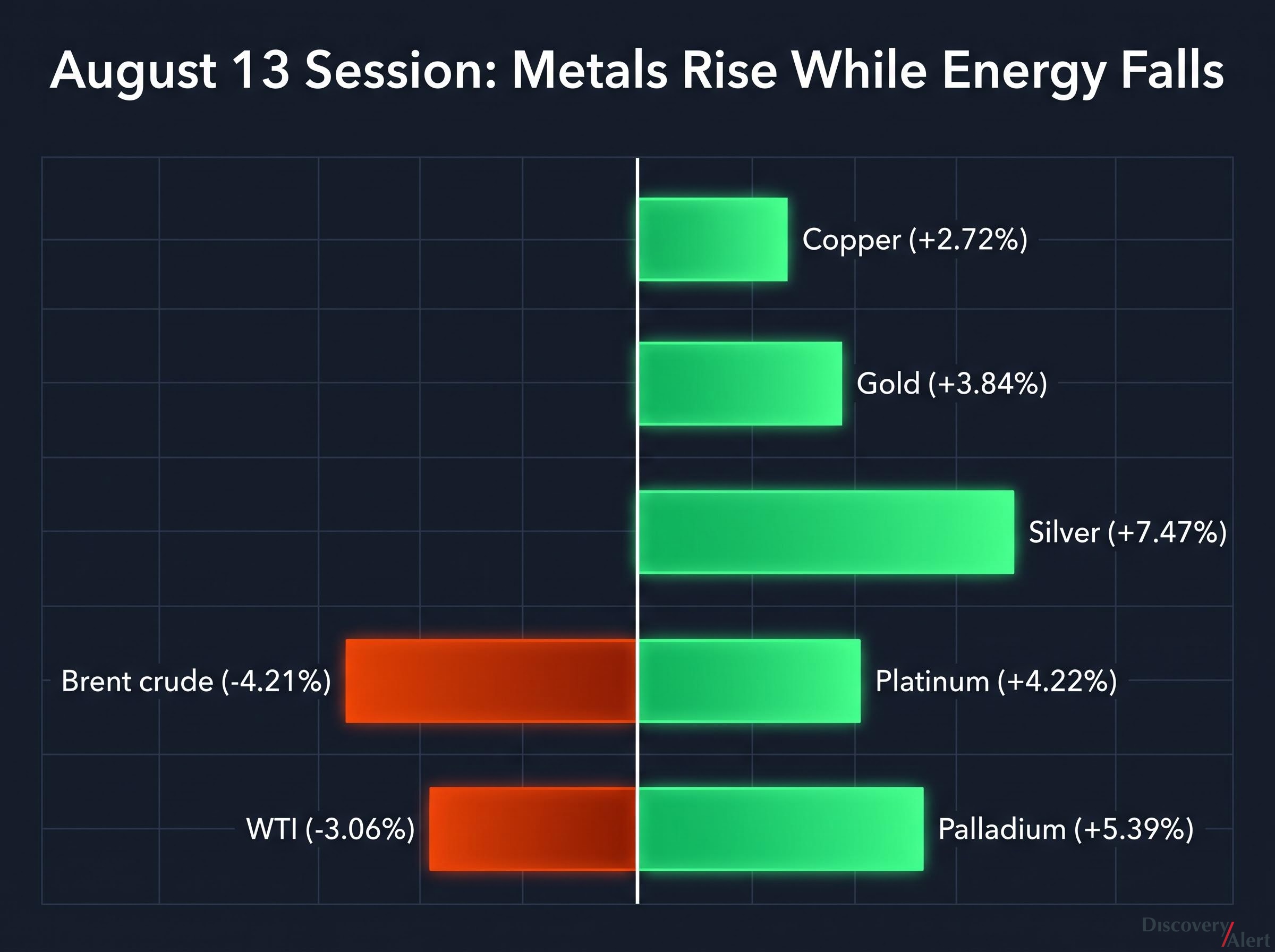
The numbers from the 13 August session speak before any interpretation does.
| Metal | Price | Session Move | Source |
|---|---|---|---|
| Copper | $5.6358/lb | +2.72% | MDC Markets via Mining.com |
| Gold | $4,713.30/troy oz | +3.84% | MDC Markets via Mining.com |
| Silver | $75.495/troy oz | +7.47% | MDC Markets via Mining.com |
| Platinum | $1,973.85/troy oz | +4.22% | MDC Markets via Mining.com |
| Palladium | $1,496.50/troy oz | +5.39% | MDC Markets via Mining.com |
A note on the copper figure: the $5.6358/lb print from MDC Markets reflects a specific contract or data series and should be read alongside the widely reported Comex benchmark record range of $6.70-$6.90/lb for front-month settlements. Both figures are relevant to the full picture, capturing different contract points within a record-setting session.
While metals surged, energy commodities moved in the opposite direction. Brent crude fell 4.21% to $104.40 per barrel and WTI dropped 3.06% to $101.85 per barrel. For mining operators, that divergence is not incidental. It is a direct margin tailwind: lower fuel costs reduce cash operating expenses precisely when metal revenues are at record levels.
MDC Markets via Mining.com reports 2027 Comex copper contracts above $7/lb, suggesting the forward curve is pricing sustained tightness rather than a transient spike. This figure has not been independently confirmed from widely cited benchmark providers.
The price action on 13 August did not emerge in isolation. Copper’s roughly 17% year-to-date gain reflects structural tightness that is visible at every level of the supply chain.
The clearest signal sits in treatment and refining charges (TC/RCs), the fees smelters charge miners to process copper concentrate. These charges have turned negative in 2026, meaning smelters are effectively paying for feed material. Negative TC/RCs confirm that physical tightness is not confined to the futures market. It is running through concentrate supply, smelter utilisation, and refined metal availability simultaneously.
LME copper pushed above $12,000 per tonne in late 2025, then escalated to the $14,000-$14,500 per tonne range by mid-2026. That progression, steady and sustained rather than sudden, carries the signature of a regime shift rather than a cyclical overshoot.
The structural copper supply deficit underpinning the 2026 price rally is not a gap that new mine approvals can close quickly; lead times from discovery to first production typically run 10-15 years, meaning the projects restarting today will not materially affect the supply balance within the current price cycle.
On the demand side, two forces are compounding the structural shortfall in ways that distinguish this cycle from its predecessors:
The interaction between constrained supply and compounding demand is what separates a structural repricing from a temporary squeeze. Understanding this distinction matters directly for how investors value development-stage copper assets.
Antofagasta reported first-half profit of approximately $2 billion, a figure that reflects the direct impact of record copper prices on a major producer’s income statement. The result, however, arrived alongside a shutdown at the company’s Los Pelambres operation, introducing material uncertainty into second-half output guidance. Revenue strength and operational fragility coexist in the same earnings release.
Major copper operations face production setbacks for reasons that extend well beyond equipment failures, as demonstrated when Codelco’s El Teniente operation encountered safety-driven stoppages that pushed the world’s largest underground copper mine off its production schedule, adding further uncertainty to an already constrained supply picture.
Vale announced acceleration of its copper expansion programme at the Salobo operation while simultaneously reducing costs. The company’s copper strategy targets approximately 700,000 tonnes of annual output by 2035, roughly double its current production. That commitment signals a structural growth posture rather than near-term price-chasing: Vale is building capacity for a market it expects to remain tight for a decade.
The cost side of the ledger tells a more complicated story. G Mining Ventures projected a 12% increase in operating expenses for the current year, driven by labour cost inflation and elevated royalty obligations. Record metal prices do not eliminate cost pressures; in many cases, they intensify them as labour markets tighten and jurisdictions raise fiscal claims.
Pan American Silver reported record share buyback activity alongside strong silver output, but the headline masked trade-offs: reduced gold production and higher expenses partially offset the buyback programme’s shareholder return.
At Northern Star, Australia’s leading gold producer, a different kind of pressure is playing out. Activist investor Elliott increased its ownership stake and advocated for board restructuring, while Northern Star’s board pushed back. The outcome of this contest will shape capital allocation decisions at one of the sector’s most significant producers.
| Company | Key Development | Key Risk | Asset / Region |
|---|---|---|---|
| Antofagasta | ~$2 billion H1 profit | Los Pelambres shutdown | Chile |
| Vale | Salobo expansion accelerated | Execution on 700,000 t/year target | Brazil |
| G Mining Ventures | Production on track | 12% opex increase (labour, royalties) | Brazil |
| Pan American Silver | Record buybacks, strong silver | Reduced gold output, higher expenses | Americas |
| Northern Star | Board defending strategy | Elliott activist campaign | Australia |
Record copper prices are not only a financial event. They are a physical-world trigger. On the same day Comex records fell, three previously stalled copper development projects advanced:
These are geographically and operationally distinct projects. They share no common operator, no common jurisdiction, and no common permitting framework. The single variable that connects all three is price.
Three independent project decisions, across three continents, within 24 hours. The common catalyst: a copper price environment that has repriced the economics of previously unviable deposits.
The mechanism is straightforward. Sustained high copper prices raise the valuation floor for development assets. Projects that could not generate adequate internal rates of return at $9,000 per tonne look materially different at $14,000 per tonne. When the forward curve prices 2027 contracts above $7/lb (as reported by MDC Markets via Mining.com), developers and their financiers are modelling project returns against a tighter long-term supply-demand balance, not a spot price they expect to revert.
Individual project terms and timelines require verification from company filings, but the pattern itself carries directional weight for investors in development-stage copper equities.
The scale of capital now entering the critical minerals space has shifted materially in 2026. Three developments from the past week illustrate the acceleration:
Sovereign capital in critical minerals has moved from a policy aspiration to a project-level reality in 2026, with government funding bodies now taking direct positions in feasibility-stage assets because private capital alone cannot price and absorb the permitting, geopolitical, and ramp-up risks that characterise greenfield development.
The US critical minerals list, published by the U.S. Geological Survey under the Department of the Interior, formally designates the minerals considered vital to national security and economic stability, providing the policy foundation that makes government funding commitments to projects covering scandium, tungsten, and antimony strategically coherent rather than opportunistic.
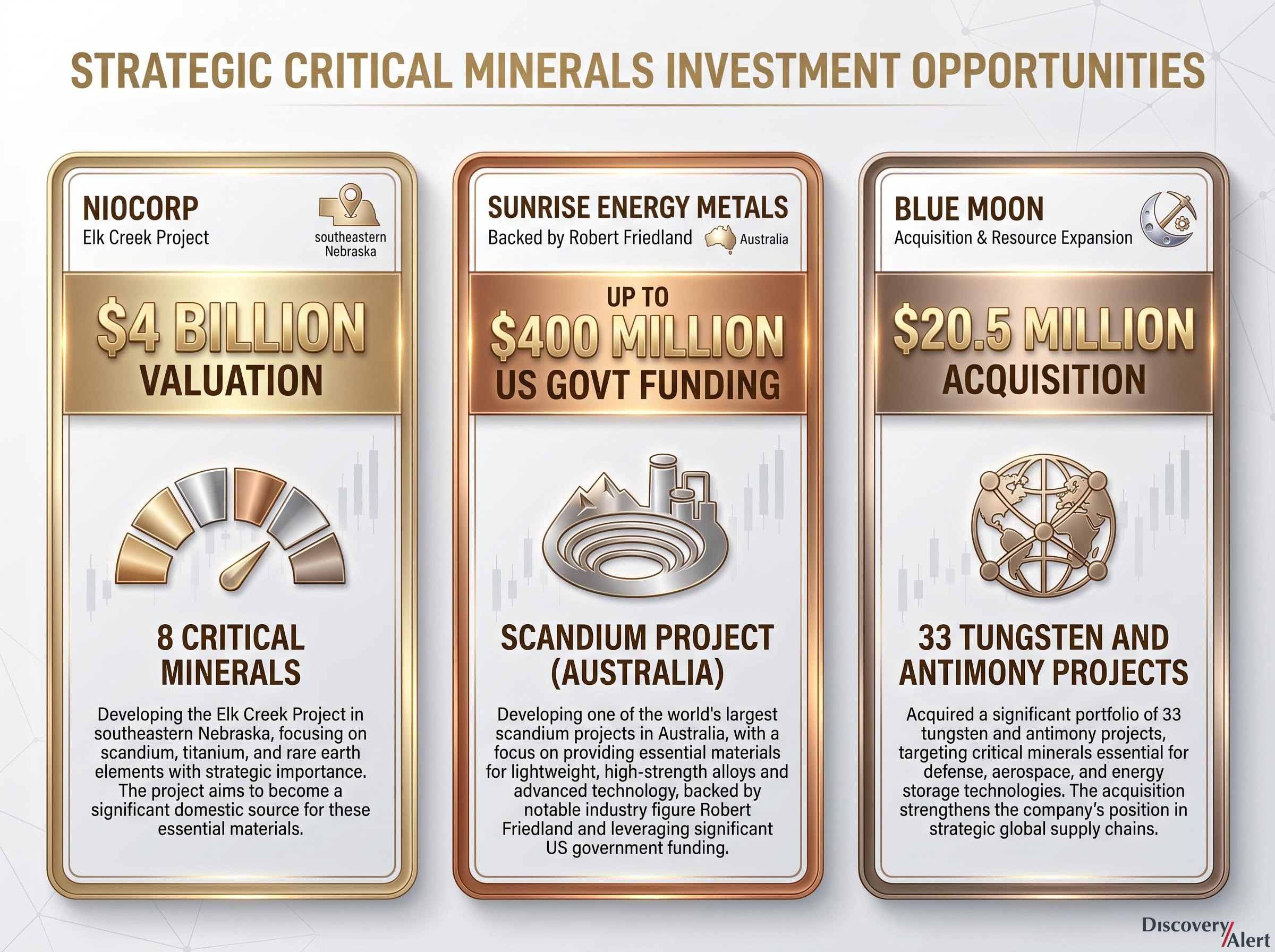
These are not exploratory gestures. They are project-scale capital commitments from governments, institutions, and experienced operators.
Analytical caveat: A study from GEM Consulting found that nameplate capacity figures for critical minerals systematically overstate realised supply. Ramp-up timelines, processing constraints, and logistics limitations mean that nominal capacity and actual delivered tonnes diverge consistently. Investors modelling critical minerals supply curves without discounting nameplate figures may be systematically overestimating future supply and underpricing scarcity.
The tailwinds are real and quantifiable. On a single session:
That combination, rising revenue per tonne and declining fuel cost per tonne, creates a rare margin expansion window for producers with operational stability.
The risks have not disappeared. They have become more specific:
Research cited by Mining.com suggests that community trust and involvement could help mining companies accelerate permitting timelines, an operational lever that may be underappreciated relative to its impact on project delivery.
The capital allocation signal, however, is directionally clear. Multiple simultaneous developments (project restarts, government funding, major feasibility completions, and a forward curve pricing 2027 copper above $7/lb) suggest that institutional and strategic capital is treating current pricing as durable rather than transient.
The convergence of record prices, project restarts, government strategic funding, and corporate earnings beats is not a collection of coincidences. It is a coherent signal: the mining cycle has entered a phase where structural tailwinds are visible across multiple time horizons simultaneously.
The GEM Consulting finding on nameplate capacity overstatement remains a standing reason to apply analytical scepticism to supply-side projections. Investors who take announced capacity at face value may be underestimating the duration and intensity of the current tightness.
Three specific developments merit close monitoring from here:
The forward investor question is specific: given that the forward curve is pricing copper above $7/lb into 2027, which development-stage and mid-tier producers are best positioned to capture margin in a sustained, rather than temporary, pricing regime?
For investors wanting to translate the current copper and precious metals signals into portfolio action, our full explainer on positioning before commodity dislocations walks through cycle-stage identification, asset selection criteria across producers and developers, and sizing frameworks for high-conviction commodity positions in a structurally tight supply environment.
This article is for informational purposes only and should not be considered financial advice. Investors should conduct their own research and consult with financial professionals before making investment decisions. Forward-looking statements, including price projections and production targets, are subject to change based on market developments and company performance.
Treatment and refining charges (TC/RCs) are fees smelters charge miners to process copper concentrate into refined metal. When TC/RCs turn negative, as they did in 2026, it means smelters are effectively paying for feed material, confirming that physical copper tightness runs through the entire supply chain, not just the futures market.
Copper prices reached record levels due to a combination of structural supply tightness (including negative TC/RCs), surging demand from AI data centre construction, grid electrification programmes, and EV infrastructure build-out, all compounding a supply deficit that took years to develop.
When oil and fuel costs fall while metal prices rise simultaneously, mining operators benefit from a rare margin expansion: cash operating expenses decline at the same time revenue per tonne is at record levels, directly improving profitability for producers with stable operations.
Three previously stalled projects advanced within 24 hours of the Comex record session: Panguna in Bougainville (Papua New Guinea), Tampakan in the Philippines, and Laver in Sweden operated by Boliden, all sharing the common catalyst of copper prices in the $14,000-$14,500 per tonne range.
Sovereign capital has moved from policy aspiration to project-level reality in 2026, with a US government entity offering up to $400 million toward Sunrise Energy Metals' scandium project and NioCorp's Elk Creek project receiving a $4 billion feasibility valuation, signalling that governments are directly funding supply chains private capital cannot absorb alone.


