
Saudi Aramco’s Exports Hold, but War-Risk Costs Tell a Darker Story
Aug 17, 2026


A geological corridor that has produced between 5 and 6 million ounces of gold already has a junior sitting 16 km from the producing mine, with a data room open and strategic investors inside it.
Aureka Limited’s Irvine Gold Project in western Victoria occupies ground within the same basalt-dome structural corridor as the Stawell/Magdala gold mine, an operation that has run for approximately 60 years and remains in production. Since relisting on the ASX at the end of 2024, Aureka has grown its global inferred JORC resource by roughly 50%, to 455,000 oz across its Victorian portfolio. The Irvine project contributes approximately 398,300 oz at 2.59 g/t Au to that total.
What follows is an examination of what the geological setting actually implies for scale potential, how management assembled the asset at a fraction of its prior valuation, where the resource stands after recent drilling and reinterpretation work, and what the realistic pathway from a 400,000 oz junior to a credible development target looks like in the current gold price environment.
The Stawell/Magdala gold mine has produced approximately 5 to 6 million ounces of gold over its roughly 60-year operating history. It is not a relic. The mine remains in production, and the basalt-dome structural model that hosts its mineralisation extends well beyond its immediate footprint.
The PorterGeo Stawell Goldfield records document approximately 127 tonnes of recovered gold from the Stawell operations, corroborating the multi-million-ounce production history that makes the structural corridor a recognised mineralised system rather than a single-deposit anomaly.
That structural model is the point. The Stawell Corridor is not a single deposit setting; it is a geological architecture. The known deposit inventory within the district already demonstrates repeatability:
The corridor extends approximately 60 km south of Magdala/Stawell. That length is not a marketing figure; it is a geological observation that reframes the project from a single-asset story to a district-scale question.
Gold occurrences distributed along the belt south of Magdala/Stawell are treated by Aureka’s management as indicators of broader exploration potential rather than isolated anomalies. Management draws a conceptual parallel to the Lake Victoria goldfields in Tanzania, where multiple large deposits occur along strike with smaller-scale mineralisation between them. This analogy is management-level framing from direct interview rather than an empirically published geological comparison, though the underlying geological concept of repeated mineralisation along fertile structural corridors is well established.
The Victorian gold portfolio that Aureka now controls was not assembled through competitive bidding. It was available because the previous owner pursued an unsuccessful Queensland acquisition that eroded the company’s position and ultimately rendered the Victorian assets distressed.
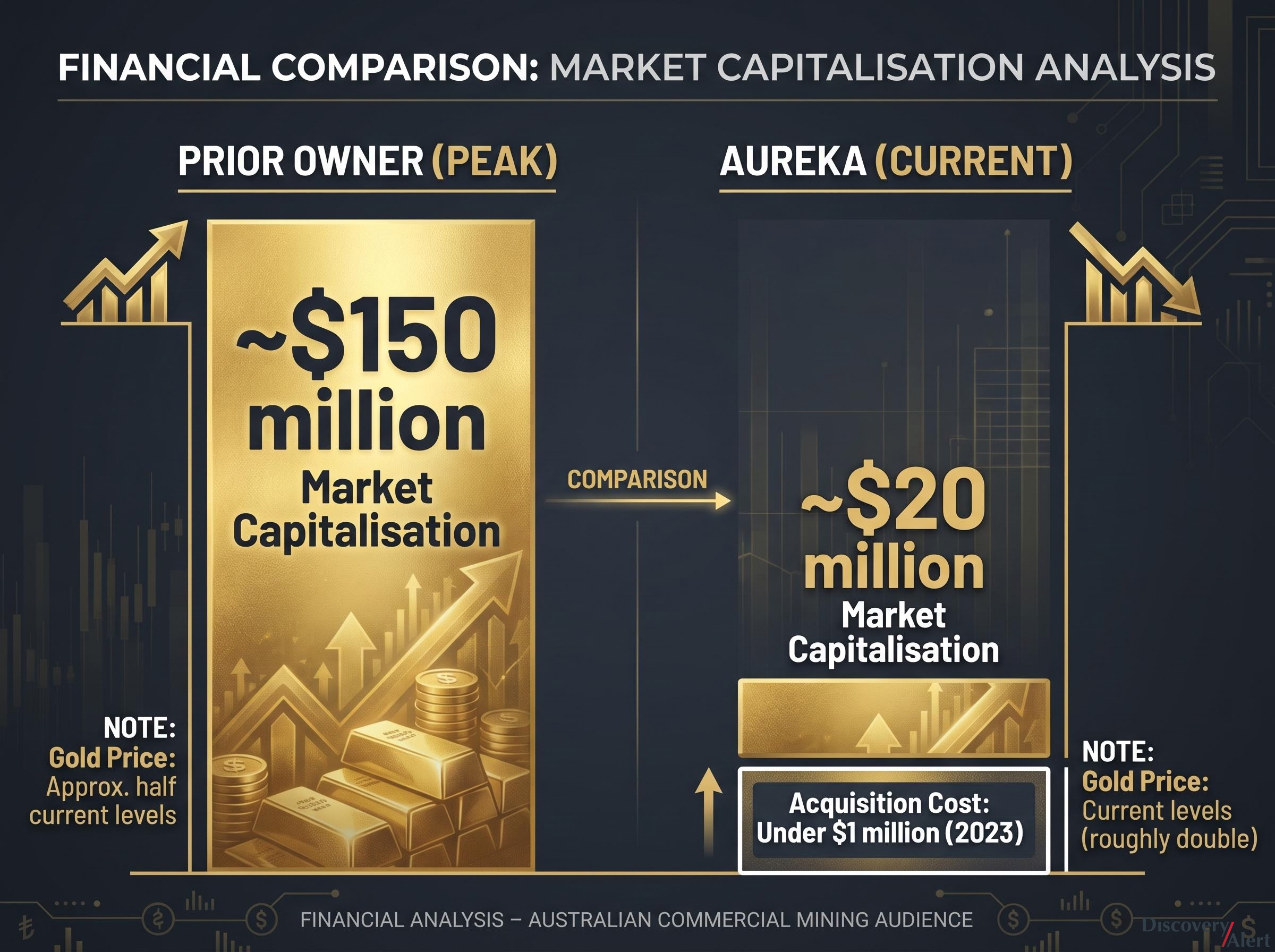
Aureka acquired the portfolio for under $1 million in 2023. The prior owner had reached a peak market capitalisation of approximately $150 million, according to Managing Director James Gurry. That acquisition cost and peak valuation are management-sourced figures; public research focuses on asset quality rather than quantifying the transaction price.
Aureka’s current market capitalisation of approximately $20 million compares to a prior owner peak of $150 million, achieved in a gold price environment roughly half of current levels.
The company moved quickly after acquisition. ASX relisting completed at the end of 2024. Systematic drilling commenced at the beginning of 2025. The asset was not left dormant.
| Metric | Prior Owner (Peak) | Aureka (Current) |
|---|---|---|
| Market Capitalisation | ~$150 million | ~$20 million |
| Gold Price Environment | Approximately half current levels | Current (roughly double prior-peak era) |
| Acquisition/Entry Cost | N/A | Under $1 million (2023) |
Management notes that at current gold prices, a comparable valuation to the prior owner’s peak would imply approximately $200 million. This is an illustrative thought experiment, not analyst consensus or a forecast.
The Irvine resource did not arrive fully formed. The flagship prospect was originally discovered in late 2017, with a maiden inferred JORC resource of 304,000 oz at approximately 2.43 g/t Au. The current resource of 398,300 oz at 2.59 g/t Au reflects approximately 94,000 oz added through the most recent update, a product of active geological reinterpretation and targeted drilling rather than passive time elapsed.
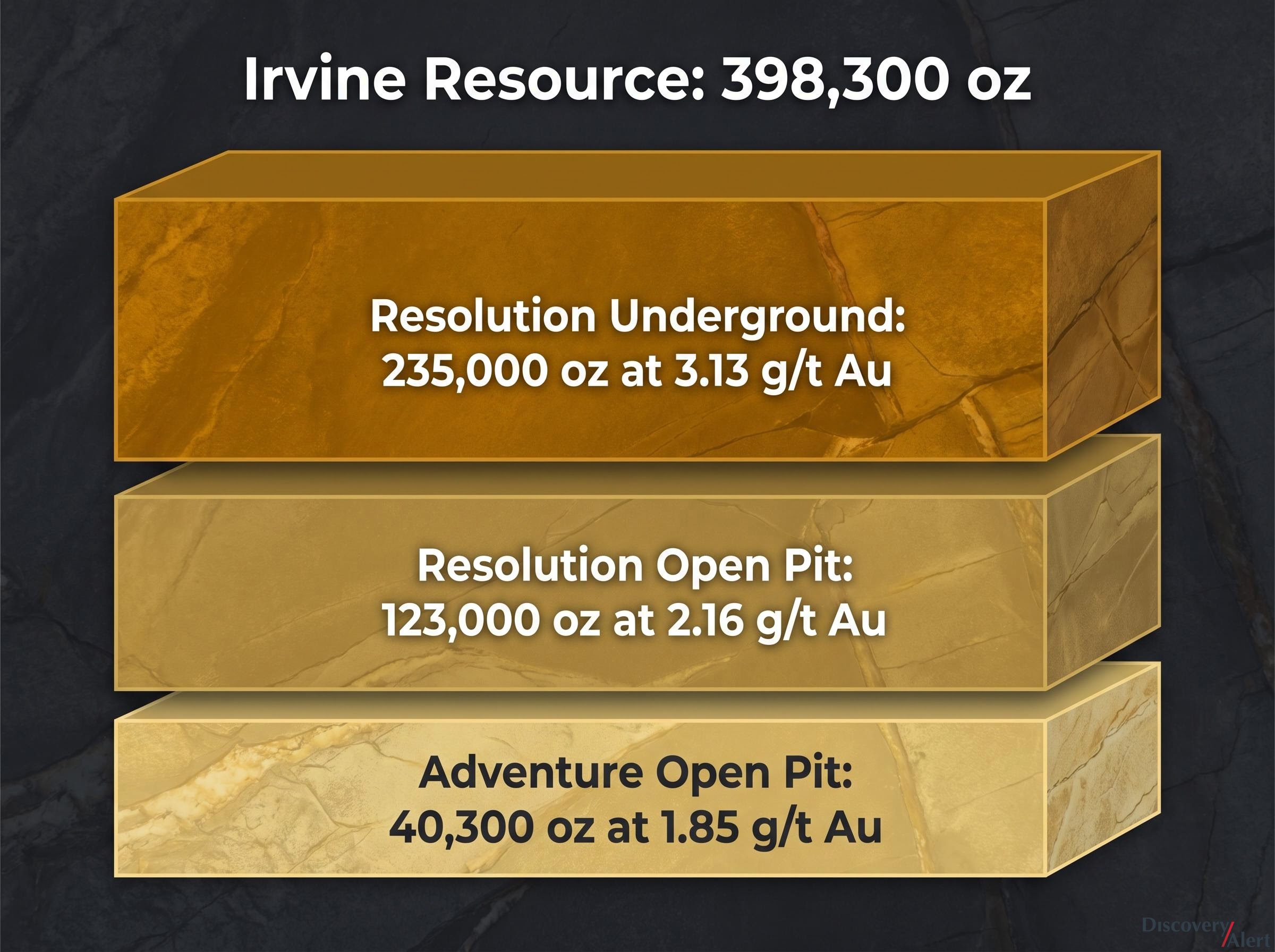
The grade profile tells its own story. The Irvine resource breaks down into three components, each with a distinct character:
Mining grade is the single number most investors cite when comparing exploration assets, yet the same grade can imply radically different project economics depending on whether the mineralisation suits open-pit or underground methods, a distinction the Irvine resource breakdown makes explicit across its three components.
| Deposit Component | Ounces | Grade (g/t Au) |
|---|---|---|
| Resolution Open Pit | 123,000 oz | 2.16 |
| Adventure Open Pit | 40,300 oz | 1.85 |
| Resolution Underground | 235,000 oz | 3.13 |
The Resolution Underground component is the analytical pivot. At 3.13 g/t, it positions a majority of the Irvine resource in territory where underground mining economics could be credible, a distinction that matters because a resource that only works at open-pit strip ratios carries a fundamentally different risk profile than one with a meaningful higher-grade underground component.
At the portfolio level, Aureka’s global inferred JORC resource sits at 455,000 oz:
That 50% growth in global resources since ASX relisting, achieved in under two years, is documented. An exploration target of 280,000 to 420,000 oz on the margins of the Irvine basalt dome sits beyond the classified resource as speculative upside, not yet classified as a mineral resource under JORC.
The JORC Code mineral resource classification framework requires that Inferred resources, like those comprising the Irvine estimate, carry a lower level of geological confidence than Indicated or Measured categories, and that exploration targets such as the 280,000 to 420,000 oz figure at the margins of the Irvine basalt dome be explicitly distinguished from classified resources in all public reporting.
The 94,000 oz uplift at Irvine was not driven primarily by additional metres drilled. It was driven by a change in how the geology was modelled.
Geological reinterpretation driving resource upgrades without proportional increases in drilling metres has been a recurring theme across ASX junior gold companies in 2025-2026, with domain redefinition and structural remodelling delivering ounce growth that the market has not consistently priced in at the time of announcement.
When Exploration Manager Joseph Story joined Aureka approximately 12 months prior to mid-2025, he restructured the geological interpretation of the Irvine deposit, identifying 11 new geological domains. A geological domain, in resource estimation, is a discrete zone within a deposit where mineralisation is expected to behave consistently. Defining domains more precisely allows resource models to capture mineralisation that a coarser model would miss or dilute.
The reinterpretation worked spatially. Down-plunge mineralisation extensions at Resolution Lode have been confirmed over approximately 220 m, and an ongoing 2,000 m diamond drilling programme is targeting further extensions. Diamond drilling was selected as the primary method for its ability to recover oriented core, which is essential for understanding the structural controls on gold mineralisation within the basalt-dome model.
The credibility of domain reinterpretation rests on the geologist doing the reinterpreting.
Story began his career at Fosterville gold mine in Victoria, including participation in early deep drilling before Fosterville became a major high-grade operation. He subsequently worked across China, Southeast Asia, and Central Asia, and most recently served as Exploration Manager for Barrick’s Tanzanian assets, overseeing a geological team of approximately 30 professionals.
His Barrick Tanzania experience, in particular, grounds the Lake Victoria greenstone-belt analogy in direct field knowledge rather than theoretical comparison, though the analogy remains management framing rather than a published geological study.
Gurry’s background is complementary. Approximately two decades as a mining analyst at Credit Suisse and Deutsche Bank across Sydney, London, and Melbourne provides the capital markets lens that informs how the company positions assets for institutional scrutiny.
The distance between a 398,300 oz inferred resource and a producing mine is not a single step. It is a sequence, and each stage carries its own uncertainty.
Aureka is running permitting work in parallel with resource definition rather than deferring it. A first small-scale mining licence application has been lodged at the Comstock pit near St Arnaud. The development milestone sequence for Irvine runs as follows:
Management’s aspirational market capitalisation at full development sits between $500 million and $1 billion. This is a management target, not analyst consensus or an independent valuation.
Victoria’s status as a Tier-1 jurisdiction with established infrastructure and a multi-decade regulatory history supports the permitting pathway in principle, though Victorian permitting timelines involve multi-year regulatory processes that are not within the company’s sole control. The production scenarios remain conceptual rather than bankable, and the gap between a current 398,300 oz resource and the 1 Moz ambition requires continued drilling success.
The Victorian permitting environment has become a more active policy conversation in 2026, with the state government facing pressure from the resources sector over timelines and regulatory uncertainty that directly affects the multi-year approvals process Aureka must navigate for Irvine’s mining licences.
At the time of interview, Managing Director James Gurry confirmed that at least a couple of strategic investors were reviewing the Irvine project in a data room. This is qualitative, management-sourced information that is not reflected in public market disclosures, consistent with standard practice prior to any potential transaction announcement.
Independent research houses have consistently identified Irvine as the centre of gravity for institutional and strategic interest. The investment thesis pillars cited across independent coverage include:
The risks sit alongside each of these pillars with equal weight:
The current gold price environment, at approximately double the levels at which the prior owner reached its $150 million peak, provides the macro tailwind. Whether that tailwind converts into a transaction or re-rating depends on execution across every milestone listed above.
The broader dynamic underlying Aureka’s valuation gap is not unique to this project: junior explorer re-rating lags major gold price moves across the sector, creating windows where assets with credible resources trade at fractions of what replacement cost or comparable transaction multiples would imply.
The analytical case for Irvine rests on a combination rather than any single factor. A basalt-dome structural corridor with 5 to 6 million ounces of demonstrated production provides the geological foundation. A sub-$1 million distressed acquisition in a Tier-1 jurisdiction established an asymmetric entry position. Rapid resource growth of 50% since relisting, underpinned by credible domain reinterpretation from a geologist with Fosterville and Barrick credentials, provides evidence that the technical work is delivering results.
The distance still to travel is specific and measurable. The resource needs to roughly double from 398,300 oz toward 1 Moz at Irvine. Mining licences require multi-year permitting. Capital will need to be raised for development. Feasibility work has not begun. The current market capitalisation of approximately $20 million prices the asset as an exploration-stage junior, and the gap between that figure and management’s aspirational $500 million to $1 billion development-stage range is filled entirely with execution risk.
Irvine is a geologically credible, high-upside junior gold asset in a jurisdiction that has supported gold mining for over a century. It carries the execution, financing, and permitting risks that are inherent to that category. For investors weighing the opportunity, the question is not whether the geology is real. The belt has already answered that. The question is whether this team, at this entry price, can close the gap between a promising resource and a producing mine.
This article is for informational purposes only and should not be considered financial advice. Investors should conduct their own research and consult with financial professionals before making investment decisions.
These statements include forward-looking projections sourced from management commentary and are subject to change based on market developments, drilling outcomes, and company performance. Past performance does not guarantee future results.
The Aureka Irvine Gold Project is a junior gold exploration asset in western Victoria, Australia, located within the Stawell Corridor, approximately 16 km from the Stawell/Magdala gold mine, which has produced 5-6 million ounces of gold over roughly 60 years.
The Irvine project holds a current inferred JORC resource of 398,300 oz at 2.59 g/t Au, which includes a higher-grade Resolution Underground component of 235,000 oz at 3.13 g/t Au and two open-pit components at lower grades.
Since relisting on the ASX at the end of 2024, Aureka has grown its global inferred JORC resource by approximately 50% to 455,000 oz, with the most recent Irvine update adding around 94,000 oz through geological domain reinterpretation and targeted drilling rather than a large increase in drilling metres.
Key risks include the need for continued drilling success to grow the resource toward 1 million ounces, multi-year Victorian permitting processes outside the company's sole control, capital requirements for development, and the fact that production scenarios and the 280,000-420,000 oz exploration target remain conceptual and unclassified under JORC.
Aureka must grow the Irvine resource toward 1 million ounces, obtain mining licence approvals (projected approximately three years from mid-2025), complete feasibility studies, raise development capital, and then build toward a conceptual production rate of 20,000-40,000 oz per year, none of which are guaranteed outcomes.


