
Saudi Aramco’s Exports Hold, but War-Risk Costs Tell a Darker Story
Aug 17, 2026


Antofagasta posted a 72% surge in pretax profit to $2 billion in H1 2026, then watched its share price fall 4.6% on the day. That disconnect captures the central tension facing copper producer equities right now: results season is genuinely strong, but the market is pricing in doubt about whether those conditions persist.
The gap between the two is where the investment decision lives. What follows unpacks the specific margin mechanics driving copper producer profitability, tests how durable those mechanics are through a three-indicator monitoring framework, and lays out the bull and bear scenarios with observable thresholds so investors can track when the thesis is changing rather than waiting for a share price move to confirm it.
Copper prices rose 36% over the period. Gold prices advanced 46%. Weather disruptions reduced Antofagasta’s production volumes, but price more than compensated for tonnage. EBITDA grew 27% to $2.84 billion. Operating cash flow grew 53% to $2.77 billion. The interim dividend nearly doubled, from 16.6 cents to 30.1 cents per share.

| Metric | H1 2025 | H1 2026 | Change |
|---|---|---|---|
| Pretax Profit | $1.16B | $2.0B | +72% |
| EBITDA | $2.24B | $2.84B | +27% |
| Operating Cash Flow | $1.81B | $2.77B | +53% |
| Interim Dividend (per share) | 16.6 cents | 30.1 cents | +81% |
| EBITDA Margin | — | 63.4% | — |
The 63.4% EBITDA margin reflects more than a copper price windfall. It signals structural operating leverage amplified by historically favourable fee conditions that are transferring margin from smelters to mine owners.
Investors who dismiss these results because production volumes fell are reading the wrong variable. For low-cost copper producers, price and fee dynamics carry more explanatory power than quarterly tonnage.
Treatment and refining charges (TC/RC) are the fees smelters charge miners to process concentrate into refined copper. When concentrate supply is tight, miners gain pricing power and these charges collapse, sometimes turning negative. The result is a margin transfer: smelters retain less, mine owners capture more.
The current environment represents an extreme version of this dynamic.
The structural copper supply deficit underpinning current TC/RC tightness is not a cyclical phenomenon that will self-correct as miners respond to price signals; greenfield project lead times and declining ore grades mean the concentrate squeeze has a multi-year floor that annual benchmark negotiations are beginning to reflect.
Spot TC/RC captures near-term stress. The annual benchmark captures structural expectations for the full contract period. Two separate signals are active simultaneously:
The benchmark settling at zero is the medium-term signal that matters most. Annual negotiations between major miners, including Antofagasta, and Chinese smelters have priced in sustained concentrate tightness through the full contract year. This is not a spot anomaly. It is a structural expectation embedded in the contracts that govern the industry’s largest processing relationships.
CRU Group’s TC/RC assessment, published in April 2026, confirmed that annual contract terms for sales to Chinese smelters settled at $0/0 cents, the lowest benchmark ever recorded, reflecting a structural expectation of sustained concentrate tightness embedded in the contracts governing the industry’s largest processing relationships.
Understanding this mechanic distinguishes investors who can assess whether current producer margins are sustainable from those reading headline copper prices alone.
Three indicators, read together as a system rather than in isolation, provide a structured framework for monitoring whether the current margin regime persists into late 2026.
| Indicator | Current Reading | What a Directional Move Signals |
|---|---|---|
| Yangshan Premium | ~$96/t (down from ~$115-119/t peak in late July) | Rising: strong Chinese import appetite. Falling below $96/t toward $70s-$80s: weakening demand, bear trigger |
| Spot TC/RC | ~-$175.7/t | Sustained above -$100/t for one full month: concentrate supply improving, reassessment warranted |
| Chinese Refined Output Growth | 0.4-0.9% range (forecasts vary) | Acceleration above 0.9%: smelters resolving the squeeze, bear case strengthens |
The Yangshan premium, the premium paid for imported copper arriving at Shanghai’s Yangshan port over the LME price, functions as a high-frequency gauge of Chinese appetite for physical metal. Levels were approximately $45-59/t earlier in 2026, spiked to a four-year high near $115-119/t by late July, then retreated to approximately $96/t. That $96/t level is the current line in the sand.
Chinese refined copper output growth, forecast in the 0.4-0.9% range depending on the source, represents the production-side variable. Constrained growth at that level means smelters are not resolving the concentrate squeeze, which supports the supply-tightness thesis.
A projected refined copper surplus of approximately 96,000 metric tons is small relative to global mine output. Its market impact depends on where inventories accumulate and on concurrent macro conditions, including Chinese industrial production and grid spending data, rather than the surplus figure alone.
The copper inventory buffer currently sitting across global warehouses is thin enough that even modest demand acceleration or supply disruption would exhaust visible stock within weeks, a structural fragility that gives the current TC/RC tightness its forward-looking significance beyond the spot price.
Investors who monitor only the copper spot price miss the leading indicators that predict margin durability before it shows up in share prices.
The bull case requires three conditions to hold:
If all three hold, supply tightness persists, miners retain outsized margin advantage, and copper prices remain supported.
The bear case carries a different set of signposts:
The single most actionable signal sits between the two scenarios: spot TC/RC sustained above -$100/t for one full calendar month, combined with a Yangshan decline below $96/t trending toward the $70s-$80s, warrants a fundamental reassessment of the supply-tightness thesis. All three indicators moving in a bearish direction simultaneously represents the material challenge scenario.
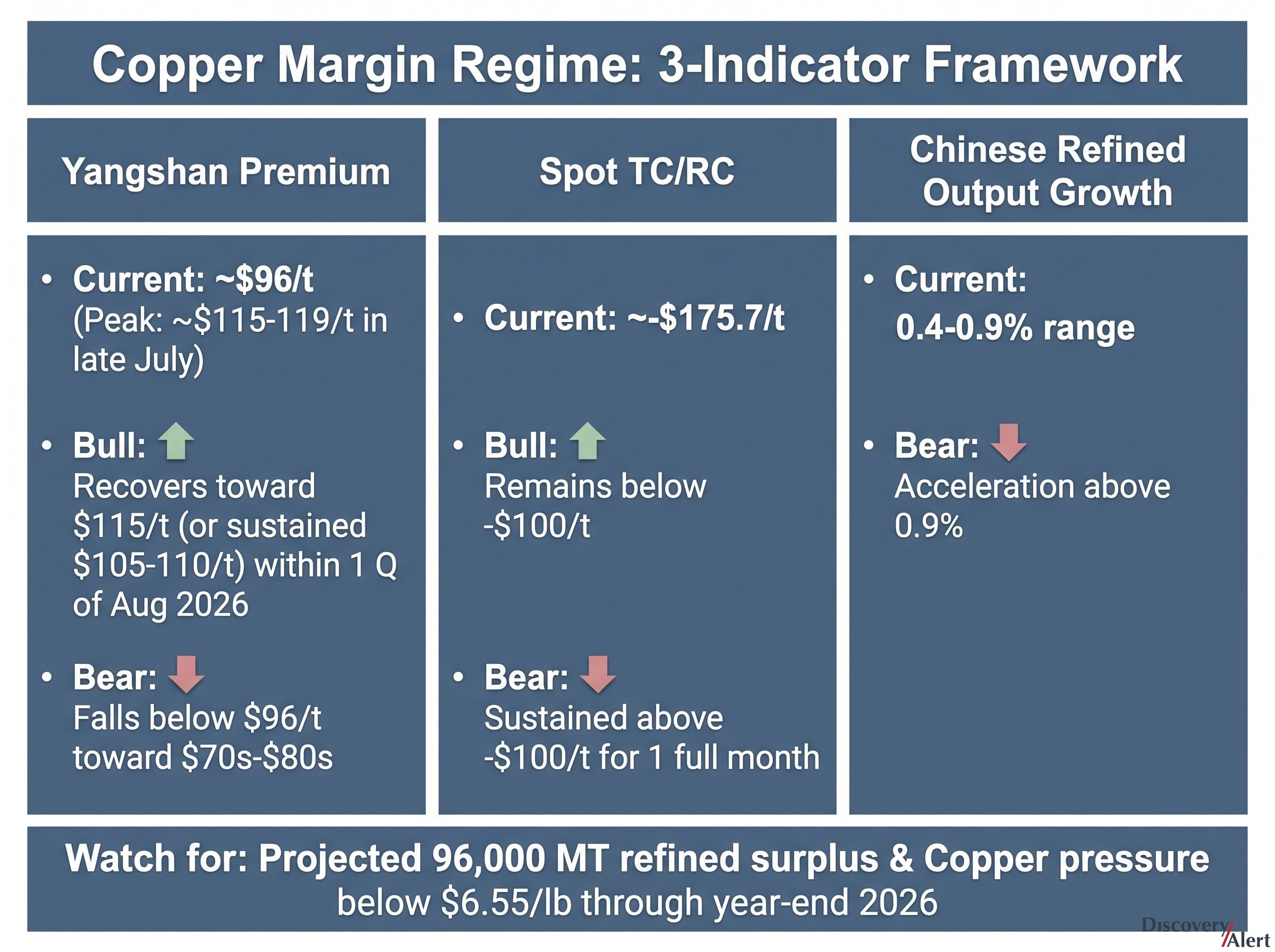
These are directional bands to interpret in context, not hard binary switches. A sustained range above $105-110/t on Yangshan, for instance, would still corroborate the bull case even without reaching exactly $115/t.
Prospective US tariffs have shifted copper into US warehouses, inflating visible US inventory readings without reflecting genuine demand weakness or a global supply surplus. No confirmed implementation timeline for US copper tariffs has been publicly disclosed as of August 2026, but the anticipation alone has been sufficient to redirect physical metal flows.
This tariff-driven dislocation also contributed to the spike in the Yangshan premium earlier in 2026, as metal flows redirected away from the US market toward Asia.
Tariff-driven copper flows have reached historic extremes, with US imports hitting a 12-year high as traders front-run prospective duties, a dynamic that has directly contributed to the Yangshan premium spike and the regional inventory distortions that make current US warehouse data unreliable as a demand signal.
Investors assessing global copper market tightness should weight regional inventory signals accordingly:
Tariffs function as a macro overlay that complicates regional inventory signals without serving as the primary driver of global copper prices. Misreading US inventory accumulation as a demand signal is a specific and common analytical error in this environment.
Elevated prices plus historically favourable TC/RC terms are producing exceptional margins for low-cost copper producers. Antofagasta’s H1 2026 results are the clearest current example of this dynamic, with the 63.4% EBITDA margin structurally supported while the three indicators remain in their current configuration.
The 4.6% share price decline on results day suggests the market is already pricing in some doubt about persistence. That doubt is not unreasonable, but the risk to copper producer equities is not recent operational noise at individual miners. It is a specific combination of conditions:
Rio Tinto’s copper pivot, involving large capital commitments to copper assets at a moment of peak producer margins, tests whether the current TC/RC and price regime is being treated by major miners as a durable structural condition rather than a cyclical opportunity to be harvested and redeployed.
The risk is not a bad quarter at one miner. It is a simultaneous shift in all three market indicators, from TC/RC normalisation to sustained Yangshan decline to Chinese refined output acceleration, occurring together.
Investors with a clear expiry condition can hold a copper producer position with discipline, monitoring specific data as it arrives rather than reacting to price noise. That is the practical value this framework delivers.
This article is for informational purposes only and should not be considered financial advice. Investors should conduct their own research and consult with financial professionals before making investment decisions. These forward-looking assessments are subject to change based on market developments and evolving supply-demand conditions.
Treatment and refining charges are the fees smelters charge miners to process copper concentrate into refined metal. When concentrate supply is tight, these charges collapse or turn negative, transferring margin from smelters to mine owners and significantly boosting producer profitability.
The Yangshan premium is the price premium paid for imported copper arriving at Shanghai's Yangshan port above the LME benchmark price. Rising levels indicate strong Chinese appetite for physical metal, while a sustained decline toward the $70s-$80s per tonne range signals weakening import demand and warrants reassessment of the bullish copper thesis.
The share price decline suggests the market is already pricing in doubt about whether the favourable conditions, elevated copper prices and historically low TC/RC charges, will persist into the second half of 2026, even though the underlying H1 results were exceptionally strong.
Anticipation of US copper tariffs has redirected physical metal flows into US warehouses, inflating visible US inventory readings without reflecting genuine demand weakness. Investors should treat US warehouse stock levels as a logistical artefact of tariff positioning rather than a reliable demand or supply signal.
Investors should track the Yangshan premium (watch for sustained decline below $96/t toward the $70s-$80s), spot TC/RC charges (a sustained move above -$100/t for one full month signals concentrate supply improving), and Chinese refined copper output growth (acceleration above 0.9% suggests smelters are resolving the concentrate squeeze).


