
Aramco Targets Europe With Deeper-Than-Expected Crude Price Cut
Aug 17, 2026


Shuka Minerals has confirmed a previously undocumented near-surface orebody at the Kabwe zinc-lead-copper-vanadium project in Zambia, with drill hole KBDD09 intersecting multi-metal mineralisation in ground that no prior NI 43-101 report had ever documented and no previous mining had ever reached. Announced on 13 August 2026, the discovery arrived during Phase 1 of an active diamond drilling programme, with the new zone located several hundred metres south of the established Speaks and Mine Club orebodies. Two additional holes targeting the same zone, KB010 and KB011, have also been drilled, with results pending. What follows sets out exactly what KBDD09 returned, why the multi-metal mineralisation signature matters beyond the headline zinc grades, how the new zone relates to Kabwe’s existing resource base, and what the expanded Phase 1 programme means for the project’s resource growth trajectory.
KBDD09 is the first of a three-hole programme specifically designed to test ground several hundred metres south of the Speaks and Mine Club orebodies. The zone it targeted had not been included in the 2023 Behre Dolbear NI 43-101 technical report, had never been mined, and had not been previously drilled. Its identification came from a combination of geological modelling and historical knowledge gathered from former site workers, according to CEO Richard Lloyd.
The discovery represents a potential addition to Kabwe’s existing resource base, subject to laboratory assay confirmation and any future NI 43-101 update. No formal resource estimate or declaration has yet been filed for this zone.
The three-hole southern programme and its current status:
For a junior explorer, confirming mineralisation outside the existing resource envelope is the kind of result that changes the scale conversation. Kabwe’s footprint may be larger than previously mapped.
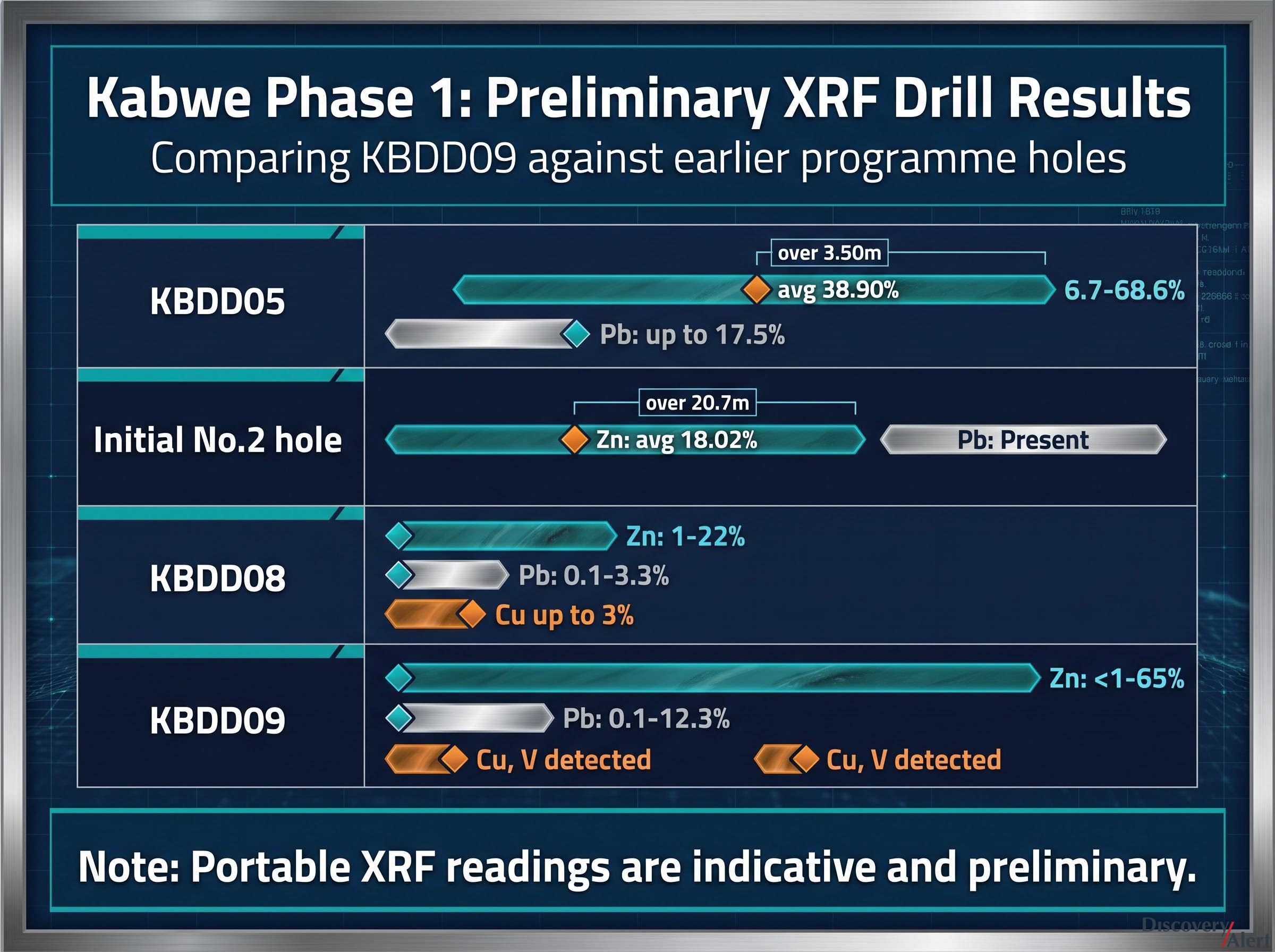
Portable XRF readings from KBDD09 returned zinc grades across defined mineralised intervals ranging from below 1% to 65%, with lead grades from 0.1% to 12.3%. Copper and vanadium were also detected at grades consistent with historically documented mineralisation at Kabwe.
These numbers require immediate context. All figures are portable XRF spot readings, which are preliminary machine-based measurements. They are not certified assays.
Portable XRF readings are a standard first-pass tool in early-stage drilling programmes, and reading drill results with the same interpretive lens a geologist applies means understanding what XRF spot measurements can and cannot tell you before laboratory assays are complete.
Compliance note: Portable XRF readings are indicative and preliminary. Laboratory verification under NI 43-101/JORC standards is required before any of these figures can be used in resource estimation. This caveat applies uniformly across the Kabwe drilling programme.
The KBDD09 readings sit within the range returned by earlier holes in the programme, providing internal consistency across the dataset:
| Hole | Target Zone | Zn Range (XRF) | Pb Range (XRF) | Other Metals |
|---|---|---|---|---|
| KBDD05 | No.2 orebody | 6.7-68.6% (avg. 38.90% over 3.50 m) | Up to 17.5% | — |
| Initial No.2 hole | No.2 orebody | Avg. 18.02% over 20.7 m | Present | — |
| KBDD08 | Speaks/Mine Club (N) | 1-22% | 0.1-3.3% | Cu up to 3% |
| KBDD09 | New southern zone | <1-65% | 0.1-12.3% | Cu, V detected |
The zinc grades detected in KBDD09 are directionally consistent with, and in places comparable to, the high-grade intervals returned by earlier holes. This reinforces internal geological confidence while the results remain subject to formal laboratory verification.
The presence of zinc, lead, copper, and vanadium within the same mineralised intervals at KBDD09 is not simply a matter of finding more metals. In geological terms, the co-occurrence of multiple metals within a single zone is interpreted as a sign that the mineralising fluids responsible for depositing them were richer or more energetic than those associated with simpler, single-commodity zones.
CEO Richard Lloyd has stated that this multi-metal signature may indicate proximity to a more central or generative part of the mineralising system, suggesting zonal character at depth. Vanadium has been historically documented at Kabwe as the minerals vanadinite and descloizite in oxidised zones. Minor elements including gallium, germanium, and tungsten have also been flagged in earlier sampling.
The metals and minor elements identified across the Kabwe system to date:
Vanadium, gallium, germanium, and tungsten are not peripheral to the Kabwe story; each sits on major government critical minerals lists, and the African critical minerals strategy contest between the US and China is reshaping how projects with multi-element profiles like Kabwe’s attract sovereign and institutional attention.
Surface XRF sampling has returned readings of up to 36.13% Zn and 9.63% Pb, with tungsten also detected, consistent with strong near-surface mineralisation extending across the project area.
When multiple metals appear in distinct spatial patterns within a single deposit, geologists interpret this as evidence that the hydrothermal system, the hot, mineral-bearing fluid that originally deposited the metals, had enough energy and chemical complexity to create different mineral zones at different distances from its source. The emerging copper oxide mineralisation in the central and southern Speaks/Mine Club areas is consistent with this zonal interpretation.
Kabwe’s multi-metal signature, including copper oxide mineralisation in the central and southern Speaks and Mine Club areas, situates Shuka within a broader regional exploration story; Zambian copper exploration activity has intensified noticeably in 2026, with multiple junior operators acquiring licences and mapping new targets across the Copperbelt and surrounding provinces.
For readers tracking Kabwe, this reframes the project as a multi-element system rather than a simple zinc-lead play, broadening the range of commodities that future resource estimates may need to account for.
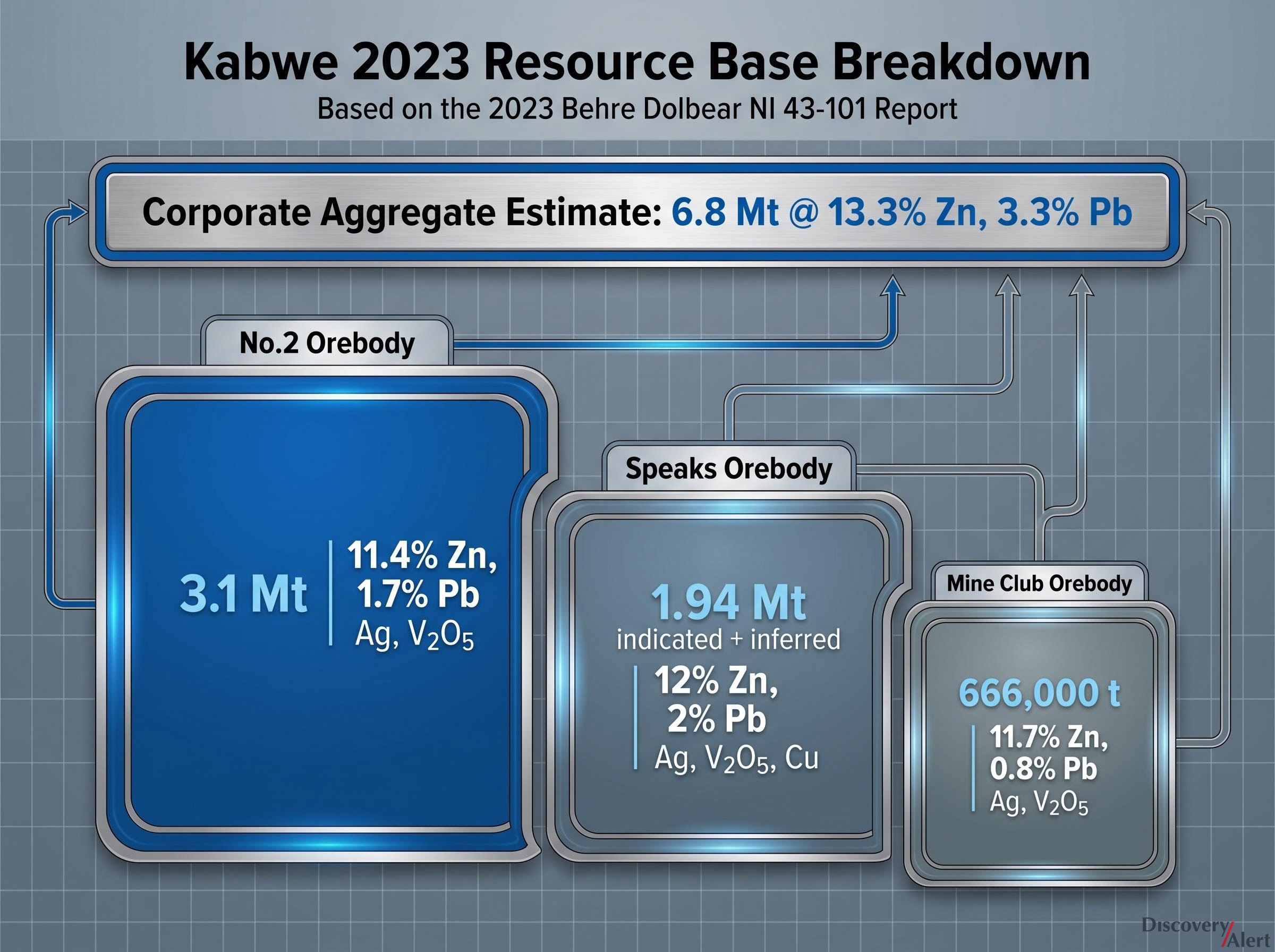
The 2023 Behre Dolbear NI 43-101 technical report documents three recognised orebodies at Kabwe, all described as open at depth:
| Orebody | Tonnage | Zn Grade | Pb Grade | Additional Metals |
|---|---|---|---|---|
| No.2 | 3.1 Mt | 11.4% | 1.7% | Ag, V₂O₅ |
| Speaks | 1.94 Mt (indicated + inferred) | 12% | 2% | Ag, V₂O₅, Cu (northern sections) |
| Mine Club | 666,000 t | 11.7% | 0.8% | Ag, V₂O₅ |
Shuka’s corporate aggregate estimate stands at 6.8 Mt at 13.3% Zn and 3.3% Pb. All three orebodies grade above 11% zinc.
The new southern zone confirmed by KBDD09 is not yet reflected in any NI 43-101 resource estimate. Laboratory assay results from KBDD09, KB010, and KB011 are required before resource estimation work for the new zone can commence. With a corporate aggregate approaching 7 Mt, the existing base provides meaningful context for evaluating whether the southern zone has the potential to be a material addition to the project.
The pathway from XRF discovery to a formal resource update involves several sequential steps, each dependent on the last:
The NI 43-101 technical report requirements mandate that any resource estimate incorporated into public disclosure must be supported by a qualified person sign-off and certified laboratory assay data, which is why the pathway from KBDD09’s XRF readings to a formal resource update involves multiple sequential verification steps before the southern zone can be reflected in Kabwe’s stated resource base.
KBDD09 is the ninth hole completed at Kabwe. Its completion, alongside KB010 and KB011, represents the final elements of the expanded 2,500 m Phase 1 programme, which was originally scoped at 2,000 m and extended following encouraging early results.
Shuka has indicated it anticipates Ox Drilling returning to site for a Phase 2 programme later in 2026. That programme is expected to be informed by the southern orebody identification and the apparent thickening of mineralisation observed across Phase 1 results. The significance of KBDD09 will be quantified progressively over the coming months rather than immediately.
The core significance of KBDD09 is structural. It confirms that mineralisation at Kabwe extends beyond the boundaries mapped in the 2023 NI 43-101 report, opening a new spatial dimension for the project that prior resource estimates had not accounted for.
The full picture will not be available until laboratory assays, KB010 and KB011 results, and Phase 2 drilling are complete. This is the beginning of a longer discovery sequence rather than a closed result.
What is clear is that Kabwe is demonstrating the characteristics of a multi-element, spatially open system, which is the condition that supports continued exploration investment.
This article is for informational purposes only and should not be considered financial advice. Investors should conduct their own research and consult with financial professionals before making investment decisions. All XRF figures referenced in this article are preliminary portable XRF spot measurements, not certified assays. These statements regarding future drilling and resource estimation are speculative and subject to change based on laboratory results and company performance.
Shuka Minerals confirmed a previously undocumented near-surface orebody at Kabwe, with drill hole KBDD09 intersecting zinc, lead, copper, and vanadium mineralisation in a zone located several hundred metres south of the established Speaks and Mine Club orebodies, an area not included in the 2023 Behre Dolbear NI 43-101 technical report.
Portable XRF readings are preliminary machine-based spot measurements used as a first-pass tool in early-stage drilling programmes; they are indicative only and must be verified by certified laboratory assays under NI 43-101 or JORC standards before they can be used in formal resource estimation.
KBDD09 returned preliminary XRF readings showing zinc grades ranging from below 1% to 65% and lead grades from 0.1% to 12.3%, with copper and vanadium also detected, consistent with the multi-metal mineralisation historically documented across the Kabwe project.
The 2023 Behre Dolbear NI 43-101 report documents three orebodies at Kabwe, being the No.2, Speaks, and Mine Club deposits, with a corporate aggregate estimate of 6.8 Mt at 13.3% zinc and 3.3% lead, all grading above 11% zinc and all described as open at depth.
The immediate next steps include laboratory assay verification of the KBDD09 drill core, finalisation of the GeoQuest Phase 1 report, geological modelling incorporating results from KB010 and KB011, and eventually an NI 43-101 technical report update for the new southern zone, followed by an anticipated Phase 2 drilling programme later in 2026.


