
Saudi Aramco’s Exports Hold, but War-Risk Costs Tell a Darker Story
Aug 17, 2026


Argus Media launched five new El Paso price assessments on 11 August 2026, creating the first dedicated diesel and gasoline benchmarks for a city that has operated as a Southwest fuel corridor for years without the formal pricing architecture to match. The launch covers one ultra-low sulphur diesel (ULSD) FOB benchmark and four conventional blendstock for oxygenate blending (CBOB) gasoline assessments, published as both outright daily prices and differentials to Gulf Coast Colonial pipeline benchmarks. For traders, distributors, and cross-border exporters who have priced El Paso fuel deals off distant Gulf Coast references with negotiated basis adjustments, the gap between commercial reality and pricing infrastructure is now closed. What follows is an analysis of the structural forces that made this formalisation inevitable, what the five new assessments change for participants across the supply chain, and why benchmark creation tends to accelerate the very commercial development it reflects.
The scope of the launch signals how seriously Argus is treating this location. Five products, not one. Outright prices alongside differentials. Integration into the flagship Argus US Products report, placing El Paso within mainstream North American refined-product pricing rather than a regional supplement.
The five new assessments cover:
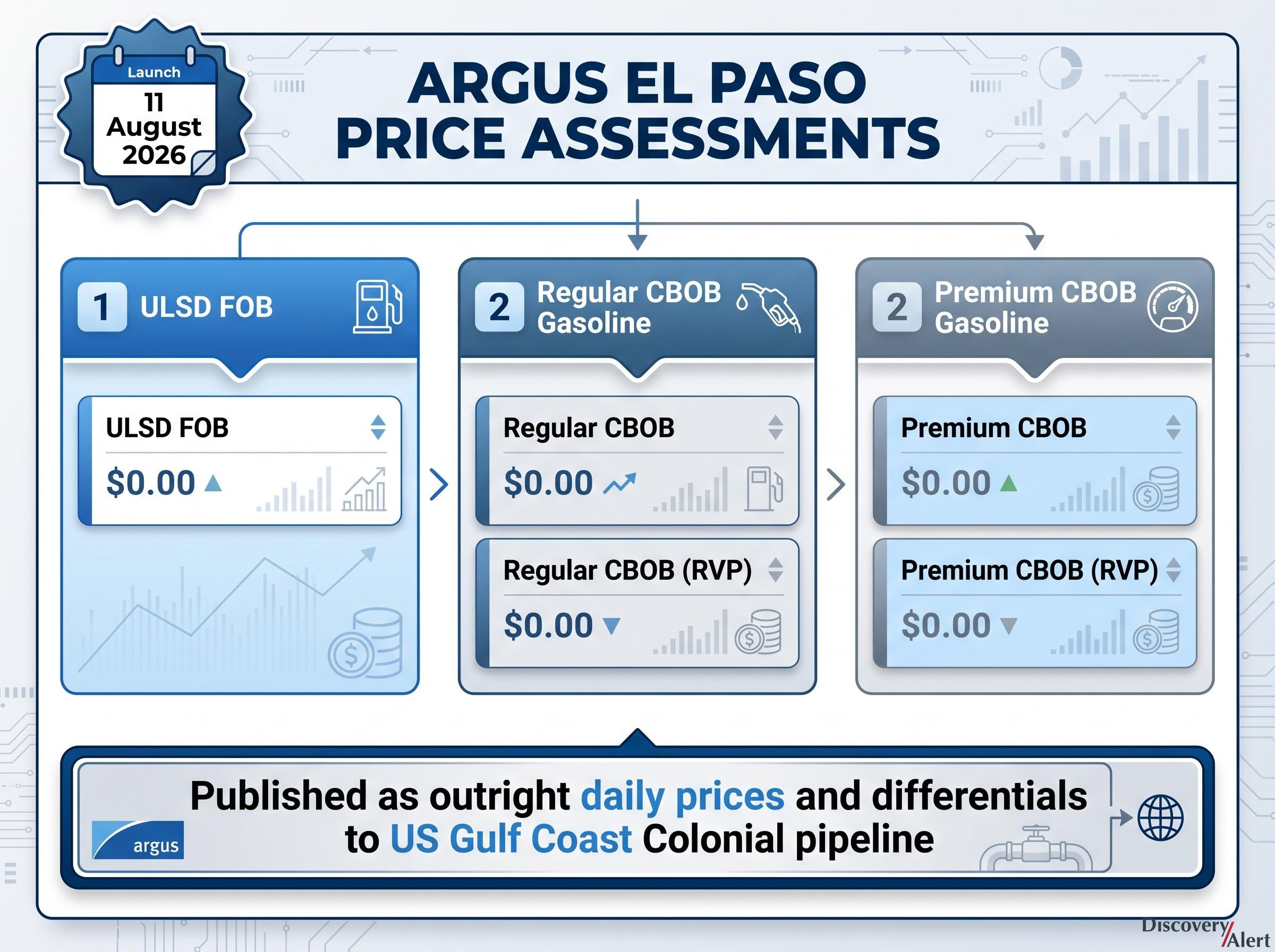
Argus describes El Paso as a “refining hub” and a gateway for westward-moving Gulf Coast product, characterising the city as central to gasoline and diesel flows across the broader Southwest.
Distillates editor Amanda Hilow and gasoline editor Jared Ainsworth at Argus Media lead the coverage. The format choice itself carries analytical weight: by publishing El Paso as a differential to Gulf Coast Colonial, Argus is positioning this hub within the existing pricing chain, not outside it.
The Argus launch did not arrive in a vacuum. Four distinct forces have been converging on El Paso for years, each reinforcing the others until a dedicated benchmark became less a commercial luxury than a market necessity.
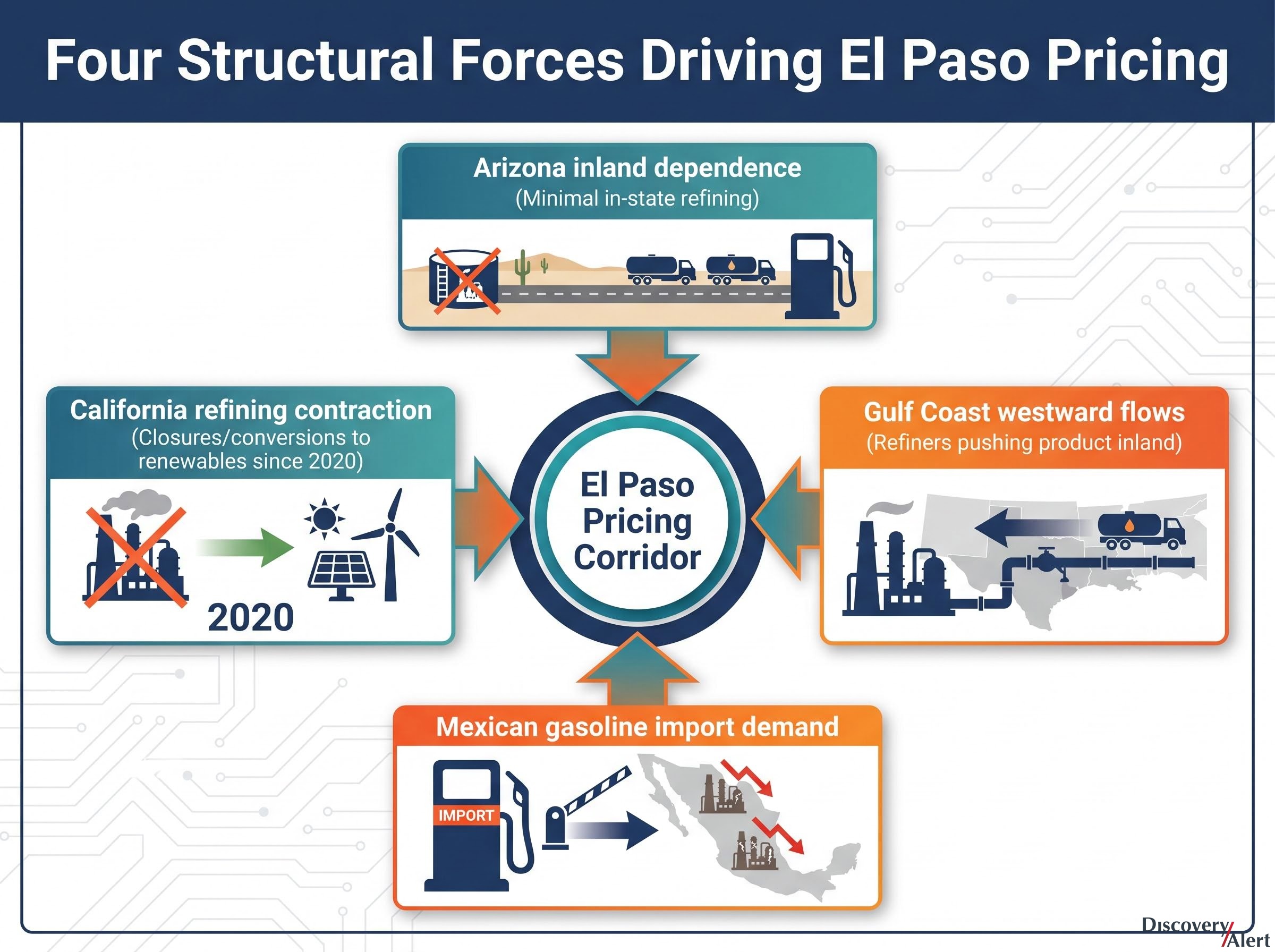
| Force | Primary Driver | Impact on El Paso Role |
|---|---|---|
| California refining contraction | Refinery closures and conversions to renewable fuels since 2020 | Strengthens inland pricing points as California’s conventional output declines |
| Gulf Coast westward flows | Gulf Coast refiners pushing product into inland corridors | Positions El Paso as the corridor reference for westward-moving fuel |
| Arizona inland dependence | Minimal in-state refining; heavy pipeline and terminal reliance | Creates persistent demand for transparent inland pricing at El Paso |
| Mexican gasoline import demand | Underperforming domestic Mexican refineries sustaining high US import volumes | Anchors El Paso as a border crossing hub for fuel exports to northern Mexico |
California Energy Commission documentation records a series of refinery closures and conversions to renewable fuels production since 2020, reducing the state’s conventional refining capacity and increasing its reliance on out-of-state supply. That contraction pulls product westward from inland pricing points. El Paso sits squarely on that corridor.
EIA analysis of California refinery closures and renewable fuel conversions since 2020 documents a capacity loss of approximately 17% of the state’s conventional refining output, a contraction large enough to structurally redirect westward product flows toward inland corridor hubs like El Paso.
Gulf Coast refiners, meanwhile, have increased the volume of product moving west. Argus frames this westward movement as a core driver of El Paso’s elevated regional role, a dynamic the new differential-based assessments are designed to capture.
Arizona has minimal in-state refining capacity. The state is heavily reliant on pipelines and terminals linked to Texas, New Mexico, and southern California. As coastal supply grows more constrained, inland hubs like El Paso gain pricing importance for Arizona buyers.
South of the border, EIA and Mexican government data show sustained high US gasoline import volumes driven by underperforming domestic Mexican refineries. El Paso, directly facing Ciudad Juárez, serves as a primary crossing point for these flows. The benchmark formalises a trade route that has been commercially active for years.
US energy price vulnerability persists even when domestic output is at record levels, because regional supply corridors, local refining constraints, and pipeline infrastructure gaps create price differentials that national production figures cannot smooth out.
The distinction matters. A rack price reflects local, point-of-sale conditions at a single terminal. A corridor benchmark operates differently: it serves as the reference for a broader region’s physical and contractual flows, arbitrating product movement across a much larger geography.
El Paso now functions as the western corridor reference in a pricing chain that begins with Gulf Coast refiners and Colonial pipeline benchmarks on the eastern side. Product moves westward along pipeline and truck distribution routes, and El Paso prices capture the economics of that movement before fuel disperses into New Mexico, Arizona, and northern Mexico.
Global oil flow disruptions at maritime chokepoints have reinforced the strategic value of overland pipeline corridors and inland pricing hubs, as traders seek routes and reference points that are insulated from seaborne supply shocks.
Argus frames El Paso as a “key pricing point for westward-moving Gulf Coast product” and a “gateway for fuel exports to Mexico,” characterising the city as central to gasoline and diesel supply across the broader Southwest.
Argus also characterises El Paso as a refining hub in its own right, not purely a transit point, reflecting local production capacity alongside its corridor function. That dual role, both producer and distributor, is what gives the new assessments commercial weight beyond the immediate region. Buyers and sellers in states and countries that never directly touch El Paso will find its prices relevant to their contract structures.
A price benchmark solves a fundamental commercial problem: when two counterparties disagree on the fair price for a commodity at a specific location, they need a transparent, third-party reference to resolve the dispute. That reference must be independent, methodologically transparent, and built on observable market activity rather than modelled estimates.
Broader crude oil market dynamics, including OPEC production decisions, refinery utilisation rates, and shifting global demand centres, feed directly into the wholesale refined-product prices that benchmarks like El Paso’s new ULSD and CBOB assessments are designed to capture at the regional level.
Argus describes the El Paso assessments as the first dedicated diesel and gasoline prices for the city, confirming that the market previously operated without a location-specific benchmark. Prior El Paso trades were priced against Gulf Coast benchmarks with negotiated or modelled basis adjustments, a process that introduced friction and opacity at every stage.
Benchmarks are launched when commercial activity in a location reaches a volume and frequency where participants benefit more from a shared reference than from individual negotiation. Once launched, a credible benchmark triggers a self-reinforcing cycle:
Argus paired the benchmark launch with a dedicated podcast episode (“Driving Discussions: El Paso’s New Role in US Fuel Pricing”), an insight paper on the El Paso diesel market, and editorial coverage in the Argus US Products report, all released 11-12 August 2026. That level of institutional commitment signals sustained attention, not a one-cycle addition.
The practical implications vary by role, but the underlying benefit is the same: a transparent, location-specific benchmark replaces estimation with precision.
El Paso regular gasoline was reported at approximately $3.95/gal in 2026 (AAA reporting), compared with a Texas state average of approximately $3.56-$3.63/gal. AAA Texas noted El Paso among the highest regular gasoline prices among major Texas metros.
That retail premium over the Texas average illustrates why El Paso is materially distinct enough to warrant its own wholesale reference. Local supply constraints and corridor economics produce a pricing environment that Gulf Coast benchmarks alone cannot accurately represent.
The benchmark reflects what El Paso already is. The more important question is what it is likely to become.
Benchmark formalisation historically precedes infrastructure investment. Once contracts are standardised around a location, the business case for physical capacity sharpens. Three categories of investment are most likely to follow:
El Paso’s geographic position, a Texas border city on Gulf Coast pipeline corridors, adjacent to New Mexico and Arizona, directly facing Ciudad Juárez and northern Mexico fuel demand, makes it structurally well-positioned for continued investment regardless of short-term price volatility.
Structural supply deficit dynamics in global crude and refined products markets create the underlying price pressure that makes regional benchmarks like El Paso’s new assessments commercially significant beyond their immediate geography, as tighter supply amplifies the cost of basis uncertainty for buyers and sellers in inland corridors.
Argus’ commitment of editorial resources, including two dedicated editors, a podcast, and an insight paper, signals that the agency regards El Paso as a sustained focus area in the US products complex. The feedback loop is now active. More structured trades generate more liquidity, which supports expanded spot and term trading, which encourages the infrastructure investment that deepens the hub’s commercial gravity.
The Argus benchmark launch is the formal marker of a structural shift that has been building through California’s refining contraction, Arizona’s inland supply dependence, Gulf Coast westward flows, and Mexico’s persistent import demand. The commercial significance for traders, distributors, and exporters is immediate and practical: transparent, location-specific pricing that replaces estimation with a shared reference.
The structural forces behind El Paso’s rise remain in place, and the benchmark feedback loop is now active. El Paso’s role in Southwest fuel pricing is more likely to deepen than to plateau.
This article is for informational purposes only and should not be considered financial advice. Investors should conduct their own research and consult with financial professionals before making investment decisions.
Readers seeking to monitor El Paso price movements should follow the Argus US Products report and the five new El Paso assessments as a primary reference for Southwest corridor pricing decisions.
The El Paso fuel pricing hub is a regional wholesale pricing reference point for diesel and gasoline in the US Southwest corridor, connecting Gulf Coast supply to inland markets in Arizona, New Mexico, and northern Mexico. Argus Media formalised this hub in August 2026 by launching five dedicated price assessments, replacing the previous practice of applying negotiated basis adjustments to distant Gulf Coast benchmarks.
Argus launched one ULSD FOB El Paso benchmark and four CBOB gasoline assessments covering regular and premium grades, each published as both outright daily prices and as differentials to the corresponding Gulf Coast Colonial pipeline benchmarks in the Argus US Products report.
Four structural forces converged to make a dedicated benchmark necessary: California's conventional refining contraction since 2020, increased Gulf Coast westward product flows, Arizona's heavy reliance on pipeline supply with minimal in-state refining, and sustained Mexican gasoline import demand driven by underperforming domestic Mexican refineries.
A dedicated El Paso benchmark allows traders, inland distributors, and US-Mexico exporters to quote, hedge, and settle contracts against a transparent, location-specific price rather than estimated Gulf Coast basis adjustments, reducing pricing disputes and negotiation friction on both spot and term deals.
Benchmark formalisation historically precedes physical and financial infrastructure growth; in El Paso's case, the most likely downstream developments include terminal storage expansion, increased pipeline throughput capacity on Gulf Coast-to-Southwest corridors, and the emergence of swaps and basis trade instruments referencing the new El Paso assessments.


