
Aramco Targets Europe With Deeper-Than-Expected Crude Price Cut
Aug 17, 2026


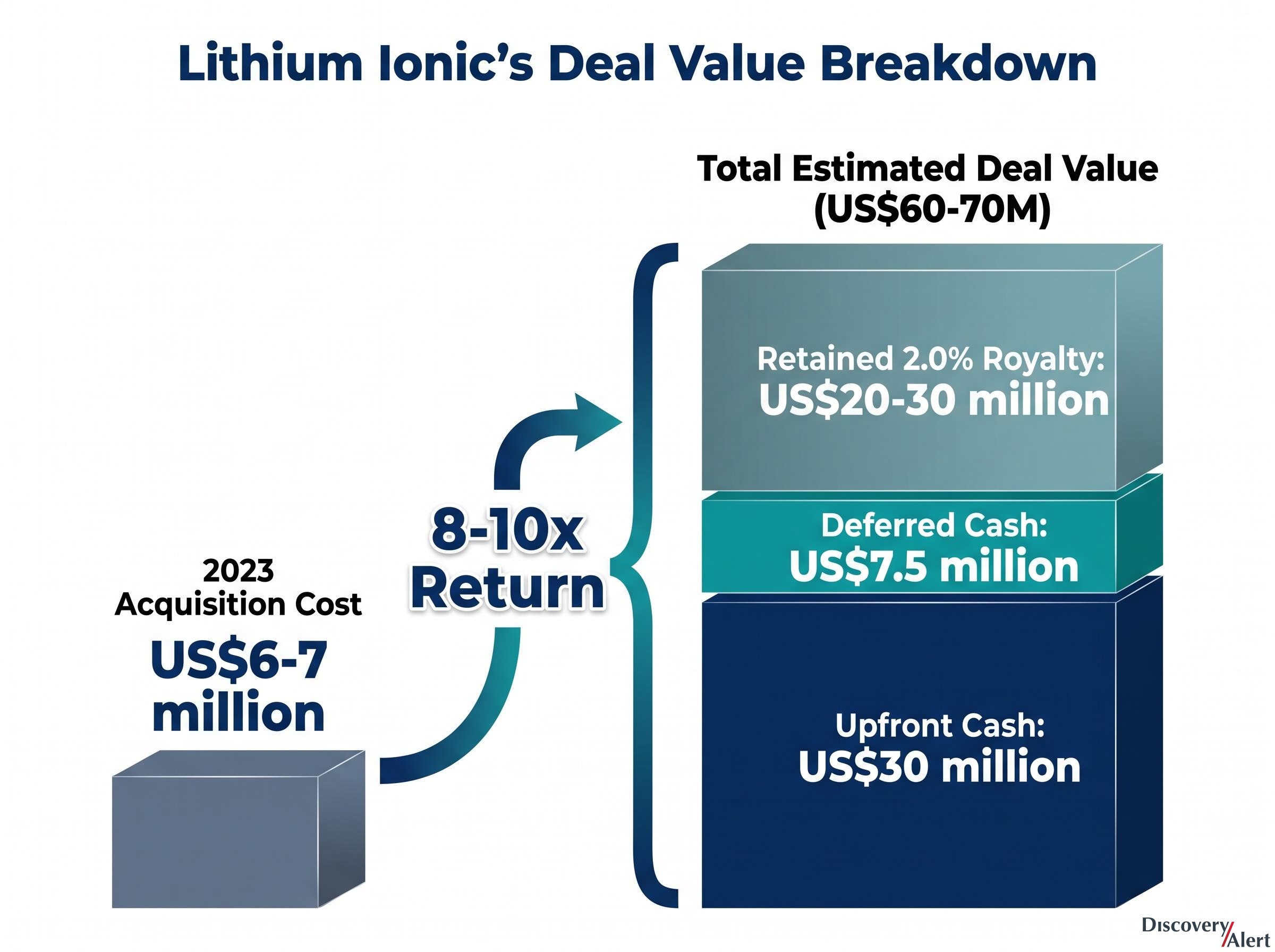
Lithium Ionic has agreed to sell its Salinas group of lithium properties in Brazil to Pilbara Minerals for US$37.5 million in cash, retaining a 2.0% net smelter royalty on future spodumene sales from the Baixa Grande deposit. Management and analyst estimates place the total transaction value at US$60-70 million, representing approximately 8-10 times the original acquisition cost of the assets in 2023. The deal, announced on 12 August 2026, arrives at a moment when lithium developers face intense scrutiny over how they fund construction without punishing shareholders through equity dilution. For investors tracking the company’s path from developer to producer, the transaction reshapes the story: US$30 million in near-term non-dilutive capital directed at the flagship Bandeira project, a deferred cash tranche tied to Pilbara’s own development timeline, and a passive royalty stream that preserves exposure to Baixa Grande’s production upside indefinitely.
The definitive agreement, signed 12 August 2026, covers the Salinas group of properties: ten mineral claims and associated assets with Baixa Grande as the centrepiece resource. Pilbara Minerals will pay US$37.5 million in two tranches, and Lithium Ionic retains a 2.0% net smelter royalty on future spodumene sales from Baixa Grande through its subsidiary Neolit.
The payment structure, however, is not a single cash-at-close event.
| Tranche | Amount | Trigger / Timing |
|---|---|---|
| Initial payment | US$30 million | Payable at closing, expected within a few months of announcement |
| Deferred payment | US$7.5 million | Payable on the earlier of Pilbara’s Colina Final Investment Decision (FID) or 31 December 2029 |
The deferred tranche is the structural detail worth noting. The US$7.5 million second payment is tied to Pilbara’s own project decision at Colina, aligning the secondary cash event with a period when Bandeira is expected to be approaching or in production. Lithium Ionic receives substantial capital immediately while retaining a contingent payment linked to its buyer’s development timeline.
The US$37.5 million cash component is the disclosed figure. The full picture requires working through the royalty arithmetic.
Lithium Ionic management estimates each 1% royalty point carries approximately US$10-15 million in value. A 2.0% royalty therefore implies an additional US$20-30 million in value, bringing total estimated consideration to US$60-70 million.
Management estimates the retained 2.0% net smelter royalty at approximately US$10-15 million per percentage point, implying US$20-30 million in additional value. This is a management estimate, not a formal third-party valuation.
Royalty valuation and re-rating mechanics are rarely straightforward: market prices for retained royalty interests tend to lag the underlying asset’s development progress, which is precisely why Lithium Ionic’s management chose to express the 2.0% NSR value as a range rather than a fixed figure.
That figure gains credibility when cross-referenced against independent analyst work. Prior coverage applied Pilbara’s Colina acquisition multiple of approximately US$150/t LCE to Baixa Grande’s roughly 486,000 t LCE resource, yielding an implied value of approximately US$73 million.
The three components of the transaction’s value stack as follows:
The implied 8-10x return on the original acquisition cost, and the fact that the total deal value was characterised as roughly equivalent to Lithium Ionic’s entire market capitalisation at announcement, underscores the degree to which the market had not been pricing Baixa Grande into the company’s valuation.
Baixa Grande is not a speculative exploration target. The January 2025 NI 43-101 Mineral Resource Estimate (MRE), a standardised technical report that quantifies the deposit’s size and grade based on drilling data, presents a deposit of meaningful scale.
| Category | Tonnage | Grade (Li₂O) |
|---|---|---|
| Measured and Indicated | 6.52 Mt | 1.11% |
| Inferred | 12.90 Mt | 0.96% |
| Total | ~19.42 Mt | 1.01% (~486,000 t LCE) |
The geological rationale for Pilbara’s acquisition is specific. Baixa Grande sits within Brazil’s Eastern Pegmatite Province, a region commonly referred to as Lithium Valley, in Minas Gerais. The deposit shares the same geological formation as the Colina deposit Pilbara acquired from Latin Resources as its principal Americas foothold.
The adjacency is direct. Consolidating Baixa Grande and Colina under a single operator is the structurally rational outcome for a company building a regional production hub. Lithium Ionic’s CEO characterised Pilbara as a cooperative partner, and the inclusion of a royalty arrangement was described as unusual for Pilbara, signalling the importance the company attached to completing this consolidation. No other buyer was likely to replicate this valuation, because no other buyer held the adjacent ground.
Brazil’s critical minerals investment landscape is attracting sovereign and institutional capital from multiple directions, with Minas Gerais in particular drawing attention as the Eastern Pegmatite Province establishes itself as a globally significant lithium production corridor.
A post-tax internal rate of return of approximately 61% is the number that anchors the Bandeira investment case.
The Updated Feasibility Study, completed in September 2025, presents a project with economics that place it among the more attractive undeveloped lithium assets in the Americas.
| Metric | Value |
|---|---|
| Post-tax NPV₈ | ~US$1.45 billion |
| Post-tax IRR | ~61% |
| Mine life | 18.5 years |
| Annual spodumene output | 177,000 tpa at 5.2% Li₂O |
| All-in sustaining costs | ~US$600/t |
| Modelled spodumene price | ~US$2,000/t |
Strong feasibility numbers alone do not make a project fundable. The off-take and financing architecture is what converts those economics into a proposition lenders can underwrite.
Benchmark Mineral Intelligence spodumene pricing data, current as of August 2026, places concentrate values at approximately US$2,000 per tonne, the same figure used as the modelled price in Bandeira’s Updated Feasibility Study and a key input to the project’s post-tax NPV calculation.
Lithium Ionic has signed binding five-year take-or-pay off-take agreements with Yahua Group and Grand Chen for a combined 170,000 tpa, effectively covering approximately 100% of planned output. These are not indicative or conditional arrangements.
The agreements include a US$20 million pre-payment facility explicitly designed to support project financing, not general working capital. A US$1,000/t floor price provision is embedded in the structure, providing lenders with visibility into minimum debt serviceability on every unit sold regardless of spot market conditions.
The combination of full off-take coverage, a floor price, and a pre-payment facility is the financing architecture that converts feasibility-stage economics from a planning document into a credible lender proposition.

The US$30 million initial proceeds from the Baixa Grande sale are earmarked for near-term operational requirements and procurement of long-lead production items at Bandeira. This directly addresses pre-production capital needs without equity dilution.
The project sits at construction-readiness. Engineering is substantially complete. Domestic power supply in Brazil has been secured. A contractor tender process for underground portals has been narrowed to a shortlist. Materials sourcing is well advanced.
One gating item remains: the federal operating permit (licença de operação), a regulatory approval required before construction can commence and final financing can close.
The sequenced pathway from the current position to first production runs as follows:
Management characterises current timeline projections as conservative.
Each step in this sequence removes a specific risk layer. The federal permit unlocks financing. Financing enables construction. The deferred tranche arrives as Bandeira approaches production. The pathway is sequential, not parallel, and the permit is the domino that sets the rest in motion.
These are forward-looking projections subject to permitting, financing, and execution outcomes.
Prior to this transaction, Lithium Ionic carried a dual-asset narrative. Baixa Grande sat in the portfolio as a secondary resource whose value was not reflected in the company’s market price. The sale crystallises that embedded value at a premium approximately equivalent to the company’s entire market capitalisation at announcement.
What the transaction removes:
What the transaction adds:
BMO and Streetwise analyst coverage frames the post-transaction investment case as centred on execution of a de-risked, feasibility-stage project. The royalty functions as a passive income layer once Pilbara reaches production at the consolidated Colina-Baixa Grande complex.
The federal operating permit for Bandeira is the single most consequential near-term catalyst. Its receipt triggers contractor award, financing close, and the start of the construction clock.
BMO and Streetwise analyst coverage flags construction licensing and environmental approvals as the near-term milestones institutional investors are watching. The catalyst sequence runs in order:
The deferred tranche, first royalty cash flows from Baixa Grande, and the production target itself all remain subject to permitting, financing, and FID outcomes. Investors evaluating entry timing have a single watchable event: the federal operating permit is the milestone that converts construction-readiness into active project execution.
The Bandeira ownership dispute adds a layer of legal complexity to the permitting and financing timeline: a lawsuit filed by Emerita over title to the project is a risk factor that institutional lenders and off-take counterparties will assess alongside the regulatory pathway.
The transaction offers a specific answer to a sector-wide question: how does a junior lithium developer fund construction without diluting shareholders into the ground?
Lithium Ionic’s approach combines three complementary funding levers:
Together, these mechanisms address the construction capital gap without the equity raises that conventionally erode per-share value for pre-production miners. No shares were issued. No dilution occurred.
Critical minerals financing at the project level increasingly relies on combinations of strategic buyer capital, sovereign-backed facilities, and off-take pre-payment structures because traditional debt markets alone cannot bridge the construction gap for projects of this scale.
The approach does carry a specific precondition. Pilbara’s willingness to pay a strategic premium was driven by the Colina adjacency, a geological rationale that made consolidation under a single operator the rational outcome. Not all junior developers hold assets with equivalent regional fit for a motivated acquirer. The model is replicable in principle but dependent on structural circumstances in practice.
A secondary asset acquired in 2023 for approximately US$6-7 million in equity consideration is sold in 2026 for an estimated US$60-70 million in total value. The proceeds fund the construction pathway for a flagship project with approximately US$1.45 billion in post-tax NPV and 100% off-take coverage.
The immediate watch item for investors is the federal operating permit for Bandeira. That single regulatory milestone is the event that sets the production timeline in motion, converting construction-readiness into contractor mobilisation, financing close, and groundbreaking.
Long after the US$30 million is deployed at Bandeira, Lithium Ionic retains a 2.0% net smelter royalty on every tonne of spodumene concentrate produced from Baixa Grande. The company no longer has to build or operate the asset. Pilbara bears the capital burden. Lithium Ionic holds the claim on output. Capital to build, a royalty to hold, and a single permitting milestone between the company and active construction.
This article is for informational purposes only and should not be considered financial advice. Investors should conduct their own research and consult with financial professionals before making investment decisions. All forward-looking statements regarding production timelines, deal completion, and royalty valuations are subject to permitting, financing, and execution outcomes. Past performance does not guarantee future results.
A net smelter royalty (NSR) is a percentage of revenue generated from the sale of mineral concentrates, payable to the royalty holder regardless of who operates the mine. Lithium Ionic retained a 2.0% NSR on Baixa Grande spodumene sales through its subsidiary Neolit, preserving ongoing economic exposure to the deposit's production upside without requiring any capital investment or operational responsibility.
While the headline cash figure is US$37.5 million, management estimates the total transaction value at US$60-70 million when the retained 2.0% net smelter royalty is included, with each 1% royalty point valued at approximately US$10-15 million. This represents an implied return of roughly 8-10 times the original acquisition cost of the Salinas properties in 2023.
The US$30 million initial cash payment received at closing is earmarked for near-term operational requirements and procurement of long-lead production items at the flagship Bandeira project in Brazil. The funds are specifically structured to advance Bandeira toward construction without issuing new shares or diluting existing shareholders.
The federal operating permit (licenca de operacao) is the key near-term catalyst, as its receipt triggers contractor award, financing close, and the start of the construction timeline. First production at Bandeira is targeted for the second half of 2027 extending into 2028, but the permit is the event that sets the entire sequence in motion.
Lithium Ionic is combining three non-dilutive funding mechanisms: US$30 million in asset sale proceeds from the Baixa Grande divestiture, a US$20 million pre-payment facility embedded in binding off-take agreements with Yahua Group and Grand Chen, and a retained 2.0% net smelter royalty that provides future passive income. No new shares were issued as part of this financing approach.


