
Aramco Targets Europe With Deeper-Than-Expected Crude Price Cut
Aug 17, 2026


Victoria’s resources sector has a new premier, a returning minister, and an industry body that has made clear it is done waiting. Ben Carroll became Victorian Premier on 28 July 2026 following Jacinta Allan’s resignation, and within days Jaclyn Symes was sworn in as Minister for Energy and Resources, a portfolio she previously held from November 2018 to August 2021. The Association of Mining and Exploration Companies (AMEC) responded immediately, but not with congratulations. CEO Warren Pearce issued a formal statement framing the transition as an opening for significant reform, paired with an explicit warning: modest adjustments would not be sufficient.
What follows is a briefing on AMEC’s specific criticisms of Victoria’s resources policy record, the concrete demands the industry body intends to put to both sides of politics ahead of the November 2026 state election, and the signals investors should track as the Carroll government defines its approach to a sector that has, by AMEC’s assessment, operated without a coherent investment strategy for years.
Pearce’s language was deliberate. AMEC’s August statement did not welcome Symes back to the portfolio with pleasantries and patient hope. It called for “significant reform” and stated plainly that marginal change would fall short of what the sector requires. The tone was conditional optimism at best, accountability framing at its core.
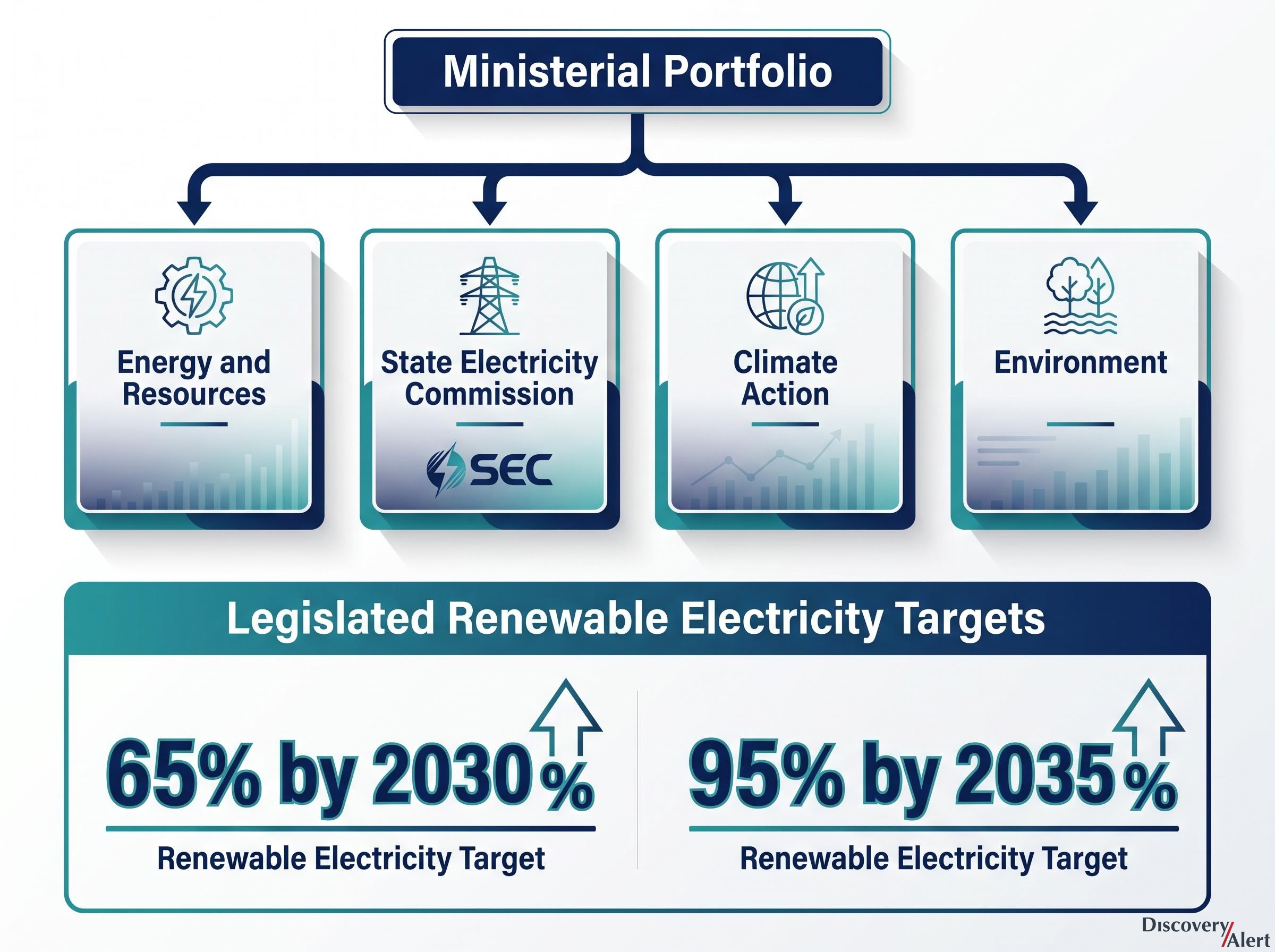
Symes returns to a portfolio she knows, but the scope of her responsibilities has expanded well beyond resources. Her combined ministerial brief now includes:
That breadth matters. Symes’ prior tenure gives her institutional knowledge of the sector’s pain points, but it also gives the sector a performance record to hold her against. AMEC has signalled it intends to do exactly that.
AMEC’s criticisms of Victoria’s policy settings are not new, but they have sharpened. The organisation contends the exploration and mining sector has been persistently treated as a low priority, with no coherent strategy to attract capital, accelerate mineral discoveries, or move projects from approval to development.
The cost pressures facing explorers illustrate the scale of the problem. The Victorian government’s own Regulatory Impact Statement for Earth Resources fees canvassed increases that quantify the regulatory burden AMEC has been warning about:
The Earth Resources Fees Regulatory Impact Statement, published by the Victorian Government in May 2025, confirms that current fees recover only 35.5% of regulatory costs, with an additional $13.7 million per year required to achieve full cost recovery, the factual basis underpinning the 234% increase figure AMEC has cited in its competitiveness warnings.
The Regulatory Impact Statement canvassed fee increases of approximately 234% to achieve full cost recovery for Earth Resources regulation, a figure that underscores the cost pressure facing exploration-stage companies operating in the state.
AMEC’s specific competitiveness criticisms, consistent across its public positions through 2026, include:
Critical mineral supply chains are being redefined at a global scale as new jurisdictions compete for capital and processing capacity, which reframes Victoria’s strategic ambiguity not merely as a domestic competitiveness question but as a decision about whether the state participates meaningfully in a structural industrial shift.
In its response to the 2024-25 Victorian Budget, AMEC welcomed the decision not to increase royalties or fees and acknowledged new funding for regulator capability. It simultaneously criticised the lack of clarity around Victoria’s critical minerals ambitions. The pattern is one of isolated positives within a broader setting of strategic ambiguity.
AMEC has indicated it will release a 2026 Victorian Election Platform targeting both government and opposition, framing resources policy as a bipartisan economic priority. The document is designed to establish concrete, measurable benchmarks rather than aspirational talking points, and its release ahead of the November 2026 state election gives it political leverage.
Based on AMEC’s advocacy history and stated positions, the platform is expected to centre on five priority areas:
The absence of a defined state strategy sits within a broader national context where critical minerals financing has increasingly required sovereign capital commitments to unlock private investment, a dynamic that makes Victoria’s strategic ambiguity particularly costly relative to jurisdictions that have moved decisively.
AMEC has been consistent that these priorities function as a package. Isolated adjustments on one or two fronts, while leaving structural issues unaddressed, would not meet the organisation’s stated threshold for meaningful reform.
For investors less familiar with Victorian policy architecture, one structural feature of Symes’ appointment carries particular weight. Resources, climate action, and environment sit within a single ministerial portfolio. This is not a bureaucratic detail; it is the mechanism through which competing policy pressures will be resolved.
Victoria’s legislated renewable energy targets, set out in official state policy, mandate 65% renewable electricity by 2030 and 95% by 2035, the binding commitments that frame every resource and approvals decision the minister will make across energy, environment, and climate portfolios simultaneously.
Victoria has legislated renewable electricity targets of 65% by 2030 and 95% by 2035. These commitments frame every resource policy decision the minister makes. The question is not whether Victoria supports renewables or resources. It is whether critical minerals and resource development are positioned as essential enablers of the energy transition, or as tightly constrained secondary activity.
| Sector development priorities | Government energy transition commitments |
|---|---|
| Faster approvals for exploration and mining | 65% renewable electricity by 2030 |
| Critical minerals project development | 95% renewable electricity by 2035 |
| Stable royalties and reduced fee burden | Large-scale offshore wind development |
| Increased geoscience and exploration support | Gas demand reduction and transition planning |
For investors in battery metals, critical minerals, or exploration-stage assets, the framing of resource development within this transition agenda is the single most consequential policy variable. Projects that can be positioned as transition-critical may face a materially different regulatory environment than those that cannot.
Battery metals market dynamics have shifted materially at the global level, with nickel supply structures reshaped by Indonesia’s processing expansion in ways that affect the relative attractiveness of new exploration projects, context that sharpens the stakes of Victoria’s positioning for investors weighing domestic versus offshore exposure.
The next several months will be unusually information-rich for anyone with exposure to Victorian resources. Four specific signals will determine whether the Carroll government’s response matches the scale of reform AMEC has demanded:

AMEC has made clear the sector will hold new leadership against concrete benchmarks rather than goodwill gestures. The organisation’s stated position is that this transition creates an opening for significant reform, and that modest adjustments are insufficient.
Investors who track these specific milestones rather than waiting for headline announcements will be best positioned to assess whether the Carroll government’s actions align with AMEC’s stated reform expectations.
The opportunity and the risk are both clearly defined. A meaningful policy reset, one that addresses fees, approvals, and critical minerals strategy as a package, could close part of Victoria’s credibility gap relative to competing Australian jurisdictions and direct capital toward under-appreciated exploration assets. A failure to respond substantively would reinforce the state’s position as a second-tier destination for resources investment, exactly the outcome AMEC has spent years warning against.
Global critical minerals competition has intensified beyond bilateral trade disputes, with major powers now embedding minerals access into strategic foreign policy frameworks, a geopolitical backdrop that gives Australian states with credible resources policies a structural advantage in attracting internationally-oriented capital.
This is not an open-ended policy conversation. The November 2026 state election provides a hard deadline, and AMEC has ensured there is no ambiguity about what the sector considers success. Pearce’s framing of the Carroll transition as an opening for significant reform, held against the explicit caveat that modest adjustments fall short, sets the terms clearly.
For investors, the forward indicators are the AMEC platform release, the government’s fee and approvals decisions, and the substance of any critical minerals policy commitment. The Carroll government’s response to these benchmarks will function as a leading indicator of Victorian resources policy direction for the next electoral cycle.
This article is for informational purposes only and should not be considered financial advice. Investors should conduct their own research and consult with financial professionals before making investment decisions.
AMEC, the Association of Mining and Exploration Companies, is an industry body that represents exploration and mining companies across Australia, advocating for competitive policy settings on fees, royalties, approvals, and critical minerals strategy at both state and federal levels.
AMEC is pushing for fee moderation to counter a potential 234% increase canvassed in the Regulatory Impact Statement, royalty and tax stability, a defined critical minerals strategy, faster and more predictable project approvals, and increased geoscience and exploration support programs.
Victoria's legislated targets of 65% renewable electricity by 2030 and 95% by 2035 sit within the same ministerial portfolio as resources, meaning how the government frames critical minerals, as either essential enablers of the energy transition or tightly constrained secondary activity, will directly shape the regulatory environment for exploration and mining projects.
The May 2025 Regulatory Impact Statement confirmed that current fees recover only 35.5% of regulatory costs, with an additional $13.7 million per year required for full cost recovery, and it canvassed fee increases of approximately 234%, a level AMEC argues would price marginal exploration projects out of viability.
Investors should monitor the release of AMEC's 2026 Victorian Election Platform, government decisions on Earth Resources fee levels, approvals performance against the existing 95% on-time processing benchmarks, and whether the Carroll government produces a concrete critical minerals strategy with defined enabling measures before the November 2026 state election.


