
Barys Resources Begins Five-Week Fieldwork to Define First Drill Targets in Kazakhstan

Barys kicks off detailed fieldwork across 335km² of 100%-owned Kazakhstan gold ground
Barys Resources (ASX: BRY) has commenced a first-stage work programme on its 100% owned exploration licences in the north Balkhash Region of Kazakhstan. The programme covers 335 km² across tenements 4238-EL and 4412-EL, targeting gold (±copper) associated with high-level silicification. This fieldwork builds on earlier work that identified seven alteration zones and gold workings within the licences, with the programme designed to generate defined drill targets ahead of an initial drilling campaign.
When big ASX news breaks, our subscribers know first
Why this fieldwork matters for the drill path ahead
The work programme is strategically designed to convert alteration signatures into drill-ready targets, de-risking the exploration process before the Company commits to drilling. The fieldwork builds on prior results from Barys that identified seven alteration zones and gold workings, with the current phase focused on refining these targets using detailed geochemical and geophysical data.
The Company has engaged leading geological consultants in epithermal and porphyry mineralisation to conduct the programme. A widescale alteration study using Aster and Sentinel 2 satellite imagery has already been completed to vector into alteration zones associated with specific geological structures, providing a framework for the ground-based work.
The field programme comprises four key components:
- Detailed geological mapping and sampling
- Ground magnetic surveys
- Detailed soil sampling programmes across the seven selected alteration areas
- Detailed gravity survey to test the more prospective areas
For investors, this systematic approach aims to vector into the most prospective zones rather than drilling blind, improving the probability of drill success and reducing capital risk in the initial drilling phase.
Understanding high-level epithermal gold systems
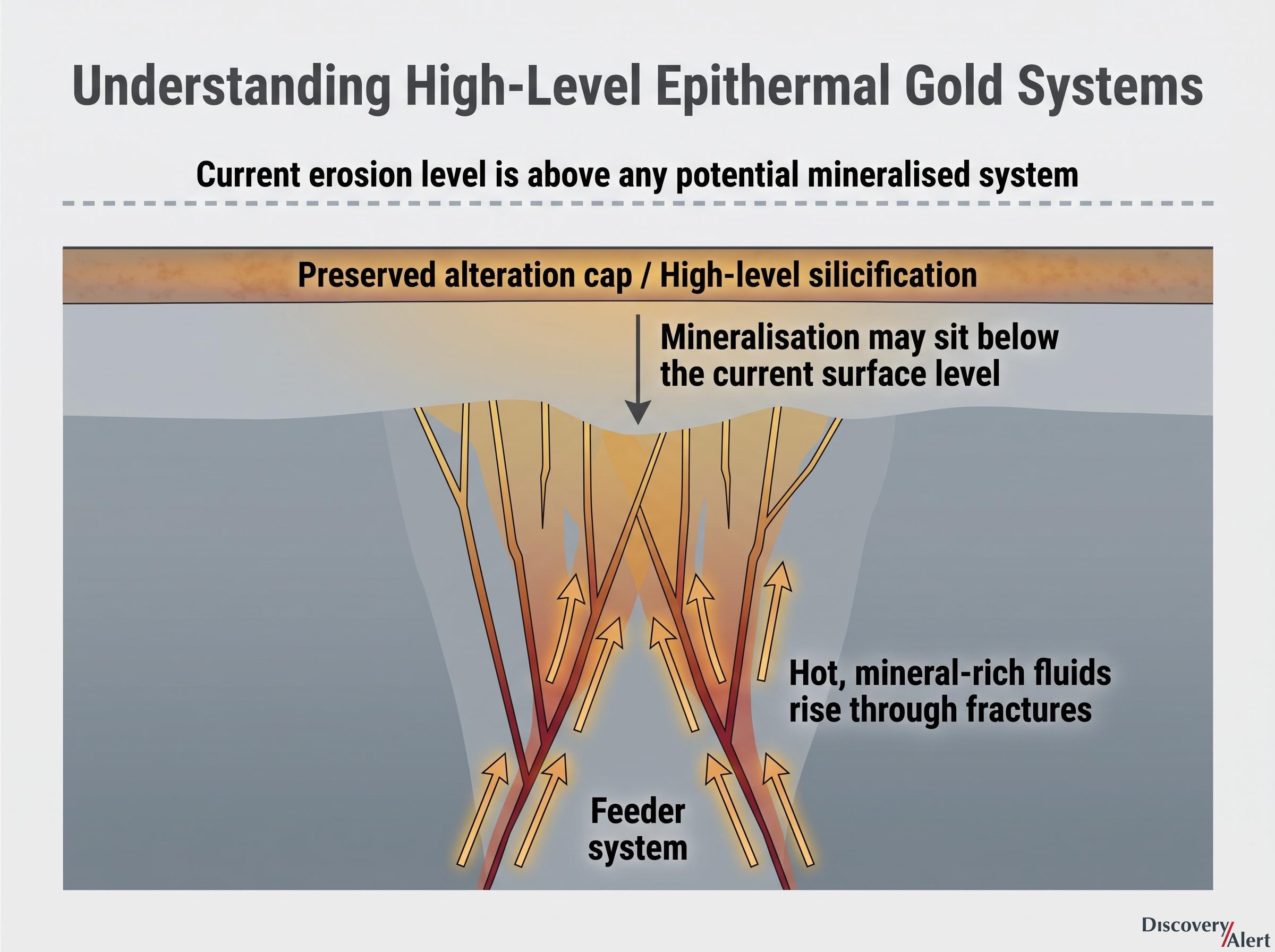
Epithermal gold systems form when hot, mineral-rich fluids rise through fractures in the Earth’s crust and deposit gold as they cool near the surface. High-level silicification — the conversion of rock into silica-rich material — and alteration zoning (changes in rock chemistry and mineralogy) are used as vectoring tools to trace these fluids back to their source, or “feeder system,” where higher-grade mineralisation may be concentrated.
The style of alteration identified in the region is described as high level epithermal, with strong indications that the current erosion level is above any potential mineralised system. In simple terms, this means the preserved alteration cap suggests that mineralisation may sit below the current surface level. The alteration visible today acts as a pointer to deeper targets.
Satellite imagery (Aster and Sentinel 2) is used to map alteration remotely across large areas by detecting spectral signatures of specific minerals. This allows explorers to identify prospective zones before committing to ground-based fieldwork, improving targeting efficiency and reducing costs.
For investors, this technical approach is aimed at improving drill-targeting success by using alteration as a pathfinder to mineralisation rather than relying on blind exploration.
The work programme and timeline to first drilling
The programme is expected to take five weeks to complete. At the conclusion of fieldwork, samples will be submitted to an internationally credited laboratory for geochemical analyses. This work will form the basis for the Company’s initial drilling programme in Kazakhstan.
The table below outlines how each component of the programme contributes to drill targeting:
| Programme Step | Purpose | Investor Significance |
|---|---|---|
| Geological mapping & sampling | Ground-truth alteration signatures | Refines targets and validates satellite data |
| Ground magnetics & gravity | Define subsurface structures | Identifies potential feeder zones for mineralisation |
| Detailed soil sampling | Detect geochemical anomalies | Highlights drill-ready areas with elevated gold signatures |
| Laboratory analyses | Confirm geochemical results | Forms the basis for initial drilling programme |
Paul Ingram, Managing Director
“This phase of our planned work is classic gold exploration, where several previously unrecognised mineral systems have been defined utilising alteration zoning to define feeder systems. Tracing geochemical and geophysical anomalies from this work will enable careful drill planning for the next phase of work.”
The next major ASX story will hit our subscribers first
Barys Resources at a glance
Barys Resources is an ASX-listed mineral explorer focused on Africa and Central Asia, with a multi-jurisdiction, multi-commodity portfolio. The Kazakhstan work programme positions the Company to advance its gold exploration toward drilling in the near term.
The Company’s broader portfolio includes:
- Central Asia: Two gold exploration licences in the North Balkhash region, Kazakhstan — the Dalnee Gold Project and Karakul Gold Project
- Niger: 100% of the Agadez Uranium Project in the Tim Mersoi Basin
- Botswana: 10% of Icon-Trading and Ashmead Holdings, which hold the Ghanzi West Copper-Silver Project (six prospecting licences)
- Botswana: 25% of Alvis-Crest, holder of two prospecting licences in the Kalahari Copper Belt (the Virgo Project)
For investors, this positions Barys as a multi-jurisdiction, multi-commodity explorer with gold exposure now advancing toward drilling in Kazakhstan.
Want the Next Kazakhstan Gold Discovery Before Drilling Begins?
Join 30,000+ investors getting FREE breaking ASX news delivered within minutes, complete with in-depth analysis. Click the “Free Alerts” button at Discovery Alert to receive real-time alerts the moment exploration and drilling updates are announced across the mining sector.