
Saudi Aramco’s Exports Hold, but War-Risk Costs Tell a Darker Story
Aug 17, 2026


Global copper demand is projected to exceed supply by 30% by 2035, according to International Energy Agency analysis. The average new mine takes 17-20 years from discovery to production. Any deposit found today will not meaningfully contribute to global supply until the 2040s.
That collision of accelerating demand and immovable supply timelines is the defining feature of the copper market in 2026. Copper is no longer simply an industrial metal tied to construction cycles. The simultaneous acceleration of AI infrastructure buildouts, data centre expansion, and energy-transition electrification has created a demand profile that is structurally cycle-resistant, running headlong into a mine supply pipeline that has not kept pace with the rate of discovery needed to fill it. This analysis explains why the copper supply gap is structural rather than cyclical, what tier-one copper assets look like at a world scale, and what the imbalance means for investors evaluating early-stage copper exposure in a market where the scarcest resource is not copper itself but large, developable deposits.
Copper has traded above $6 per pound for months, sitting at approximately $6.55-$6.63/lb as of early August 2026, even as gold and silver have experienced price softness. That divergence is not coincidental. It is the market’s forward-looking verdict on structural adequacy in a metal where new supply takes nearly two decades to respond to price signals.
The International Copper Study Group (ICSG) projects refined copper production growth of just 0.9% in 2026, against an existing deficit of approximately 150,000 tonnes. That gap alone is tight. Three concurrent supply-pressure factors are stacking on top of it:
The ICSG forecasts refined copper production growth of just 0.9% in 2026, against a deficit of approximately 150,000 tonnes. The price signal is not noise.
Exchange inventories have risen above 1.1 million tonnes, providing a near-term cushion. But the concern embedded in the copper price is not about today’s warehouse stocks. It is about whether annual production will match annual demand over the next 10-20 years. The flow-based projections from the IEA, S&P Global, and ICSG consistently say it will not.
Exchange inventories above 1.1 million tonnes look reassuring in isolation, but the copper inventory buffer represents days of global consumption rather than a meaningful structural cushion, which is precisely why analysts focused on flow-based supply projections treat current warehouse stocks as a near-term distraction from the decade-level deficit.
Copper’s demand base has structurally diversified. Legacy demand from construction, manufacturing, and conventional infrastructure remains, but two new categories of buyer have emerged whose spending is governed by decade-long strategic capex commitments rather than quarterly GDP growth:
The buildout of AI-scale data centres requires copper at every layer: building wiring, server racks, cooling systems, transformers, high-capacity power distribution, and grid connections linking new generation facilities to the facilities themselves. As AI workloads and model sizes grow, the copper intensity of each new facility compounds. Hyperscale operators are not timing their buildouts to GDP forecasts. They are executing against strategic competitive positioning, making their copper demand relatively insensitive to conventional business cycle softening.
Electric vehicles, charging infrastructure, renewable power generation (solar, wind), and the grid modernisation required to distribute that power all rely heavily on copper. The United Nations projects copper demand to rise more than 40% by 2040. IEA-linked analysis suggests existing mines and projects under construction may meet only approximately 80% of copper needs by 2030, even before AI-related demand is fully factored in. Both the IEA and UN characterise copper as a critical bottleneck for the energy transition.
The IEA Global Critical Minerals Outlook identifies copper as a potential systemic constraint on the energy transition, projecting demand growth that current mine supply pipelines are structurally unprepared to meet across the 2030-2040 period.
Demand anchored to decade-long infrastructure programmes cannot be expected to soften in a conventional recession, which materially changes the risk profile of copper exposure compared to other industrial metals.
The 17-20 year timeline from discovery to production is not a single delay. It is a sequence of phases, each of which must complete before the next begins:
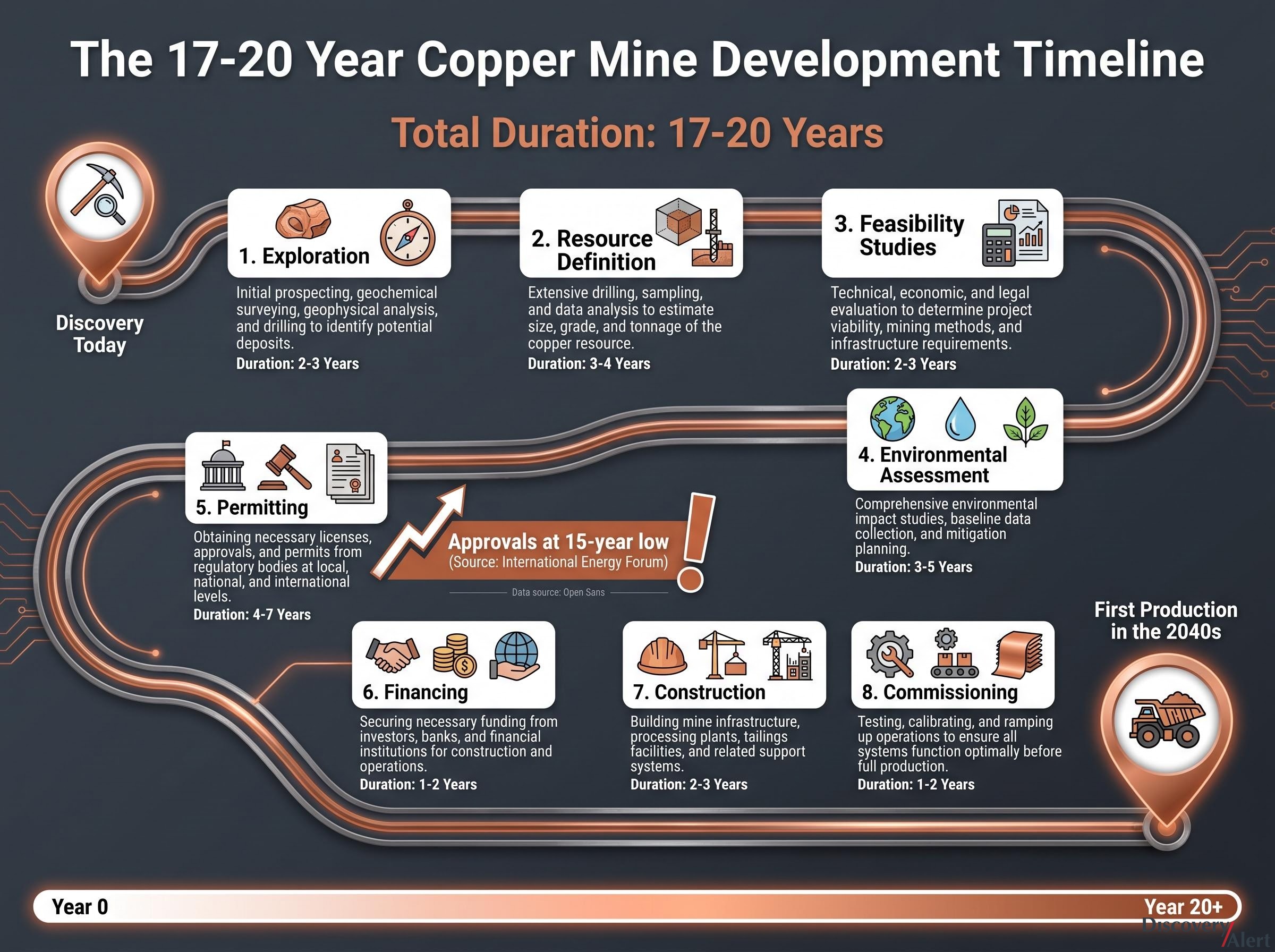
According to the International Energy Forum, regulatory approvals for new copper mines are at their lowest level in 15 years, highlighting permitting as a binding constraint on the project pipeline.
Latin America’s mine development pipeline, anchored by major operations in Chile and Peru, represents the largest single geographic concentration of future copper supply, yet the region’s permitting constraints, water access disputes, and community opposition are among the most visible examples of why regulatory bottlenecks are now at a 15-year low globally.
Under an optimistic scenario, any deposit discovered today would produce first copper well into the 2040s. Global mined copper output reached 21.8 million tonnes in 2022, up only approximately 1 million tonnes over three years. The ICSG and industry analysts estimate the world needs to add approximately 1 million tonnes of new production every year to keep pace with demand growth, a rate the current pipeline is not achieving.
The price signal cannot call forth supply in time to address the 2030s deficit. That is not a market inefficiency. It is a physical constraint.
Even if development timelines could be compressed, the geological pipeline does not contain sufficient inventory to fill the gap. Few genuinely large new copper deposits have been found over the last decade despite sustained exploration spending. The absence of discoveries is not a neutral baseline; it is an active signal that the earth’s most accessible large copper systems may already have been identified.
S&P Global projects a copper deficit of approximately 10 million tonnes by 2040, roughly 25% below projected demand. Filling that gap would require multiple tier-one projects that are simply not visible in the current pipeline.
The African copper supply chain, anchored by the Democratic Republic of Congo and Zambia, has emerged as one of the few regions where new tier-scale copper production could realistically advance over the next decade, though the infrastructure deficits and jurisdictional risks in those corridors add complexity that pure tonnage projections do not capture.
S&P Global copper supply analysis published in early 2026 projects global copper production peaking at 33 million tonnes around 2030 before declining, while demand surges approximately 50% from current levels, giving quantitative weight to the 10-million-tonne shortfall figure cited by analysts tracking the structural deficit.
What distinguishes a tier-one copper asset from a typical operation is scale. The difference matters for the structural deficit thesis because only tier-one projects move the global supply needle.
| Metric | Tier-one asset | Typical smaller mine |
|---|---|---|
| Contained copper | Minimum 5 million tonnes | Significantly below 5 million tonnes |
| Annual production capacity | Approximately 500,000 tonnes/year | 100,000-200,000 tonnes/year |
| Relevance to closing global deficit | Moves the structural needle | Meaningful locally, insufficient globally |
The International Energy Forum reports that approvals for new mines are falling, suggesting fewer large viable projects are advancing through the pipeline. Major miners including BHP are focusing growth strategies on securing large copper positions precisely because such deposits are scarce and increasingly strategic. Muro Capital, in partnership with BHP, is specifically targeting world-class copper deposits for this reason. Tio, CEO of Muro Capital, has described a portfolio discovery as representing a transformational opportunity rather than a conventional exploration find.
The structural thesis creates a genuine investor decision, not a simple buy signal. Copper exposure carries materially different risk profiles depending on where in the value chain the investment sits.
| Factor | Producing/near-producing assets | Early-stage exploration |
|---|---|---|
| Cash flow timing | Near-term revenue generation | No cash flow; value is probability-weighted |
| Primary risk category | Operational risk, cost inflation | Geological and permitting risk |
| Price cycle sensitivity | Higher; cash margins compress in downturns | Lower; value anchored to long-term scarcity thesis |
| Relevance to structural deficit | Contributes existing supply | Only tier-one discoveries address the global gap |
For early-stage exploration companies targeting large copper deposits, the investment proposition is anchored not in near-term cash flow but in the probability-weighted value of a future tier-one discovery in a market projecting multi-decade deficits. The IEA and S&P Global characterise copper as a potential systemic constraint on economic growth and technological progress, which supports durably elevated price assumptions in that probability framework.
The risks remain substantial. Investors should weigh these explicitly:
Small copper operations producing 100,000-200,000 tonnes per year are insufficient to meaningfully address the global gap. Only very large discoveries move the structural needle, which concentrates both the opportunity and the risk.
This article is for informational purposes only and should not be considered financial advice. Investors should conduct their own research and consult with financial professionals before making investment decisions. Exploration-stage mining investments carry significant risk, including the possibility of total capital loss. Past performance does not guarantee future results.
Three structural constraints converge on a single conclusion:
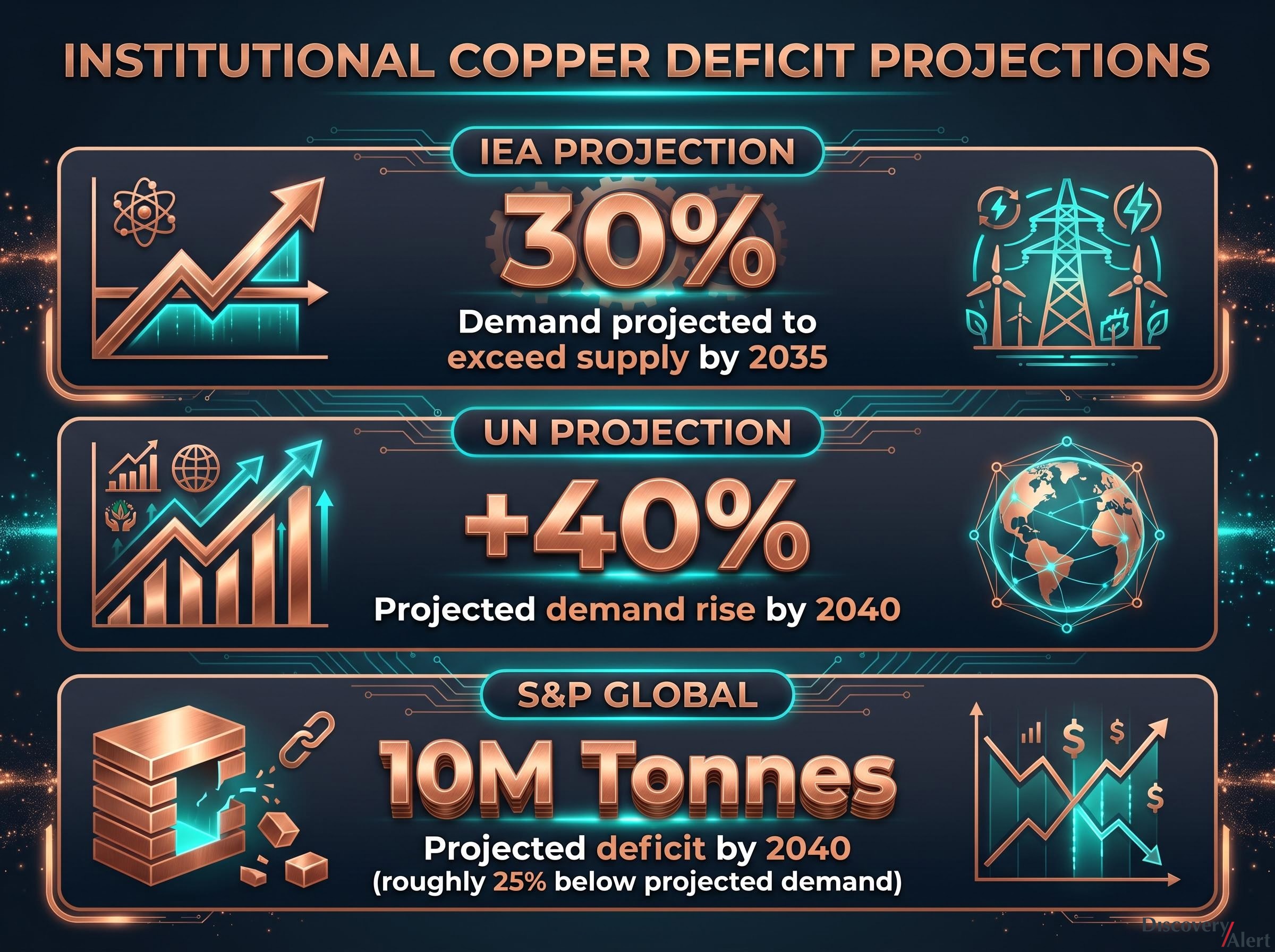
Three major institutional projections frame the scale of the problem: the IEA projects demand could exceed supply by 30% by 2035; the UN projects demand to rise more than 40% by 2040; S&P Global projects a deficit of approximately 10 million tonnes by 2040.
Near-term price and inventory dynamics will fluctuate. Exchange stocks may build or draw depending on quarterly conditions. But the flow-based analysis from the IEA, ICSG, and S&P Global consistently shows annual production falling short of annual demand growth over a 10-20 year horizon.
The question for investors, policymakers, and industrial consumers is not whether copper will be scarce in 2026. It is whether sufficient large, developable deposits exist in the global pipeline to supply the AI-driven and electrification-driven economy of the 2035-2045 period. The timeline arithmetic, at present, suggests they do not.
For investors wanting to see how institutional capital is already positioning around the structural deficit, our deep-dive into Crescat’s thesis on the mining supply gap examines how one of the more prominent commodity-focused funds has deployed a large-scale drilling programme specifically because it believes the discovery pipeline is insufficient to meet demand through the 2030s and 2040s.
The copper supply crisis refers to a projected structural shortfall where global demand is expected to exceed supply by 30% by 2035, driven by AI infrastructure investment and energy transition electrification colliding with a mine development pipeline that takes 17-20 years to bring new production online.
The full development process from discovery to first production takes 17-20 years on average, covering exploration, resource definition, feasibility studies, environmental assessment, permitting, financing, construction, and commissioning, meaning deposits found today will not produce copper until the 2040s.
A tier-one copper asset contains a minimum of 5 million tonnes of copper and can produce approximately 500,000 tonnes per year; only projects at this scale are large enough to meaningfully address the projected 10-million-tonne global deficit by 2040, while smaller mines producing 100,000-200,000 tonnes annually are insufficient to move the structural needle.
AI-scale data centres require copper across building wiring, server racks, cooling systems, transformers, and grid connections, and because hyperscale operators are executing decade-long strategic capital programmes rather than timing investment to GDP cycles, their copper demand is relatively insensitive to conventional recessions.
Copper has traded above $6 per pound, reaching approximately $6.55-$6.63 per pound in early August 2026, because the market is pricing in a structural long-term supply shortfall rather than reacting to near-term warehouse stocks, with simultaneous supply disruptions at Grasberg, Chilean operations, and SX-EW facilities compounding an existing 150,000-tonne refined copper deficit.


