
Saudi Aramco’s Exports Hold, but War-Risk Costs Tell a Darker Story
Aug 17, 2026


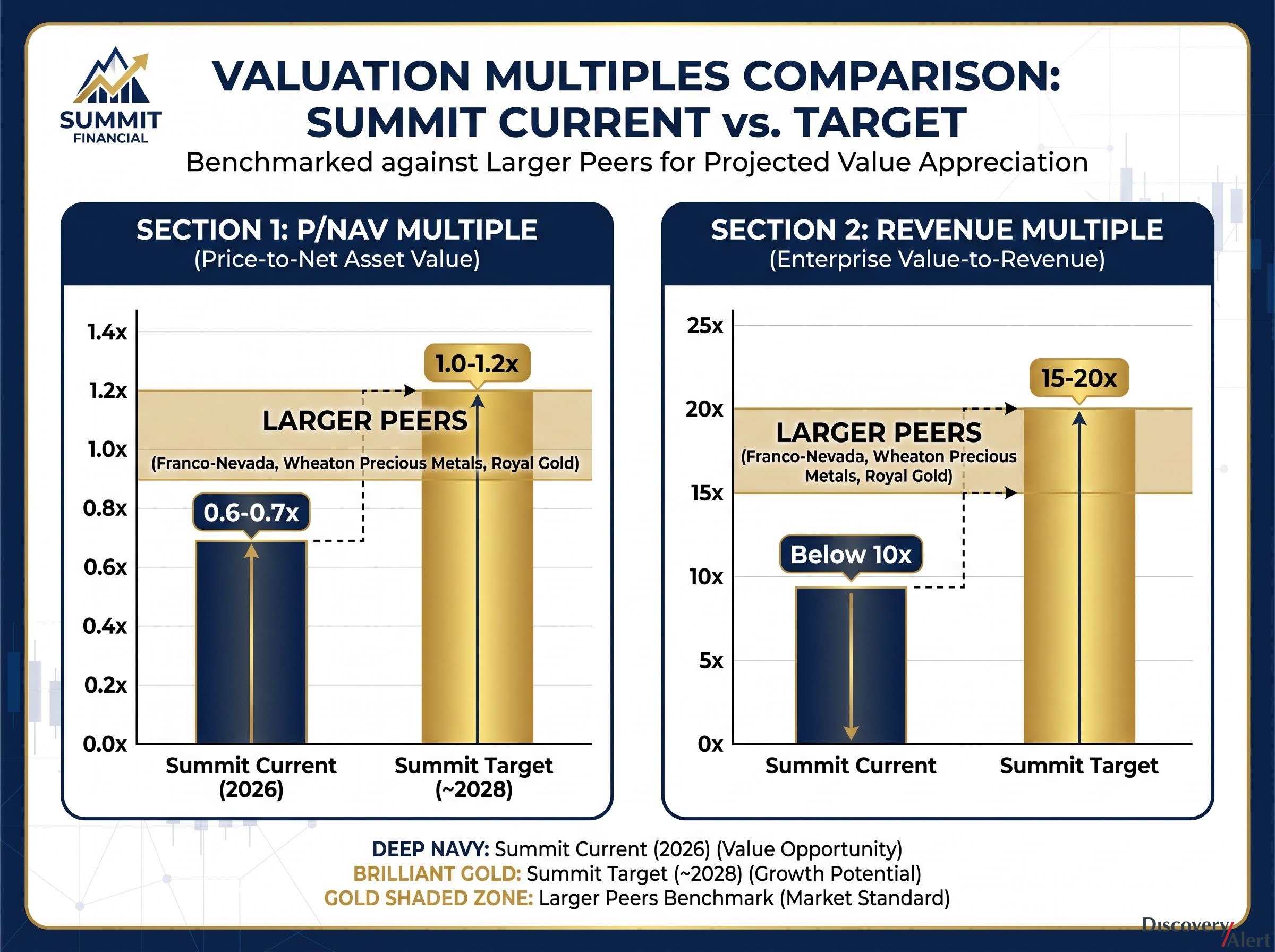
Summit Royalties trades at roughly 0.6x NAV. Its larger peers, Franco-Nevada, Wheaton Precious Metals, and Royal Gold, command 1.0-1.2x or higher. That gap is not a mystery to management, but closing it requires executing against a specific sequence of milestones that most small-cap royalty companies never clear. The completion of the Star Royalties acquisition in July 2026 brought Summit’s portfolio to approximately 48 royalties and streams across Canada, the United States, and Australia, establishing a more scaled platform at the early-to-mid execution stage of a re-rating thesis that management has articulated in quantitative terms. What follows is an analytical framework for evaluating exactly what it takes for a smaller royalty company to earn institutional-grade multiples, using Summit’s stated targets, financing structure, and peer comparisons as the working case.
The discount is not arbitrary sentiment. It reflects three compounding structural constraints that every small-cap royalty company must address before institutions will pay peer-level multiples.
Summit’s current P/NAV sits at approximately 0.6-0.7x, versus the established peer range of 1.0-1.2x or higher. On a revenue basis, the stock trades below 10x revenue, compared with approximately 15-20x for larger royalty names.
Those gaps persist because of three reinforcing conditions:
Franco-Nevada, Wheaton Precious Metals, and Royal Gold command premium multiples because they have cleared all three layers over decades. For a company like Summit, the re-rating case is credible only to the extent that each layer is being addressed in sequence, not merely hoped away.
Management has been explicit about the quantitative targets they believe will carry Summit from junior-tier multiples toward peer-level valuation. The logic runs as a sequence: production growth feeds revenue, revenue feeds market cap, and market cap unlocks institutional eligibility.
The central production target is a run-rate of approximately 4,000 gold-equivalent ounces (GEO) by the end of 2028. Management links that GEO level to approximately $15-20 million in annual revenue, depending on commodity prices, with a broader revenue ambition of $20-30 million as the level they believe can support 1.0-1.2x NAV and 15-20x revenue multiples.
| Metric | Current (2026) | Target (~2028) |
|---|---|---|
| P/NAV multiple | ~0.6-0.7x | ~1.0-1.2x |
| Revenue multiple | Below 10x | ~15-20x |
| GEO run-rate | Building | ~4,000 GEO |
| Annual revenue | ~$10-20M (growing) | ~$15-30M |
| Market cap | Sub-$100M (est.) | $200-300M (target) |
Management has acknowledged that the precise revenue figure triggering broader market recognition is approximate rather than a hard threshold. The targets are derived from observing past re-ratings of comparable royalty companies and how institutional engagement scales once revenue and market cap clear certain levels.
The $200-300 million market cap ambition is not a vanity metric. It connects directly to daily liquidity minimums that institutional funds require before they can build and exit positions without significant price impact. At current levels, Summit sits below the investable universe for most mandated funds.
Portfolio diversification across operators, including assets operated by IAMGOLD and Newmont, simultaneously addresses a second institutional gating condition: revenue quality. Multiple cash-flowing royalties backed by larger operators reduce single-counterparty risk, improving the modelling comfort that institutions require alongside raw scale.
Every acquisition Summit makes either builds or erodes value on a per-share basis. The decision logic behind its financing framework determines which outcome investors get.
Management operates with three available approaches, each matched to a different asset risk profile:
Summit’s $50 million credit facility, secured with National Bank of Canada, was structured specifically to allow acquisitions of producing or near-term producing royalties without requiring equity issuance at depressed multiples, a design feature that management considers central to preserving per-share NAV through the growth phase.
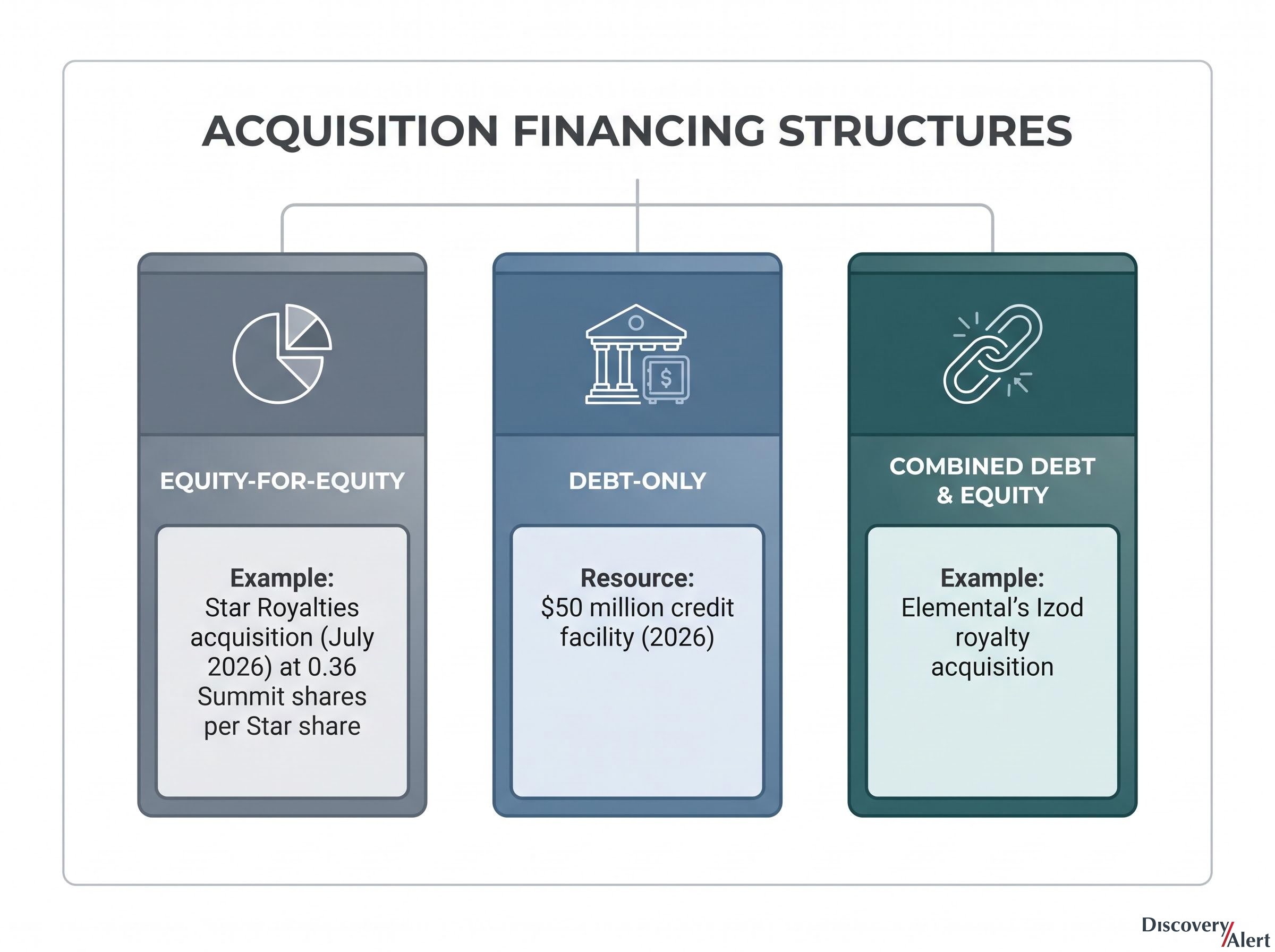
“Debt requires higher confidence in the asset’s path to production.” This discipline principle governs which financing tool Summit applies to each transaction, and it is the standard investors should use to evaluate whether each deal is structured appropriately.
The credit facility’s strategic importance lies in its ability to let Summit act quickly on attractive producing royalties without always issuing equity at depressed prices, directly supporting the GEO and revenue targets management has articulated for 2028.
Management’s milestones are internally logical, but they only matter if they satisfy the conditions that institutional allocators actually apply. Shifting the analytical frame to the buyer’s perspective reveals where Summit’s current trajectory aligns with those requirements and where gaps remain.
Institutional gating conditions for royalty company re-ratings cluster around four observable dimensions:
Institutional eligibility thresholds in the royalty sector are not published criteria but observable patterns: market cap minimums, daily liquidity requirements, and portfolio diversification standards have all been documented through past re-rating events at comparable companies, and Summit’s stated targets map closely onto those observed benchmarks.
The gap between Summit’s current positioning and full institutional eligibility is narrowing, but the track record dimension, the one that requires time rather than transactions alone, remains the least addressed as of mid-2026.
For equity holders in an early-stage royalty company executing successfully, the payoff compounds through two channels simultaneously. The first is growth in absolute NAV and revenue as acquisitions add cash-flowing royalties and existing assets advance toward or through production. The second is a higher multiple applied to each dollar of NAV and revenue once the company crosses the threshold from junior-tier to institutional-grade.
This double leverage is what makes the risk-reward profile of companies at Summit’s stage compelling for investors willing to accept execution uncertainty. A move from 0.6-0.7x NAV to 1.0-1.2x, combined with underlying NAV growth from deal activity, could produce equity returns that significantly exceed the pace of revenue growth alone. By 2028, if management’s targets are met, the projected profile would be approximately 4,000 GEO, $15-30 million in revenue, and multiples converging toward established peer ranges.
That compounding logic, however, depends on execution proceeding broadly as planned. It is not guaranteed.
The gold price environment underpinning Summit’s revenue projections is itself driven by structural demand factors that extend well beyond normal market cycles; central bank accumulation, which independent analysts estimate materially exceeds official reporting, has provided a durable floor that commodity-price-dependent revenue models increasingly depend on.
For investors wanting to pressure-test the execution assumptions behind management’s targets, our deep-dive into Summit’s 2028 growth plan examines the two structural risks that analysts consider most likely to delay or derail the re-rating thesis, with specific scenario analysis on deal flow constraints and commodity price sensitivity.
The analytical framework built across this article converts into four observable dimensions that investors can monitor on a quarterly basis:
The quality of each transaction matters as much as the pace of deal flow. A scorecard that tracks both gives investors the ability to update their thesis with new information rather than relying on price movement alone.
The valuation gap between Summit and its larger peers is structural but not permanent. The conditions required to close it are specific, observable, and within management’s control to a meaningful degree. The double leverage effect makes the risk-reward asymmetry compelling for investors who can tolerate execution uncertainty, but the thesis lives or dies on deal quality and capital discipline rather than market sentiment. Investors positioned in this name have a concrete monitoring framework: track the four scorecard dimensions quarterly, and revisit conviction as milestones are met or missed. The milestones are clear. The execution is what remains to be proven.
This article is for informational purposes only and should not be considered financial advice. Investors should conduct their own research and consult with financial professionals before making investment decisions. Past performance does not guarantee future results. Financial projections are subject to market conditions and various risk factors.
P/NAV (price-to-net asset value) is the ratio of a royalty company's market capitalisation to the estimated net present value of its royalty and streaming assets. Small-cap royalty companies like Summit typically trade at 0.6-0.7x NAV, well below the 1.0-1.2x or higher that established peers command, meaning investors are effectively buying assets at a discount to their assessed intrinsic value.
Small-cap royalty companies face three compounding structural discounts: concentration risk from fewer producing assets, market capitalisation below the $100-200 million minimum many institutional funds require, and an absence of a demonstrated capital allocation track record across multiple market cycles.
Summit's management has targeted a run-rate of approximately 4,000 gold-equivalent ounces by end of 2028, linked to annual revenue of $20-30 million, and a market capitalisation of $200-300 million, which are the levels management believes can support 1.0-1.2x NAV and 15-20x revenue multiples comparable to larger royalty peers.
Summit's $50 million credit facility, secured with National Bank of Canada, is specifically designated for acquiring producing or near-term producing royalties with high cash-flow certainty, allowing the company to grow without issuing equity at depressed multiples and thereby preserving per-share NAV through the growth phase.
The double leverage effect refers to two simultaneous value drivers: growth in absolute NAV and revenue as new royalties are added, combined with a higher valuation multiple applied to each dollar of NAV once the company crosses from junior-tier to institutional-grade status, which can produce equity returns that significantly exceed the pace of revenue growth alone.


