
Saudi Aramco’s Exports Hold, but War-Risk Costs Tell a Darker Story
Aug 17, 2026


Asia absorbed more than 80% of the crude and LNG transiting the Strait of Hormuz before the Iran war began. That single figure explains why the same conflict that has moved global crude benchmarks by double-digit percentages has produced something categorically more acute on the other side of the world.
By mid-2026, Asian energy markets are operating under a form of stress that headline oil prices do not fully capture. Brent and WTI measure crude. What is actually binding for Asian buyers is refined product availability, LNG cargo access, and the compounding effect of two disrupted chokepoints simultaneously constraining supply into the region. The International Energy Agency has described the current disruption as the largest in modern oil-market history. Yet the instruments most investors watch, crude benchmarks priced in London and New York, systematically understate the severity of conditions facing refiners, petrochemical producers, and LNG importers across the Indo-Pacific.
This analysis separates the Asia-specific crisis from the global crude narrative, examines the distinct mechanisms driving each pressure point, and identifies where the real price stress is building for energy investors tracking the 2026-2027 window.
The first distinction to make is structural. Brent and WTI are crude oil benchmarks. They price the raw commodity at major trading hubs. Asia’s binding constraint in 2026 is not at the crude layer; it is at the refined product and LNG layer, where logistics disruptions, feedstock scarcity, and chokepoint closures have created shortages that crude prices alone do not register.
The IEA has described the 2026 supply disruption as the largest in modern oil-market history, a characterisation that centres on the scale of flows removed from global markets through the Strait of Hormuz.
The IEA Oil Market Report characterises the Middle East conflict as creating the largest supply disruption in the history of the global oil market, noting that crude and oil product flows through the Strait of Hormuz have fallen from around 20 million barrels per day to a trickle, a collapse that underpins the severity of conditions facing Asian buyers.
The geography makes this asymmetric. Pre-war, over 80% of the crude and LNG transiting Hormuz was destined for China, India, Japan, and South Korea. The strait carries approximately 20% of global oil and LNG trade. Its disruption is not evenly distributed. European and North American buyers source primarily from non-Gulf producers and face higher costs but retain access to alternative supply. Asian buyers face something closer to a structural supply gap.
EIA data on Hormuz transit flows estimated that 89% of crude oil and condensate moving through the strait went to Asian markets in the first half of 2025, with China, India, Japan, and South Korea together accounting for 74% of those volumes, a concentration that explains why disruption distributes so asymmetrically across importing regions.

Investors monitoring only Brent or WTI for exposure signals are watching the wrong instrument for Asia-specific risk.
US energy vulnerability to Hormuz-driven shocks illustrates a broader principle at work in 2026: record domestic production insulates an economy from crude volume shortfalls but does not protect it from the refined product and LNG price contagion that radiates outward from chokepoint closures.
The Iran war and Hormuz closure have severed Gulf crude feedstocks from Asian refineries, and the scarcity has propagated downstream through refined fuels, naphtha, and petrochemical inputs. This is not a crude supply problem that refineries can solve by sourcing alternative barrels. It is a feedstock, logistics, and capacity problem that has created product shortages even where crude volumes appear nominally adequate.
Asian companies report feedstock cost increases of up to 50%. In stressed scenarios, Asian product prices have implied crude equivalent values of approximately $150 per barrel, according to proprietary analysis, even when Brent trades below that level. The gap between the crude benchmark and the product-layer reality is where the crisis actually lives.
| Supply Chain Layer | Effect of Hormuz Disruption | Market Signal to Watch |
|---|---|---|
| Crude feedstocks | Gulf crude supply to Asian refineries severed; feedstock costs up to 50% higher | Regional crude differentials vs. Brent |
| Refined fuels (diesel, gasoline, jet fuel) | Product shortages at refinery gate; implied crude equivalent ~$150/bbl in stressed periods | Crack spreads (product price minus crude input cost) |
| Petrochemical feedstocks (naphtha) | Naphtha scarcity driving price increases across downstream industries | Naphtha-to-crude ratio; petrochemical margins |
The downstream cascade extends well beyond fuel. Naphtha scarcity is driving cost increases into:
Russian refining capacity losses may be compounding this dynamic. Ukrainian strikes have reduced Russian product exports, though mainstream 2026 crisis reporting centres on Hormuz as the dominant driver rather than Russian refinery outages. The Russian element is best understood as a plausible compounding factor rather than an established consensus driver.
The crack spread, not the crude price, is the operative signal for refinery-exposed positions in 2026.
Qatar is the world’s largest LNG exporter, and Hormuz closure has cut its most direct route to Asian buyers. Strikes and outages at Qatari LNG facilities have compounded the disruption. Estimates suggest 30 billion cubic metres to 35 million tonnes per year in LNG has been removed from global supply chains, though these figures have not been independently confirmed in mainstream sources. The Indo-Pacific absorbs more than 80% of that loss.
The shift in LNG market outlook from surplus to deficit predates the Hormuz closure in structural terms, but the war has accelerated the transition by removing Qatari export volumes precisely when spot markets had the least capacity to absorb the shortfall.
LNG prices in Asia have surged more than 100% since the Iran war began, with forecasts suggesting a further approximately 50% increase if the Strait of Hormuz remains largely closed.
The supply loss has forced Asian buyers into spot markets at premia that are reshaping who gets energy and who does not.
Asian LNG buyers have been paying approximately $5 per MMBTU above prevailing TTF benchmark prices to secure cargoes, according to proprietary analysis. The directional premium is consistent with public data, though the specific figure has not been independently confirmed. Japan, South Korea, and Taiwan possess the fiscal capacity to absorb these premia. Their governments and corporate sectors can pay above-market rates without triggering immediate budget crises.
Lower-income Asian economies cannot compete at these prices. Pakistan, Bangladesh, and Vietnam lack the financial firepower to outbid wealthier neighbours for scarce spot cargoes, creating a structural divide in energy access across the region.
Long-term LNG contracts priced on pre-war formulas have become deeply in-the-money relative to spot, concentrating windfall value with contract holders. LNG producers and portfolio players with destination-flexible contracts and Atlantic Basin or U.S. export capacity are structurally positioned to capture Asian premia. This makes LNG infrastructure and flexible contract holders a central position in the 2026-2027 energy trade, not a peripheral one.
LNG infrastructure positioning by major Asian buyers is already shifting in response to the supply disruption, with state-owned importers acquiring carrier capacity as a hedge against spot market volatility rather than committing to new long-term supply agreements at distressed prices.
Start with a cargo loading at a Gulf terminal, bound for an Asian refinery. Under normal conditions, it transits Hormuz and steams east. With Hormuz effectively closed, the simplest alternative is to reroute southward around Africa or northward through the Suez Canal. The problem is that not all vessels can take the alternative route.
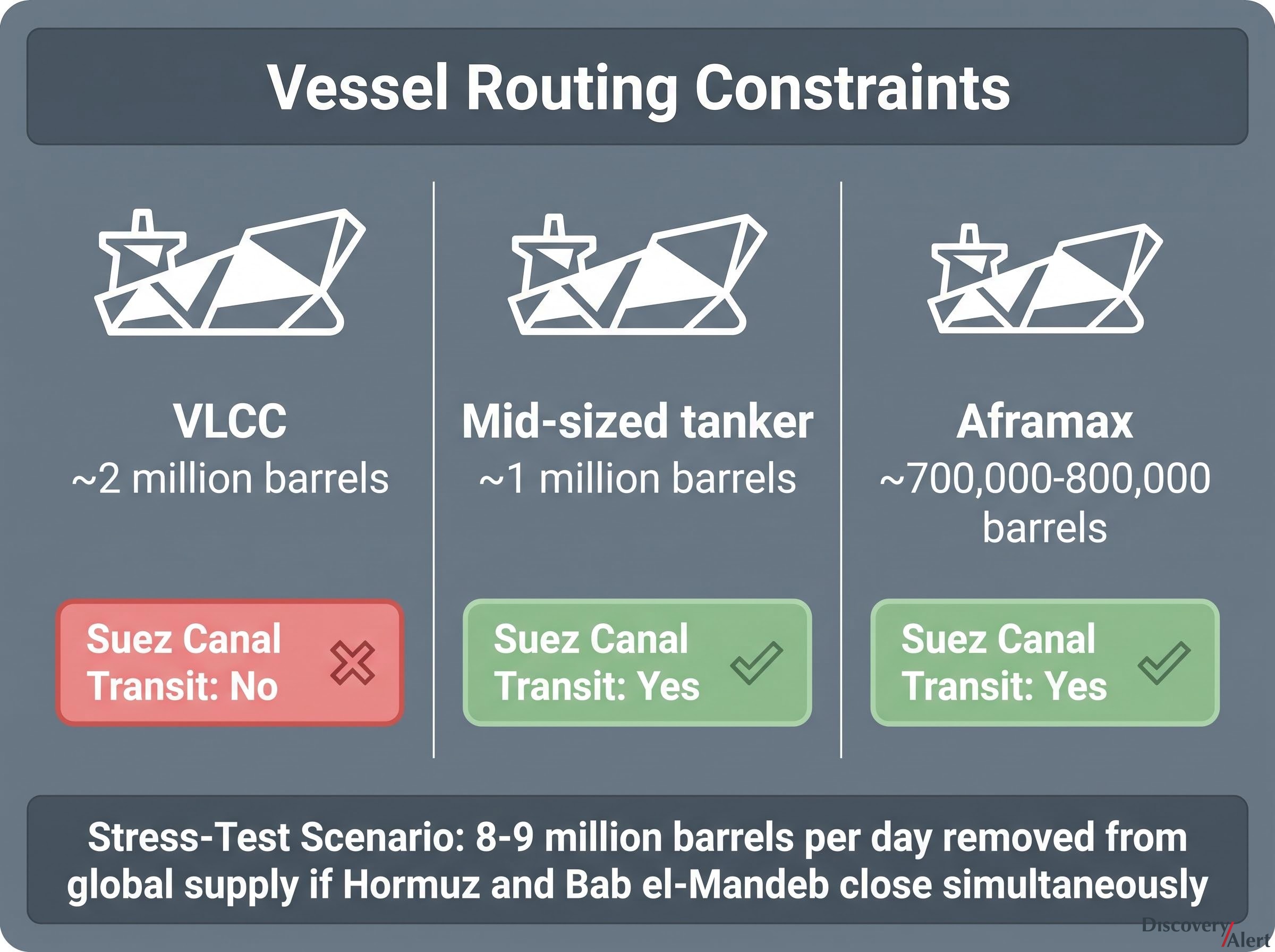
| Vessel Type | Approximate Capacity | Suez Canal Transit Possible | Implication for Asia Supply |
|---|---|---|---|
| VLCC (Very Large Crude Carrier) | ~2 million barrels | No | Largest crude carriers cannot redirect via Suez; routing constrained |
| Mid-sized tanker | ~1 million barrels | Yes | Retains Suez routing flexibility; can redirect to European markets |
| Aframax | ~700,000-800,000 barrels | Yes | Most routing flexibility; captures rerouting premia |
Houthi attacks on shipping through the Bab el-Mandeb Strait have added a second constraint. Tankers diverted by Bab el-Mandeb disruptions have been pushed northward through Suez toward European markets rather than eastward toward Asia, removing product supply from Asian-bound routes. Mainstream 2026 coverage centres on Hormuz as the dominant chokepoint, and Bab el-Mandeb’s contribution should be understood as a plausible compounding factor rather than an independently documented primary driver.
The dual chokepoints operating simultaneously in 2026 have produced a flow-splitting effect that no single benchmark captures: Hormuz removes Gulf supply from eastward routes while Bab el-Mandeb pushes diverted tankers northward toward Europe rather than toward Asian buyers.
If both Hormuz and Bab el-Mandeb remain closed simultaneously, an estimated 8-9 million barrels per day could be removed from global supply, according to proprietary analysis. This figure represents a stress-test scenario rather than a confirmed current flow reduction.
The vessel-size distinction is not a shipping technicality. It determines which tanker operators capture rerouting premia and which remain constrained, making it directly relevant to shipping equity positioning. Operators with fleets sized for constrained-canal routing are earning sustained day-rate premia that conventional tanker market analysis would not predict from crude price movements alone.
New supply is unlikely to arrive fast enough to resolve this crisis through conventional price signals. The balancing mechanisms are less comfortable than a supply response. In order of likelihood:
Japan, South Korea, and Taiwan are absorbing the shock through financial capacity. Their corporate sectors and government budgets can sustain elevated energy costs without triggering rationing. South Korea’s semiconductor sector profitability has provided a partial buffer for affected workers, though specific figures cited in some analyses regarding bonus payments have not been corroborated in mainstream sources.
The cost is real but manageable. These economies pay more and pass some costs downstream, but the supply chain remains intact.
Pakistan, Bangladesh, and Vietnam face a qualitatively different situation. Governments across these economies have increased fossil fuel subsidies to shield consumers, straining national budgets already under pressure. Coal ramp-up has emerged as the primary substitution response, illustrating how demand destruction in cleaner fuels can coexist with dirtier substitution at the system level.
The 1970s analogy is instructive. During the U.S. oil crises, fuel distribution shifted from price-based allocation to administrative rationing. Extended Hormuz disruption could produce similar dynamics in lower-income Asian economies, qualitatively changing the risk profile for businesses dependent on those markets. The distinction matters: not just higher prices, but potential administrative unavailability of product.
EV adoption in Asia and Europe is partially offsetting petroleum demand, but this offset operates at the margin rather than at the scale needed to compensate for chokepoint-driven supply removal.
Even if Hormuz reopened immediately, several months of supply normalisation would likely be required before product shortfalls ease materially. The acute risk window extends through approximately mid-2027.
Crude oil is the raw input. Refined products, including diesel, gasoline, jet fuel, and naphtha, are the outputs processed at refineries. These are distinct markets with distinct price dynamics. A disruption to feedstock supply chains, refinery capacity, or product distribution logistics can drive product shortages even when crude supply appears nominally adequate.
The gap between crude availability and product availability is where Asia’s 2026 crisis lives. Gulf crude may exist in storage or be available from alternative sources, but if it cannot reach Asian refineries in sufficient volumes, or if those refineries lack the feedstock mix they require, the product market tightens independently of crude benchmarks.
Crack spreads measure the margin between crude input cost and refined product sale price. When crack spreads widen sharply, it signals that product-layer stress is exceeding crude-layer stress. This is precisely the pattern visible in Asian markets in 2026.
Asian product prices have implied crude equivalent values of approximately $150 per barrel in stressed periods, while Brent has traded below that level. Feedstock costs for Asian companies have risen up to 50%. Brent and WTI do not capture these regional product premia or feedstock tightness when logistics are binding. Investors relying solely on crude benchmarks as their proxy for Asian energy exposure will systematically underestimate the severity of conditions facing regional refiners, petrochemical producers, and LNG importers.
Asia’s 2026 energy crisis is a refined products and LNG crisis, structurally distinct from crude benchmark movements, and disproportionately concentrated in the Indo-Pacific due to Hormuz dependency. The analytical picture is not one crisis but two divergent outcomes within a single region: prosperous economies absorbing elevated costs through financial capacity, and lower-income economies facing rationing, coal substitution, and fiscal strain.
The variables that matter most through mid-2027 are specific and monitorable:
The honest uncertainty remains. The trajectory depends on Hormuz, and even a resolution carries a multi-month normalisation lag that would keep product markets stressed beyond any ceasefire. The Bab el-Mandeb compounding effect, the Russian refining contribution, and the exact timing of the post-acute transition are scenario variables not yet fully documented in mainstream data. They warrant inclusion in stress-test assumptions rather than baseline forecasts.
This article is for informational purposes only and should not be considered financial advice. Investors should conduct their own research and consult with financial professionals before making investment decisions. Financial projections and scenario estimates referenced in this analysis are subject to market conditions and various risk factors. Past performance does not guarantee future results.
The Asia energy crisis in 2026 is a refined products and LNG supply crisis driven by Hormuz closure, distinct from the global crude oil shock measured by Brent and WTI. Because over 80% of Hormuz transit flows are destined for Asian markets, the disruption is structurally concentrated in the Indo-Pacific rather than evenly distributed across global buyers.
Brent and WTI measure crude oil at major trading hubs, but Asia's binding constraint in 2026 is at the refined product and LNG layer, where feedstock scarcity and logistics disruption have pushed implied crude-equivalent product prices to approximately $150 per barrel in stressed periods, even when crude benchmarks trade below that level.
Lower-income economies including Pakistan, Bangladesh, and Vietnam are most exposed because they lack the financial capacity to outbid wealthier neighbours for scarce spot LNG cargoes, while Japan, South Korea, and Taiwan can absorb the approximately $5 per MMBTU premium above TTF benchmark prices required to secure supply.
Investors should prioritise crack spreads and regional product differentials over crude benchmarks, alongside Hormuz operational status, Asian LNG spot premiums relative to TTF, tanker day-rate trends across vessel classes, and government policy responses including subsidy expansion and coal substitution decisions.
Very Large Crude Carriers carrying approximately 2 million barrels cannot transit the Suez Canal, limiting their rerouting options when Hormuz is closed, while smaller Aframax tankers carrying 700,000-800,000 barrels retain full routing flexibility and are capturing sustained day-rate premiums as a result.


