
Saudi Aramco’s Exports Hold, but War-Risk Costs Tell a Darker Story
Aug 17, 2026


At a long-term contract price of roughly $90 per pound, uranium pricing was expected to pull significant new supply into the market. It has not. No major new mines are scheduled to come online before 2030, and uncovered reactor demand stretches well past 2027. Global uranium consumption continues to exceed production while nuclear build-out accelerates, driven by energy security concerns that have intensified since 2022. Yet sentiment toward uranium equities remains negative despite the structural case strengthening, creating a potential entry window that looks less like a momentum trade and more like a mispriced cycle. This analysis examines why the supply deficit resists correction, how term-contract mechanics reshape producer economics, what historical precedent suggests about the scale of the energy security catalyst, and which company-level metrics separate durable investment candidates from speculative noise. It also addresses the question most uranium commentary avoids: how much of a portfolio this thesis actually warrants.
The standard commodity logic holds that high prices cure high prices. Capital flows toward production, supply expands, and the price retreats. In uranium, that mechanism is muted to the point of dysfunction.
At approximately $90 per pound on long-term contracts, uranium pricing has reached levels widely expected to incentivise new primary mine development. It has not done so. No major new mines are scheduled to come online before 2030.
Three structural barriers explain why:
The demand side offers no relief. Reactor life-extensions are being approved across the United States and Europe. New builds are underway in Asia. Uncovered reactor demand beyond 2027 gives future suppliers pricing leverage that current producers cannot yet capture. The deficit is not cyclical. It is architectural.
Most commodity investors instinctively track spot prices. In uranium, that instinct leads to the wrong conclusions.
Spot uranium prices reflect immediate-delivery transactions in a relatively thin market. They are volatile, headline-generating, and largely irrelevant to producer economics. Term contract prices, by contrast, represent multi-year supply agreements negotiated directly between mining companies and nuclear utilities. These contracts typically lock in pricing tiers, volume commitments, and escalation mechanisms that span five to ten years or longer.
The price that matters to a uranium miner’s future revenue is the term contract price, not spot. Term prices currently sit near multi-year highs even as spot remains volatile.
The structural shift from opportunistic spot purchasing to long-term contracting is now a core pillar of the uranium investment thesis, according to CruxInvestor and multiple sector analysts. Utilities that deferred procurement during the post-Fukushima period are re-entering the market with longer contract horizons and higher price tolerance. For producers with strong term-contract books, this translates into revenue visibility that no other segment of the mining industry matches.
Equity re-ratings in uranium tend to follow term contract announcements more reliably than spot price movements. Investors screening uranium producers should treat the contracted revenue book, its duration, pricing tiers, and counterparty quality, as the primary valuation input.
Energy security arguments are easy to overstate. The historical record, however, suggests the current geopolitical environment has precedent, and the precedent produced nuclear fleets.
The 1973 Arab oil embargo forced governments to confront a structural vulnerability: dependence on imported hydrocarbons for electricity generation. Two countries responded with nuclear build-out programmes that reshaped their energy systems for decades.
| Geopolitical shock | Policy response | Outcome |
|---|---|---|
| 1973 Arab oil embargo | Japan: national nuclear construction programme | Third-largest nuclear fleet globally |
| 1973 Arab oil embargo | France: national nuclear construction programme | Fourth-largest nuclear fleet globally |
| Post-2022 energy security reassessment / Persian Gulf conflict | Global: reactor life-extensions, new builds, policy support | Projected recognition within 8-10 year horizon |
The current catalyst, a combination of post-2022 geopolitical reassessment and the ongoing Persian Gulf conflict, is expected to be recognised as a comparable driver within an 8-10 year horizon, according to Rick Rule of Rule Investment Media. That recognition timeline is measured in years, not quarters, which sets appropriate return expectations for investors sizing positions today.
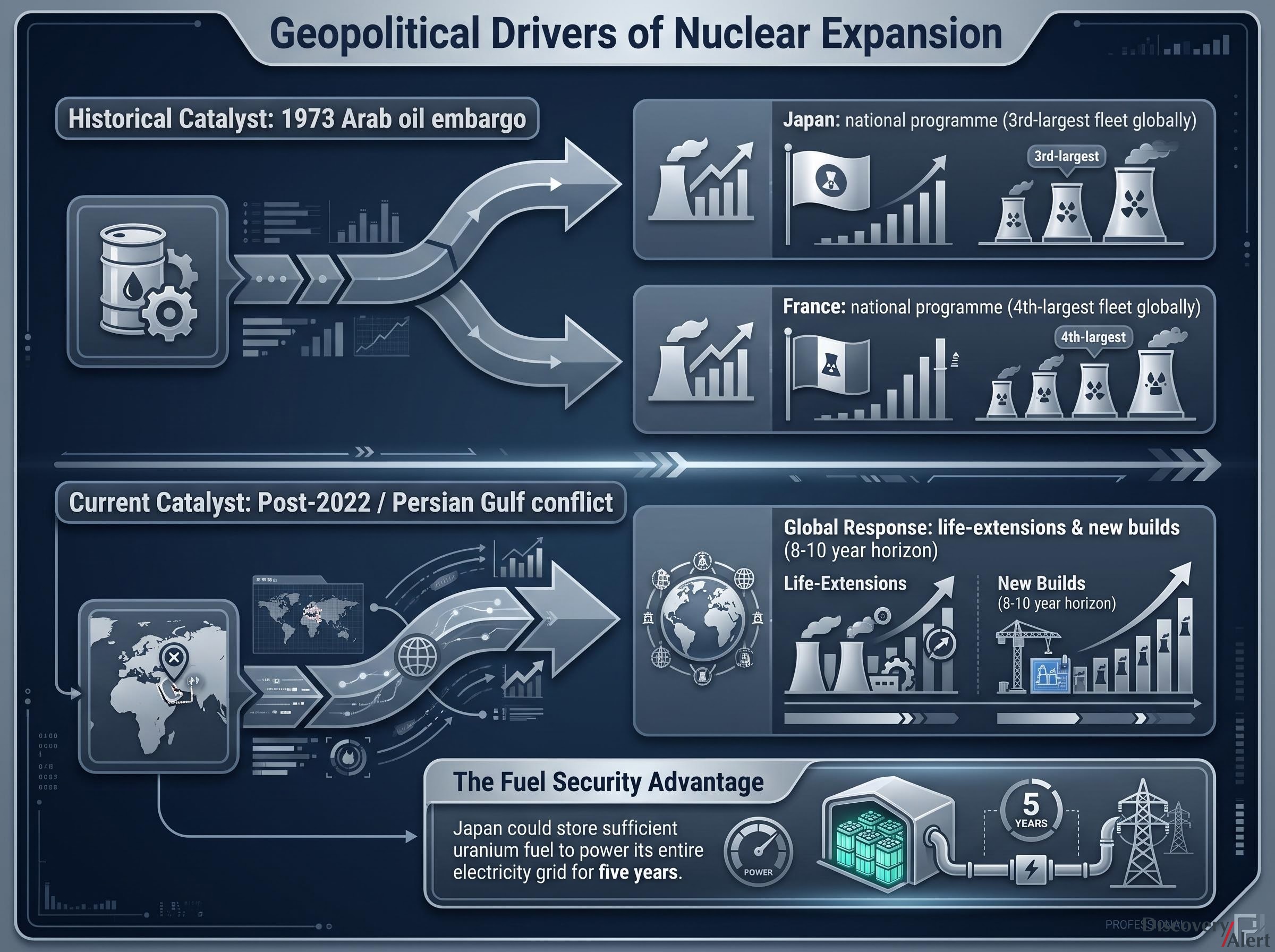
Japan’s Diet has highlighted a structural differentiator that separates nuclear from every other energy source: Japan could store sufficient uranium fuel to power its entire electricity grid for five years. No equivalent storage is physically possible with oil, gas, coal, or renewables. Governments are actively incorporating this fuel-stockpiling capability into energy security planning, alongside the dual demand drivers of decarbonisation and AI-related power consumption.
Abstract screening criteria gain credibility when applied to real companies. The following positions, attributed to Rick Rule of Rule Investment Media, illustrate how the same analytical lens produces different conclusions across the producer-developer-explorer spectrum.
Denison Mines represents an asymmetric technology bet. The company is constructing an in-situ recovery (ISR) at-depth project, a method that has not been attempted at commercial scale; prior work has been limited to bench-scale testing.
The estimated downside if the ISR at-depth project fails is approximately 25%. The estimated upside if it succeeds is roughly two to three times the current share price.
That defined risk-reward profile is precisely what makes Denison investable as a satellite position. The downside is quantifiable, and the upside is tied to a specific technical milestone rather than general market sentiment.
Kazatomprom screens attractively on cost metrics. It is inexpensive by conventional measures. Rule Investment Media avoids it. The reason is the jurisdictional risk overlay: unresolved middle management departures and production startup difficulties make governance and operational transparency difficult to assess. Low cost alone does not offset opaque operational risk.
US uranium producers are uniformly considered overpriced relative to both the AISC and ROCE screens. Yet they are expected to continue rising. Government subsidisation of domestic uranium production and strong retail investor preference for American-produced uranium create a policy premium that supports valuations above the structural quality threshold. This is momentum positioning, not fundamentals-based positioning. Investors should understand which they are buying.
Energy Fuels has evolved from a pure uranium producer into a combined uranium and rare earth processing business, leveraging its infrastructure for radioactive rare earth oxide handling and potential uranium recovery from processing waste. For investors seeking pure uranium exposure, this represents thesis drift: the equity no longer tracks uranium alone.
The structural thesis can be entirely correct and the position can still inflict serious damage. Uranium equities are operationally volatile, with large drawdowns and extended periods of underperformance as predictable features of the cycle rather than exceptional events.
Sizing guidance centres on risk tolerance and sector expertise:
The recommended portfolio structure follows a tiered approach:
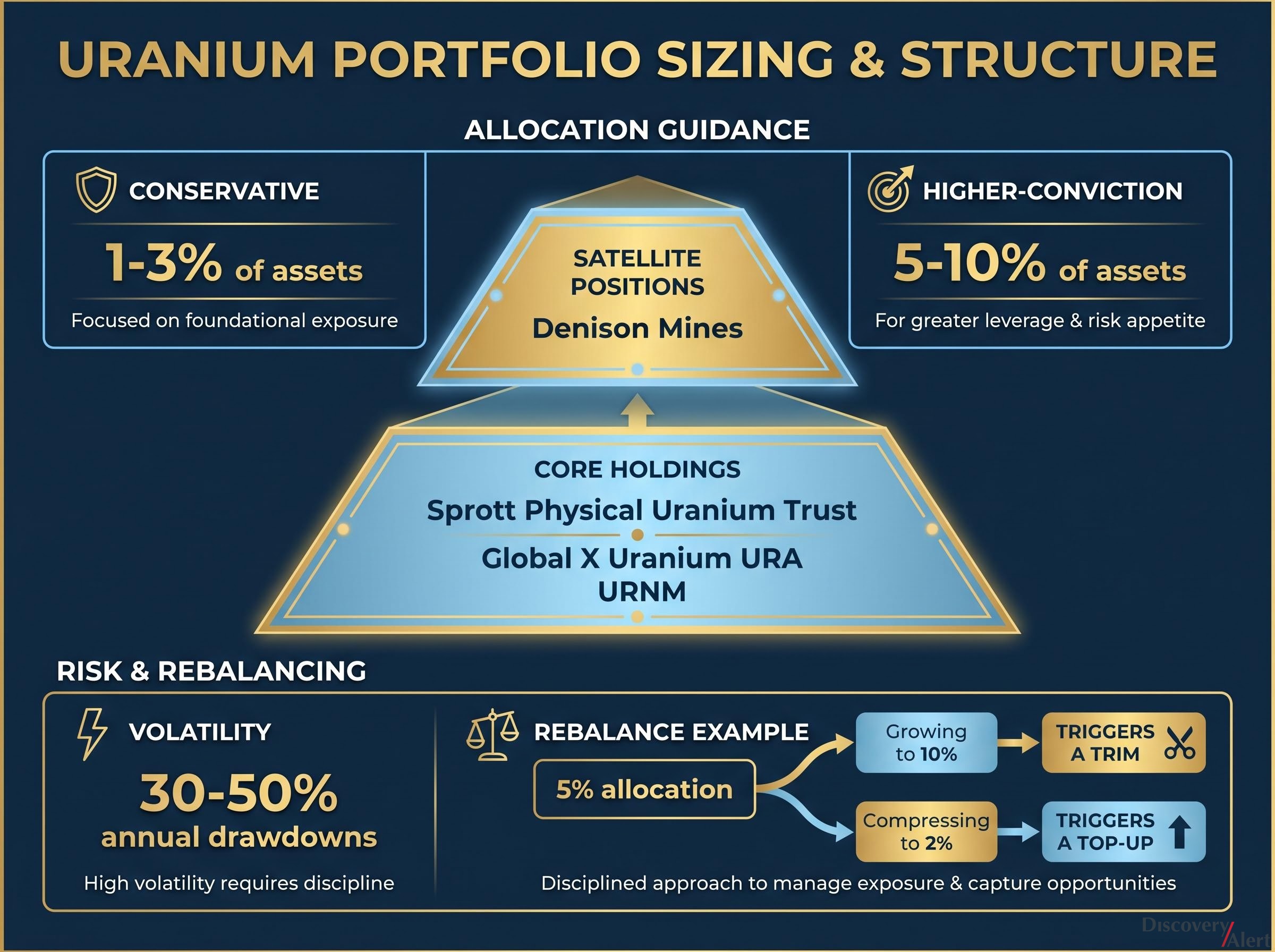
Dollar-cost averaging is the appropriate entry mechanism for a thesis that plays out over years, not quarters. Phased entry reduces timing risk in a sector where 30-50% drawdowns can occur within a single calendar year without the structural case changing.
Predefined rebalancing thresholds, set before the position is initiated, prevent reactive decision-making during large price moves. If a 5% allocation grows to 10% on a spot price spike, the threshold triggers a trim. If it compresses to 2% on a sentiment-driven selloff, it triggers a top-up. The discipline is mechanical by design.
Current negative sentiment toward uranium equities has not yet reached the extreme pessimism levels observed approximately five to six years prior. The trade may still have room to develop before reaching a sentiment inflection point.
Three structural pillars remain intact: the non-self-correcting supply deficit, the term-contract revenue model that provides producers with unmatched revenue visibility, and the energy security demand driver whose historical parallels produced the third and fourth largest nuclear fleets in the world.
The investment framework, lowest-cost quartile AISC, ROCE exceeding 25%, credible NAV discount, and clean jurisdictional risk profile, is the tool for monitoring and re-evaluating positions over the multi-year holding period this thesis requires. Readers applying the framework to specific uranium equities should review the latest NI 43-101 technical reports and term-contract announcements from any producer under consideration, treating these as primary sources rather than relying solely on consensus broker commentary.
This article is for informational purposes only and should not be considered financial advice. Investors should conduct their own research and consult with financial professionals before making investment decisions. Past performance does not guarantee future results. Financial projections are subject to market conditions and various risk factors.
—
A uranium term contract is a multi-year supply agreement negotiated directly between a mining company and a nuclear utility, locking in pricing tiers, volume commitments, and escalation mechanisms for five to ten years or longer. Because these contracts determine the actual revenue a producer receives, term contract prices are far more relevant to producer economics than the volatile spot price most investors track.
Three structural barriers prevent new supply from responding to price signals: uranium projects take a decade or more from discovery to first production, permitting involves nuclear safety and environmental frameworks far more complex than those for other metals, and the capital intensity plus long payback horizon deters speculative investment. At roughly $90 per pound on long-term contracts, pricing has reached levels expected to incentivise new mines, yet none are scheduled to come online before 2030.
Conservative investors are advised to allocate 1-3% of total assets to uranium, while higher-conviction investors with sector expertise may consider 5-10%. A phased entry using dollar-cost averaging is recommended because 30-50% drawdowns within a single calendar year are a predictable feature of the cycle, not exceptional events.
The suggested structure uses a core-satellite approach: the core holds physical uranium trusts such as Sprott Physical Uranium Trust and diversified ETFs such as Global X Uranium URA or URNM, while the satellite allocation targets developers like Denison Mines and special situations with asymmetric risk-reward profiles.
Japan's parliament has highlighted that the country could store enough uranium fuel to power its entire electricity grid for five years, a capability with no equivalent in oil, gas, coal, or renewables. This unique fuel-stockpiling advantage is being incorporated into energy security planning globally, reinforcing long-term demand for uranium alongside decarbonisation and AI-related power consumption growth.


