
Saudi Aramco’s Exports Hold, but War-Risk Costs Tell a Darker Story
Aug 17, 2026


Institutional models from the last lithium cycle missed something. The gap between official supply statistics and real-world output from African operations points to a data blind spot that is only now becoming visible, and its implications for how investors model the next upcycle are material. Africa produced 124,230 tonnes of lithium carbonate equivalent (LCE) in 2024, and Benchmark Minerals identified the continent as the largest regional lithium supply growth area in 2025. Yet as recently as 2022, S&P Global placed Africa’s share of global lithium supply at approximately 1%. This is not a story about a marginal footnote to the established supply hierarchy. It is a story about a structural repositioning already underway, built on geological cost advantages, reinforced by Chinese capital flows, and carrying jurisdiction-specific risks that require careful underwriting before any investment conclusion can be drawn.
The advantage starts underground. African lithium deposits sit on Precambrian cratons and pegmatite belts characterised by high-grade lithium-bearing minerals. That geological foundation gives African mines a structural input advantage before any operational decision is made.
The cost numbers follow directly. African lithium production costs typically range from $250 to $650 per tonne of spodumene concentrate, compared with approximately $800 per tonne at Australian operations. Claudia Cook of Fastmarkets has noted that spodumene from some African projects is priced US$20-$30 below the Newcastle spot price, reflecting lower production costs.

| Region | Approx. Cost Range (per tonne) | Price vs. Newcastle Spot | Geological Foundation |
|---|---|---|---|
| Africa | $250-$650 | US$20-$30 discount | Precambrian cratons, high-grade pegmatite belts |
| Australia | ~$800 | Benchmark (Newcastle spot) | Hard-rock spodumene, higher-cost geological settings |
When Australian hard-rock operations moved to care-and-maintenance during the price downturn, lower-cost African producers continued operating. That resilience is not circumstantial. It is geological.
Tom Benson, CEO of Lithium Africa, asserts that nine of the ten lowest-cost spodumene operations globally are in Africa, with Greenbushes as the sole non-African entry. This claim has not been corroborated by USGS, S&P Global, or Fastmarkets. The directional argument that African spodumene carries a structural cost advantage over Australian peers is, however, independently well supported.
The distance between two numbers tells the story. Tom Benson and Lithium Africa estimate that Africa contributed 10-20% of global lithium supply during the 2022-2023 boom cycle. USGS and S&P Global official data placed Africa’s 2022 share at approximately 1%.
That is not a rounding error. It is an order-of-magnitude discrepancy, and it raises a direct question about the reliability of institutional supply models that informed investment decisions during the last upcycle. Goldman Sachs is one institution that, according to Lithium Africa, failed to reflect this supply at the time.
S&P Global now forecasts Africa could reach approximately 12% of global supply by 2027, a figure that would represent a dramatic acceleration from the official 2022 baseline but would still sit below Lithium Africa’s estimate of what was already happening during the boom.
The most credible explanation for the gap lies in how African supply reaches the market. A significant portion of output during the last boom is believed to have originated from artisanal and mid-scale private producers operating outside formal reporting channels.
Global Witness has warned that the lithium rush in Africa risks fuelling corruption and opaque deals, with transparency and accountability weaknesses that cause standard institutional supply models to undercount true output.
This pattern is not unique to lithium. Cobalt from the DRC carries the same data-gap problem in official supply models. Academic and NGO literature on African transition minerals consistently identifies under-reporting in artisanal segments, and USGS data confirms Africa produced approximately 2,100 tonnes of contained lithium in 2018, representing roughly 2% of world output at the time, a baseline that already understated the informal sector.
DRC mining investment carries some of the most acute versions of the governance and data-gap problems the article identifies: artisanal supply, opaque deal structures, and government leverage over foreign operators have all shaped cobalt’s supply dynamics in ways that now appear to be replicating in lithium.
The USGS Mineral Commodity Summaries 2025 provides the baseline global lithium production statistics against which the Africa data gap becomes most visible, recording Africa’s formal-sector output at a fraction of the figures cited by private-sector analysts tracking informal and artisanal supply channels.
If institutional models systematically undercounted African supply in the last cycle, the forward projections built on those frameworks may again be underestimating the speed of Africa’s contribution.
Spodumene concentrate is the raw material that enters a processing pipeline running from African mines to battery cells. The sequence matters because it determines where value is captured:
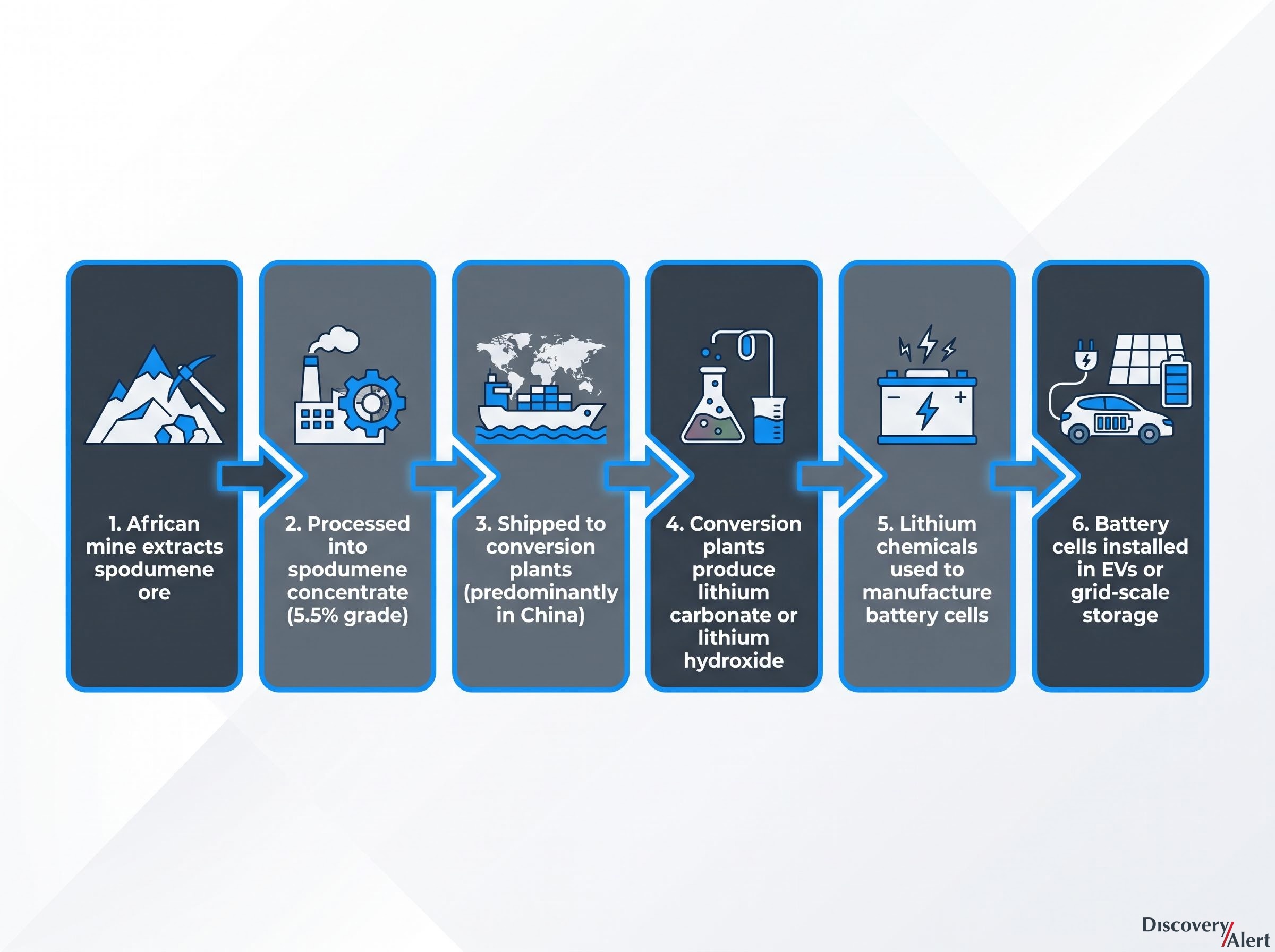
Africa currently has almost no lithium chemical conversion facilities onshore, according to the African Energy Chamber. Virtually all African lithium production is processed in China. This positions the continent as a low-cost raw material supplier at step one of the pipeline, which limits value capture but also limits project-level capital complexity.
Spodumene (5.5% grade) was priced at approximately $2,000 per tonne as of 30 July 2026, according to Tom Benson in an interview with Commodity Culture, compared with roughly $500 per tonne when Lithium Africa acquired its Springbok project.
The conversion capacity built during 2022-2023 represents sunk capital. Once constructed, these plants do not disappear between price cycles. Chinese converters now have a structural, recurring need for raw spodumene input regardless of short-term price volatility.
That dynamic creates a demand floor for African spodumene that is embedded in physical infrastructure, not dependent on spot market sentiment.
Chinese capital has moved into African lithium with a pattern that carries analytical weight beyond the geopolitical headline. Where technically capable, well-resourced acquirers deploy capital tells investors something useful about which projects and jurisdictions passed independent due diligence.
The anchor example is Goulamina in Mali, the continent’s largest active lithium operation, developed as a joint venture between Leo Lithium Ltd. and Ganfeng Lithium Co.
| Metric | Detail |
|---|---|
| Resource | 267 million tonnes at 1.38% Li₂O |
| Phase 1 Capacity | 506,000 tonnes per year (spodumene concentrate) |
| Phase 2 Capacity | 1 million tonnes per year |
| JV Partners | Leo Lithium Ltd. and Ganfeng Lithium Co. |
| Production Start | December 2024 |
USGS confirmed planned capacity of over 23,000 tonnes per year of contained lithium at Goulamina. Ganfeng’s involvement mirrors its broader strategy: the company has secured lithium positions across Africa, Australia, and Latin America, while Tianqi holds a stake in Greenbushes.
S&P Global characterised Chinese firms as having established an “early mover” advantage in Africa’s lithium supply chain by mid-2023. The same analysis suggests Chinese investment could increase African lithium raw material output more than 30-fold by 2027, though this projection has not been independently verified.
The US-China competition for African minerals adds a geopolitical layer to the commercial calculus: Chinese firms have moved faster and with fewer governance conditions attached, while Western capital has struggled to match the speed or scale of deployment in the same jurisdictions.
Claudia Cook of Fastmarkets argues that Africa is becoming a key pillar of China’s battery supply chain dominance, with Chinese firms targeting African projects for their lower costs and regulatory environments.
For non-Chinese investors, the pattern of Chinese capital deployment in Africa is not just a competitive consideration. It functions as a map of where sophisticated buyers with the most direct commercial incentive to assess project quality have placed their capital.
Africa’s cost advantage is real, but it is not freely available. Four distinct risk categories require separate assessment:
Africa is not a single risk profile. Legal frameworks, fiscal regimes, and political stability vary enormously between Zimbabwe, Mali, Namibia, Ghana, and the DRC. Tom Benson has emphasised that successfully operating in Africa requires specialised local knowledge and established relationships; it is not a jurisdiction for operators who attempt to parachute in.
Mali, where Goulamina operates, faces active coup politics, Sahel insurgency activity documented in proximity to the mine, and the presence of Russian security contractors. These conditions are specific to that jurisdiction and should not be generalised across the continent.
Zimbabwe imposed a ban on unprocessed lithium ore exports in 2022, followed by further measures on concentrates with immediate enforcement in early 2026, according to Reuters. Namibia is pursuing similar beneficiation policies.
This policy trend is spreading. It represents a structural shift in how African governments are approaching the resource-to-battery value chain, and it directly affects the economics of export-oriented spodumene operations. Investors and operators must factor in the risk of mid-project policy change across multiple jurisdictions.
Lithium demand is being driven by three converging forces. EV adoption, particularly elevated penetration in China with meaningful growth across Europe, is the primary driver. Grid-scale battery storage for renewable energy integration and AI data centre power is emerging as a significant supplementary source. Consumer electronics represent a persistent baseline demand layer.
Tom Benson has noted that solar-plus-battery systems are now cost-competitive with coal-fired generation in certain regions, a dynamic that broadens the demand base beyond transportation.
Africa’s supply trajectory is accelerating against this backdrop:
S&P Global forecasts Africa could reach approximately 12% of global supply by 2027. Benchmark Minerals identified the continent as the largest regional lithium supply growth area in 2025. Spodumene prices have recovered approximately 180% year-over-year as of 30 July 2026, according to Benson, with conversion capacity built during 2022-2023 supporting a higher price trough in subsequent cycles.
Claudia Cook of Fastmarkets has projected a scenario in which Africa reaches approximately 80% of global supply by 2030. This represents an outlier forecast from a specific analyst and should not be treated as consensus.
The question for investors is not whether African supply matters. It is whether the projects they are evaluating carry the cost structure and operational foundations to capture this opportunity across a full market cycle.
The analytical arc converges on a clear conclusion. African spodumene’s structural cost advantage, running $250-$650 per tonne against an Australian benchmark of approximately $800, is geological in origin, confirmed by independent cost data, and reinforced by Chinese capital flows that function as a sophisticated proxy for project-level quality assessment.
The risks are real. Governance, policy, security, and logistics challenges are specific, country-level, and not uniformly distributed. Successful operation requires the kind of local knowledge that cannot be acquired from a distance.
Africa’s identified lithium resources total approximately 26.7 million tonnes, representing roughly 5-6% of global resources according to the African Energy Chamber. Projects beyond Goulamina, including Ewoyaa in Ghana, signal that supply growth is not a single-project story.
As conversion capacity locks in demand for African raw supply and S&P Global’s 12%-by-2027 forecast approaches reality, the window in which African lithium assets can be assessed without the scrutiny they warrant is narrowing. Investors who engage with this supply picture now, with clear eyes on both the cost structure and the jurisdictional risk map, are positioned to make more informed decisions than those relying on institutional models that have already proven to undercount the continent’s contribution once.
Investors treating supply chain risk as a portfolio variable, rather than a project-level footnote, are better positioned to assess how African lithium’s data gaps, policy shifts, and Chinese capital concentration interact with broader critical minerals exposure across a portfolio.
Africa’s identified lithium resources total approximately 26.7 million tonnes, representing roughly 5-6% of global resources. The structural cost advantage that underpins these deposits is geological, not operational, and it does not erode between price cycles.
This article is for informational purposes only and should not be considered financial advice. Investors should conduct their own research and consult with financial professionals before making investment decisions.
Forward-looking statements, including supply share projections and price forecasts, are subject to change based on market developments, policy shifts, and operational performance. Past performance does not guarantee future results.
Spodumene concentrate is the processed form of lithium-bearing ore, typically at 5.5% lithium oxide grade, that African mines ship to conversion plants, predominantly in China, where it is refined into lithium carbonate or hydroxide for battery manufacturing. Africa's structural cost advantage in producing this concentrate, ranging from $250 to $650 per tonne versus roughly $800 per tonne in Australia, positions the continent as a critical low-cost input supplier for the global battery supply chain.
A significant portion of African lithium output during the boom is believed to have come from artisanal and mid-scale private producers operating outside formal reporting channels, causing official data from bodies like USGS and S&P Global to place Africa's 2022 share at roughly 1% while private-sector analysts estimated the true contribution at 10-20% of global supply.
Zimbabwe is the leading producer and an active policy actor on beneficiation, Mali hosts Goulamina, the continent's largest active lithium operation, and Namibia, South Africa, Ghana, and the DRC are all expanding capacity, with S&P Global forecasting Africa could reach approximately 12% of global lithium supply by 2027.
Chinese firms such as Ganfeng Lithium and Tianqi have established an early-mover advantage by securing stakes in major African lithium projects, with Ganfeng co-developing Goulamina in Mali alongside Leo Lithium, and S&P Global suggesting Chinese investment could increase African lithium raw material output more than 30-fold by 2027.
Zimbabwe imposed a ban on unprocessed lithium ore exports in 2022 and enforced further restrictions on concentrates in early 2026, while Namibia is pursuing similar beneficiation policies, representing a spreading trend of governments asserting downstream processing rights that can materially alter the economics of export-oriented spodumene operations mid-project.


