
Aramco Targets Europe With Deeper-Than-Expected Crude Price Cut
Aug 17, 2026


Spot gold opened the week at $4,055.76 per ounce, up 0.4%, after a White House announcement to pause strikes on Iran pulled oil prices down more than 5% and reshaped the inflation calculus for precious metals overnight. The move on Monday, 3 August 2026, is not a single-variable story. Four forces converged simultaneously: a geopolitical pause in the Middle East, a sharp oil price decline, a softer U.S. dollar following yen intervention, and public dissent from three Federal Reserve officials warning that rates need to rise further. Each of these variables has its own trajectory, and each faces a fresh test from labour market data arriving throughout this week. What follows maps the specific forces driving today’s rally, explains the macro mechanics behind each, and identifies the exact catalysts that could extend or reverse the move before Friday’s nonfarm payrolls release.

President Trump announced a hold on fresh strikes against Iran, with Monday talks scheduled but no stated deadline for reaching an agreement. Oil fell more than 5% on the news. Gold rose. The two moved in opposite directions, and the mechanism is not about safe-haven flows. It is about inflation expectations and what they mean for interest rates.
The relationship works in two directions:
U.S. gold futures climbed 0.9% to $4,054.00 on Monday as the oil pullback shifted the macro backdrop from hawkish pressure toward stabilisation. The geopolitical risk itself has not disappeared; it has paused.
Geopolitical oil risk in the current cycle is not symmetric: a resumption of Iran strikes would not simply reverse Monday’s 5% pullback but would trigger a more complex repricing as supply routes through two distinct chokepoints face simultaneous pressure.
Tim Waterer, Chief Market Analyst at KCM Trade, noted that a sustained gold move would require a clearer oil decline, a weakening U.S. dollar, or a pivot in Fed rate expectations. Without at least one of those conditions firming, the rally remains conditional.
That conditionality is the point. The Iran pause removed one headwind without providing a durable tailwind, leaving gold in a position where the next catalyst determines direction.
The gold price is a dollar-denominated number, but the bid underneath it on Monday was not purely American. The U.S. dollar weakened following government intervention to support the Japanese yen, and the softness reduced the effective cost of gold for international buyers pricing the metal in their own currencies.
The mechanism is direct. When the dollar falls, an ounce of gold becomes cheaper in euros, yen, yuan, and every other currency. That tends to broaden demand beyond U.S. borders, adding a layer of support that domestic sentiment alone would not generate. Monday’s nominal dollar-price gain of 0.4% may understate how strong the bid looks in local-currency terms for non-U.S. investors.
Gold price discovery is shifting away from purely dollar-denominated benchmarks as Eastern buyers increasingly set the marginal price, which means Monday’s dollar weakness transmission mechanism may be structurally more powerful in this cycle than historical correlations would predict.
The risk runs in the other direction with equal force. A dollar rebound, whether driven by stronger U.S. economic data or more hawkish Fed guidance, would raise the cost of gold for international buyers and act as a direct headwind. Investors monitoring precious metals exposure this week should treat dollar direction as a transmission mechanism between the data releases and the gold price itself.
Three Federal Reserve officials voted against last week’s policy decision, warning that delaying a rate increase risks keeping inflation persistently above the central bank’s 2% target. The dissent is not routine procedural disagreement. It reflects a structural tension at the centre of gold’s current pricing.
The three dissenters are focused on a specific set of concerns:
The FOMC’s July 2026 policy statement confirms the three dissenting votes and the committee’s stated commitment to returning inflation to the 2% objective, providing the official record of the internal divide that now sits at the centre of gold’s rate-risk calculus.
For gold investors, the critical distinction is between nominal interest rates and real interest rates (the rate adjusted for inflation). Gold benefits from inflation because it is perceived as a store of value when purchasing power erodes. But gold suffers when real interest rates rise, because holding a non-yielding asset carries an increasing opportunity cost compared to bonds or deposits that pay a return.
Gold benefits from inflation but suffers when real interest rates are rising, because the opportunity cost of holding a non-yielding asset increases relative to alternatives that generate income.
Gold has shown resilience in the current high-rate environment, but that resilience is not immunity. A shift toward more unified hawkishness from the Fed, validating the dissenting voices and raising the perceived terminal rate, represents one of the primary risks to the rally. The distinction between nominal rates and real rates is the variable most likely to trip up investors who assume inflation automatically supports gold regardless of the rate backdrop.
Gold was not alone on Monday. All four major precious metals rose simultaneously, and the breadth of the move changes the interpretation.
| Metal | Monday Price | Monday Move (%) |
|---|---|---|
| Gold | $4,055.76/oz | +0.4% |
| Silver | $58.13/oz | +0.9% |
| Platinum | $1,649.35/oz | +0.5% |
| Palladium | $1,294.92/oz | +1.7% |
A rally confined to gold alone would signal safe-haven demand, capital moving into the one metal most associated with geopolitical fear. A rally across all four metals signals something broader: a macro re-rating tied to the dollar, rates, and industrial demand expectations.
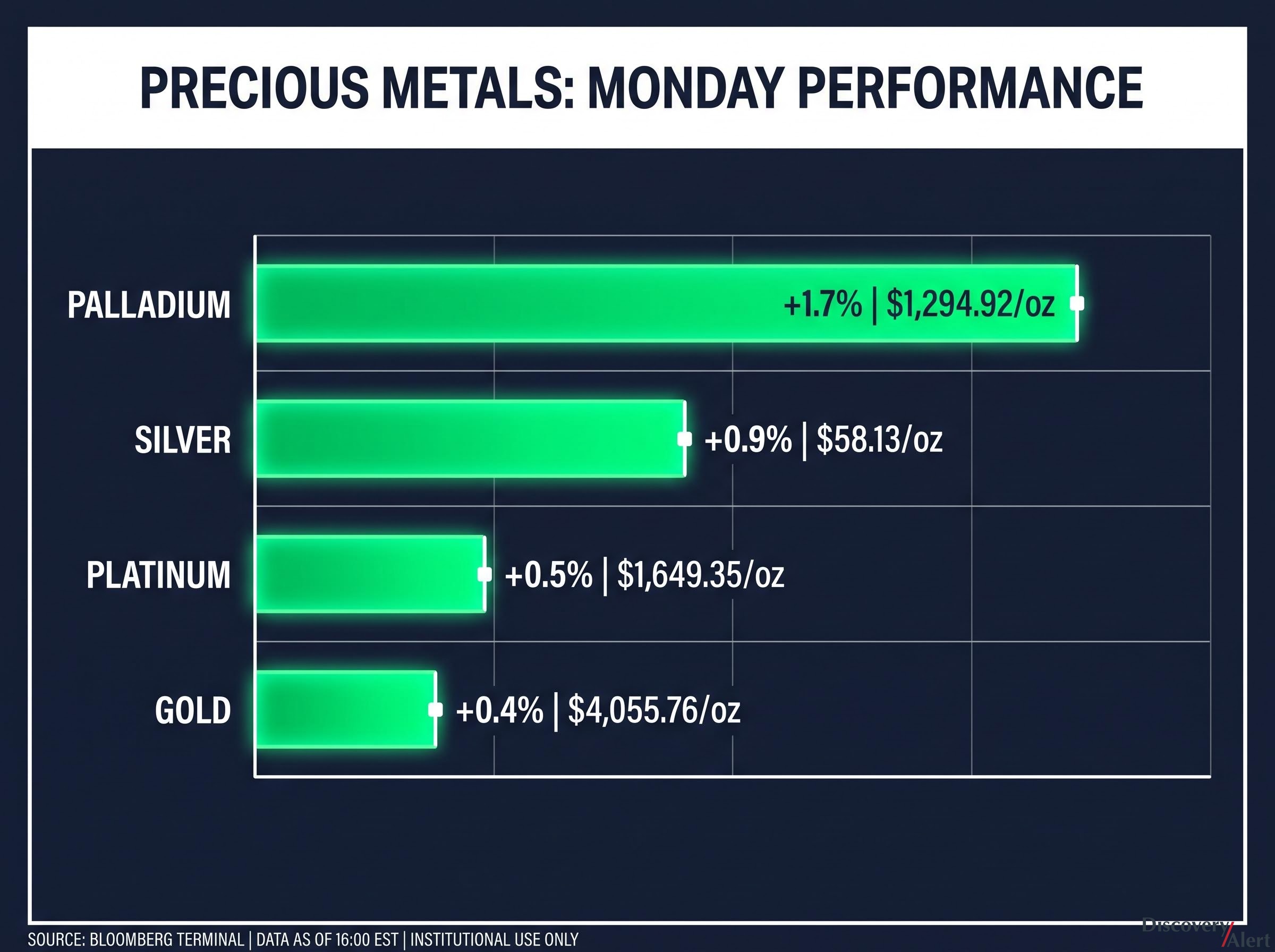
Silver’s 0.9% gain is particularly telling. Silver trades as both a monetary metal and an industrial input, making it a sensitive indicator of whether the move is purely defensive or reflects broader economic recalibration. Palladium’s 1.7% rise, the sharpest of the group, suggests markets are also reassessing auto-sector and industrial demand risks.
Silver supply deficits, now entering their sixth consecutive year, provide a structural underpinning to silver’s monetary sensitivity; this means the metal’s 0.9% Monday gain reflects not just dollar weakness but a persistent physical tightness that amplifies macro tailwinds.
Investors with exposure across the metals complex should treat the synchronised move as confirmation that this rally has macro support, not just geopolitical sentiment. That distinction matters because macro-driven rallies tend to persist even if specific headlines stabilise.
Four U.S. labour market reports land this week, and each one directly reprices the September Fed meeting:
The BLS nonfarm payrolls data series tracks total paid employment across all non-farm business establishments, with seasonal adjustment methodology designed to isolate genuine labour market shifts from calendar effects, making each monthly release the primary input into Fed rate deliberations.
The directional framework is clear. A strong NFP print with firm wage growth pushes September hike odds higher and is bearish for gold. A soft NFP and cooling labour indicators support a hold or eventual easing, extending the precious metals bid.
Gold is consolidating in the low $4,000s, with support near $4,000 as the key technical level if labour data disappoint the bulls. On the upside, a soft data sequence could push gold toward the $4,300-$4,400 resistance zone. Analysts describe 2026 as more likely a consolidation year in the $4,000-$4,500 range than a straight-line return above $5,000.
For investors with active precious metals positions, this week’s data sequence is not background noise. Each release reprices the September Fed meeting, which is the primary determinant of real yields and dollar direction through the near term.
Two scenarios define the week’s range of outcomes for precious metals.
Conditions that support further gains:
Conditions that could cap or reverse the rally:
Five monitoring points for the week: Whether gold holds support near $4,000; how markets reprice the September Fed meeting; whether the oil pullback proves durable; diplomatic outcomes around Iran; and whether the hawkish Fed dissent broadens into a more unified policy signal.
The single most consequential variable is the intersection of Iran diplomatic outcomes and Friday’s NFP, with dollar direction serving as the transmission mechanism between both.
Today’s price represents a mid-cycle consolidation position, not an obvious top or a screaming buy. Institutional research suggests 2026 is more likely a consolidation year in the $4,000-$4,500 range. The four forces that drove Monday’s move, the Iran pause, the oil decline, the softer dollar, and Fed uncertainty, share one characteristic: each is conditional and reversible.
The 2026 consolidation range of roughly $4,000-$4,500 is not a bearish signal; it reflects a mid-cycle pause where the structural drivers remain intact but near-term catalysts are insufficient to push prices to new highs without a fundamental shift in rate or dollar expectations.
Investors who understand that distinction are better positioned to size exposure and manage event risk through Friday than those reacting to the headline price alone. The convergence of Iran diplomacy and nonfarm payrolls data will determine whether this push above $4,000 marks the start of the next leg higher or the ceiling of a short-lived reaction rally.
This article is for informational purposes only and should not be considered financial advice. Investors should conduct their own research and consult with financial professionals before making investment decisions. Past performance does not guarantee future results, and financial projections are subject to market conditions and various risk factors.
When oil prices fall, inflation expectations ease and the likelihood of further rate hikes declines, which reduces the opportunity cost of holding non-yielding gold and supports higher prices. On 3 August 2026, a 5% oil drop triggered by a pause in Iran strikes helped push gold up 0.4% to $4,055.76 per ounce.
Because gold is priced in U.S. dollars, a weaker dollar makes gold cheaper for buyers using other currencies, broadening demand beyond U.S. borders and adding a layer of support to the price. Monday's dollar softness, following Japanese yen intervention, amplified the gold rally for non-U.S. investors even beyond what the nominal 0.4% dollar-price gain suggests.
Three Fed officials voted against the July 2026 policy decision, warning that delaying a rate increase risks entrenching inflation above the 2% target, which signals potential for higher real interest rates. Rising real rates increase the opportunity cost of holding non-yielding gold, making more unified hawkish Fed communications one of the primary risks to the current rally.
A rally across all four major precious metals signals a broad macro re-rating tied to the dollar, rates, and industrial demand expectations, rather than a narrow safe-haven flight into gold alone. Silver gained 0.9%, platinum 0.5%, and palladium 1.7%, with the breadth of the move confirming macro support rather than purely geopolitical sentiment.
Four reports land this week: JOLTS job openings, ADP employment, weekly jobless claims, and Friday's nonfarm payrolls (NFP), and each one directly reprices the September Fed meeting. A strong NFP print with firm wage growth would push rate-hike odds higher and act as a bearish signal for gold, while soft data would extend the precious metals bid.


