
Saudi Aramco’s Exports Hold, but War-Risk Costs Tell a Darker Story
Aug 17, 2026


An exploration project with a 100% drill-hit rate across 125 holes, institutional backing from one of the most closely watched precious-metals funds, and a landowner who is also an equity partner is rare at any stage of the mining cycle. At Flat, all three are present simultaneously. As of mid-2026, Tectonic Metals is running its largest-ever drill programme at the Flat Gold project in Alaska’s Kuskokwim Mineral Belt, roughly 40 km from the Donlin Gold deposit. The project has attracted a C$92 million financing and a 40,000-metre, five-rig campaign designed to generate the drill density needed for a maiden NI 43-101-compliant resource. For resource investors evaluating whether an early-stage discovery merits deeper attention, Flat offers an unusually rich set of data points to assess. This analysis examines the geological metrics, economic logic, capital structure, and material risks behind the project, giving investors the analytical framework to evaluate it on its merits.
The gravitational anchor is obvious. Donlin Gold, jointly advanced by Barrick Gold and NOVAGOLD, sits approximately 25 miles to the north-east with a measured and indicated resource of roughly 39 million ounces of gold.
Donlin’s approximately 39 Moz measured and indicated resource makes it one of the world’s largest undeveloped gold deposits, and its eventual development is widely expected to bring major energy and transport infrastructure into the broader Kuskokwim region.
Proximity to a deposit of that scale matters for infrastructure optionality, but it does not, on its own, validate Flat’s geology. What does is Flat’s own footprint. The project sits on 99,840 acres of predominantly Native-owned land belonging to Doyon Ltd., and the geological work completed to date has confirmed an intrusion-related gold system with characteristics that qualify it as district-scale by any conventional measure:
Location and geological setting are the first filter serious resource investors apply. Flat’s position adjacent to a known world-class system, on a large contiguous land package with its own district-scale signatures, clears that filter with unusual confidence.
A 100% drill-hit rate is a headline number. Its significance depends on what sits behind it: how many holes, how many metres, and what the intercepts look like against independent benchmarks.
Through the 2025 season, Tectonic drilled 125 holes totalling over 18,372 metres, a company record. Gold was intersected in every hole. That sustained hit rate across an expanding programme implies a large, continuous mineralising system and a target model that is reliably converting geological interpretation into drill-confirmed mineralisation.
The standout result came from Chicken Mountain.
9.94 g/t Au over 36.58 m (approximately 364 gram-metres), including 15.73 g/t Au over 22.86 m and 104.23 g/t Au over 3.05 m.
At Alpha Bowl, the first 2025 reverse-circulation hole returned 2.23 g/t Au over 41.15 m (approximately 92 gram-metres), including 4.00 g/t Au over 21.34 m. A prior season intercept of approximately 4.5 g/t Au over 49 m (approximately 220 gram-metres) added further weight. More than 3 km of mineralised strike at the Chicken Mountain-Alpha Bowl complex has been drilled, with mineralisation remaining open in all directions and vertical extent confirmed to 325 metres.
Gram-metres is a straightforward metric: grade (g/t) multiplied by intercept length (m). It allows investors to compare intercepts across different deposit types on a single scale. Newmont’s internal discovery criteria require three or more holes each exceeding 100 gram-metres to classify an exploration target as a discovery, a useful independent filter that did not originate with the company reporting the results.
| Intercept Location | Grade (g/t Au) | Length (m) | Gram-Metres | vs. 100 g·m Threshold |
|---|---|---|---|---|
| Chicken Mountain (high-grade) | 9.94 | 36.58 | ~364 | Exceeds (3.6x) |
| Prior season intercept | ~4.5 | 49.00 | ~220 | Exceeds (2.2x) |
| Alpha Bowl (composite) | 2.23 | 41.15 | ~92 | Approaching |
| Alpha Bowl (internal) | 4.00 | 21.34 | ~85 | Approaching |
Multiple intercepts at or above the 100 gram-metre threshold across the Chicken Mountain-Alpha Bowl complex are consistent with bulk-tonnage continuity. Against Newmont’s independent benchmark, the results meet the criteria for discovery classification, a reference point that does not depend on the company’s own framing.

Flat’s preliminary metallurgical testwork returned gold recoveries exceeding 90% at coarse crush (approximately three-quarter inch). That number is where the economic logic of the project pivots.
Preliminary heap-leach gold recovery: exceeding 90% at coarse crush, against a typical industry range of 55-85%.
A recovery rate above 90% at coarse crush indicates excellent cyanide solubility, low refractory behaviour, and minimal sulphide interference. In practical terms, the gold can be extracted through a relatively simple heap-leach process rather than requiring complex pre-treatment. Tectonic describes Flat as a free-milling, reduced intrusion-related gold system (RIRGS), a deposit type where the mineralogy favours straightforward processing. Fort Knox in Alaska and Eagle in the Yukon are the closest operating analogues: both are open-pit, bulk-tonnage, free-milling operations.
Natural Resources Canada’s geological research on reduced intrusion-related gold systems documents the mineralogical characteristics, low sulphide content, and tectonic settings associated with this deposit class across Alaska and the Yukon, providing the scientific framework that explains why free-milling behaviour and high cyanide solubility are structurally expected rather than coincidental in deposits of this type.
The three main processing routes for gold deposits differ materially in capital intensity and operating complexity:
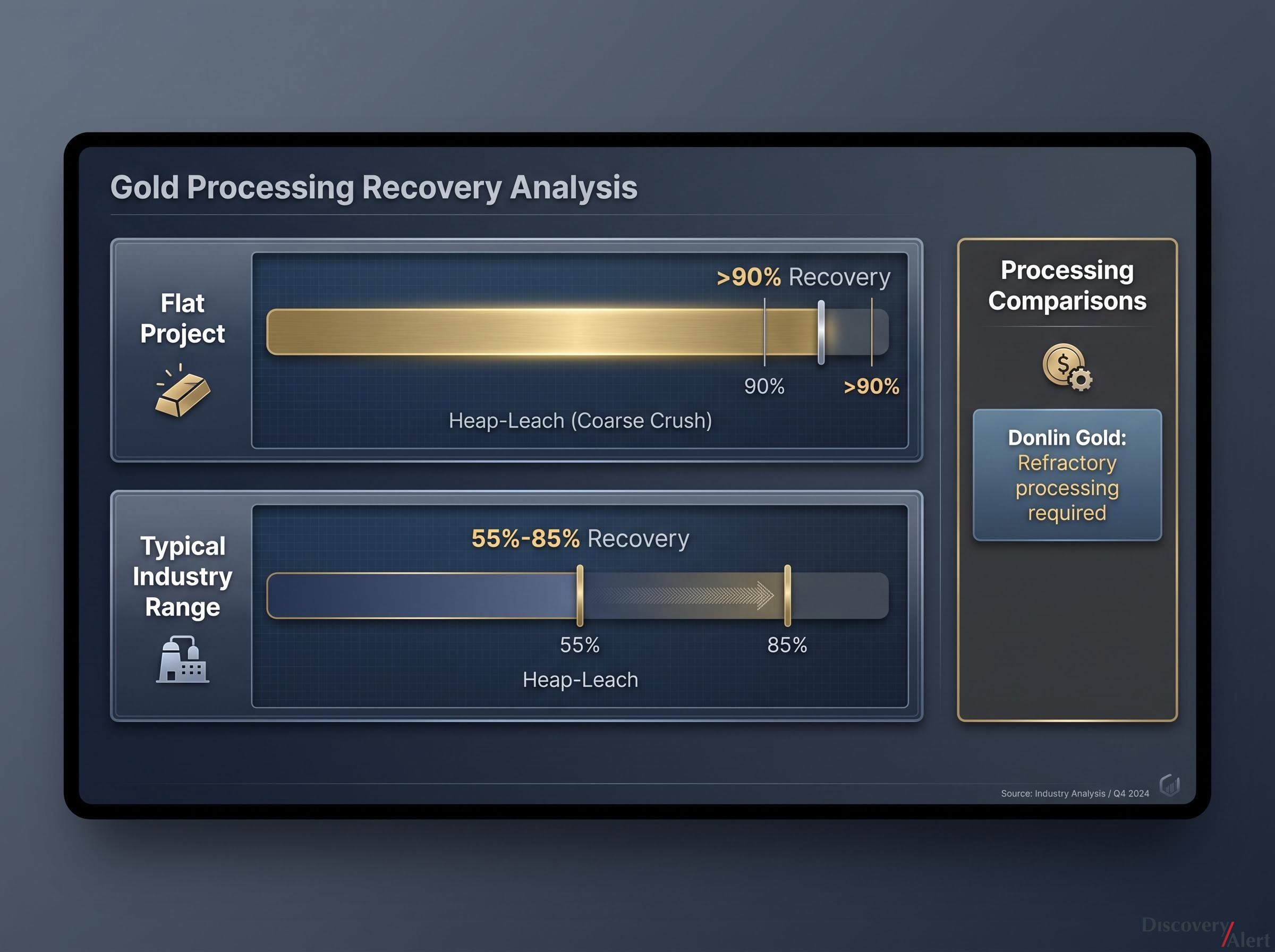
In remote western Alaska, where energy and logistics costs are at a premium, the distinction between a heap-leach and a refractory circuit has outsized consequences. Donlin Gold, by contrast, requires refractory processing, a factor that has contributed to its high estimated capital cost. A natural gas pipeline under construction to Donlin Creek, approximately 25 miles away, could improve regional energy access over time, but even with improved energy supply, Flat’s processing simplicity materially broadens the universe of potential developers or acquirers beyond majors-only capital commitments.
Gold mining cost structures in remote jurisdictions like western Alaska sit at the high end of the global cost curve, and the current period of elevated gold prices has compressed all-in sustaining cost ratios for producers while simultaneously raising the capital hurdle for new projects entering the development pipeline.
Crescat Capital and Doyon Ltd. are both significant investors in Tectonic, but they communicate different things about the project.
Crescat is a precious-metals-focused fund whose activist metals portfolio spans more than 70 junior mining companies. Tectonic is Crescat’s largest position excluding a side-pocket holding, and its second-largest position across all funds. In the May 2025 non-brokered private placement, Crescat’s principals contributed C$3.5 million personally alongside their fund allocation. That placement, initially targeted at C$7 million, closed at C$12.74 million, more than 80% oversubscribed. A subsequent financing raised C$92 million, funding the 40,000-metre, five-rig 2026 campaign.
Crescat’s activist junior mining portfolio spans more than 70 positions, but the concentration of capital in Tectonic, as both the largest non-side-pocket holding and a position anchored by personal co-investment from the firm’s principals, reflects a level of conviction that is unusual even within that broadly deployed strategy.
The C$92 million follow-on financing is among the largest single exploration financings in the junior gold sector in recent years, and funds a programme scale rarely seen at the pre-resource stage.
Crescat’s precious metals fund and activist metals portfolio have outperformed both the GDX and GDXJ ETF benchmarks since inception, a track record that lends additional weight to its position sizing.
Doyon communicates something different. As Alaska’s largest private landholder and the owner of the 99,840-acre land package on which Flat sits, Doyon is not a passive landlord. It is Tectonic’s second-largest shareholder, with over USD $5 million invested. This dual role, landowner and equity partner, materially reduces social-licence and permitting friction relative to a standard exploration project on contested or federal land.
The capital structure sends three distinct signals:
In a sector where promotional financings with weak institutional participation are common, oversubscribed placements anchored by personal co-investment and landowner equity are a meaningful differentiator.
An independent analyst at 3L Capital, Steven Theron, estimates that drilling completed through the prior season delineated approximately 4.1 million ounces of gold at the Chicken Mountain and Alpha Bowl areas at an estimated discovery cost of approximately USD $6 per ounce.
The USD $6 per ounce estimated discovery cost is a third-party, non-NI 43-101-compliant figure. No compliant resource has been filed at Flat as of August 2026.
The inputs behind the estimate: drilling costs of approximately CAD $1,000 per metre, with an all-in discovery cost of approximately USD $800 per metre, divided across the estimated ounces identified. Against a historical industry discovery cost range typically cited at USD $20-60 per ounce in established jurisdictions, the figure is striking.
It is also analytically fragile in specific ways. Early-stage drilling concentrates on the highest-confidence zones, where hit rates and grades are at their peak. As drill density increases toward resource-definition spacing, average grade and discovery efficiency typically decline. The airstrip access and established camp infrastructure at Flat help control cost per metre, but the per-ounce calculation will be tested as the 40,000-metre 2026 programme moves into areas of lower geological certainty.
Projects that eventually reached compliant resource status required substantially more drilling than Flat has completed to date:
| Project | Total Resource (Moz) | Approx. Metres to Resource | Deposit Style |
|---|---|---|---|
| Great Bear (Kinross) | ~6.8 | ~850,000 m | High-grade gold |
| Coffee (Yukon) | ~3.8 | ~280,000 m | Oxide gold |
| Eskay Creek (Skeena) | >5.0 | ~220,000 m | VMS/epithermal |
The per-ounce discovery cost metric is frequently cited in junior mining promotion. Understanding its inputs and the conditions under which it holds, particularly that it is calculated on an early-stage drilling base and carries no NI 43-101 compliance, allows investors to use it as a reference point rather than a settled fact.
The analytical frame shifts here from what Flat has demonstrated to what it must still prove. Between its current exploration-stage status and a development-decision-ready asset sit four specific milestones, each a binary checkpoint with consequences in either direction:
The Tectonic Metals resource conversion question sits at the centre of the 2026 programme: 40,000 metres across five rigs is designed specifically to achieve the drill density required for NI 43-101 compliance, a threshold that transforms exploration intercepts into a figure that institutional capital can underwrite.
Alaska’s mining permitting process requires coordination across multiple state and federal agencies, with reclamation plan approvals and land-use determinations adding time that even well-supported projects on Native corporation lands cannot fully compress, a structural feature of the regulatory environment that investors should factor into any timeline assumption for Flat.
The material risks that investors should weigh against the geological upside are specific:
Flat is best assessed as a high-beta, early-stage discovery play. The upside case requires sustained geological delivery across a substantially larger drill programme. The downside case is amplified by Alaska-specific capital intensity and the absence of a compliant resource baseline. Each milestone ahead represents both a value-creation opportunity and a potential inflection point where the thesis is confirmed or revised.
Early-stage discovery positioning in single-project juniors like Tectonic requires a different analytical framework than buying into a producer or royalty stream: the return profile is driven almost entirely by binary geological outcomes, which means position sizing and entry timing carry more weight than they do in more liquid commodity equity strategies.
Flat combines district scale, a free-milling metallurgical profile, institutional alignment, and a 100% hit rate into a configuration that is uncommon at the junior exploration stage. The geological signatures, drill performance against independent benchmarks, and capital structure each independently clear analytical filters that many early-stage projects do not.
The central caveat remains clear: no NI 43-101-compliant resource exists. The path to development involves years of additional drilling, permitting, and capital allocation, and the current valuation is entirely forward-looking. The specific events that will determine whether the thesis holds are the 2026 drill season’s grade continuity results, progress toward a maiden resource, and Crescat’s position as a directional signal to monitor for institutional conviction.
This article is for informational purposes only and should not be considered financial advice. Investors should conduct their own research and consult with financial professionals before making investment decisions. All non-NI 43-101-compliant ounce estimates referenced in this article are third-party analytical figures and should not be treated as formal resource or reserve declarations. Past performance does not guarantee future results, and forward-looking statements are subject to change based on market developments and project performance.
—
The Flat Gold project is an early-stage gold exploration asset operated by Tectonic Metals, located in Alaska's Kuskokwim Mineral Belt approximately 40 km from the Donlin Gold deposit, on a contiguous 99,840-acre land package predominantly owned by Doyon Ltd.
A 100% drill-hit rate across 125 holes totalling over 18,372 metres indicates a large, continuous mineralising system where the geological model has reliably converted interpretation into drill-confirmed mineralisation across an expanding programme, a consistency that is uncommon at the junior exploration stage.
Gram-metres is calculated by multiplying intercept grade by length, allowing comparison across deposit types; Newmont's internal discovery threshold requires three or more holes exceeding 100 gram-metres, and Flat's Chicken Mountain intercept of 9.94 g/t Au over 36.58 m returned approximately 364 gram-metres, exceeding that threshold by 3.6 times.
Preliminary testwork returned gold recoveries exceeding 90% at coarse crush, above the typical heap-leach industry range of 55-85%, meaning the deposit can be processed through a relatively simple and low-capital circuit rather than the costly refractory processing required by nearby Donlin Gold, which is a material advantage given Alaska's high energy and logistics costs.
Tectonic must file a maiden NI 43-101-compliant resource, confirm heap-leach recovery performance at pilot scale, advance permitting through Alaska's multi-agency regulatory process, and complete detailed capital and operating cost modelling that accounts for remote western Alaska's energy, labour, and logistics premiums.


