
Saudi Aramco’s Exports Hold, but War-Risk Costs Tell a Darker Story
Aug 17, 2026


A processing plant costs roughly A$715 million to build. The Genesis-Vault merger is built on the observation that one already exists, 35 kilometres away.
With both companies’ assets concentrated in Western Australia’s Leonora-Laverton district, the proposed merger is not a conventional consolidation play. It is a district-scale processing strategy designed to eliminate a discrete capital obligation from Genesis’ balance sheet before the first shovel turns at Tower Hill. The combined Leonora-Laverton corridor produced approximately 465,000 ounces in the most recent financial year, placing it second only to Newmont’s Boddington mine among Australian gold operations.
This analysis unpacks the operational mechanics, quantified synergies, and competitive positioning logic behind the deal, giving investors a clear framework for assessing whether the A$2.0 billion synergy projection is structurally credible or promotional arithmetic.
The mechanical foundation of this transaction is not financial engineering. It is a map coordinate.
Genesis’ Tower Hill deposit sits approximately 35 kilometres from Vault’s King of the Hills (KOTH) processing facility, both within the Leonora-Laverton district of Western Australia’s northern Goldfields. That distance is short enough to enable direct ore haulage to an existing mill, which eliminates the need for Genesis to fund construction of a standalone processing plant.
The capital cost of that avoided plant: approximately A$715 million.
Key figure: The A$715 million in avoided growth capital expenditure represents a discrete, quantifiable benefit, not an estimate of diffuse operational efficiencies. It removes a specific infrastructure obligation from the merged entity’s balance sheet.
The three geographic pairings that define the deal’s structure are worth isolating early:
For investors evaluating the merger premium or exchange ratio, the capital avoidance figure is the single most defensible number in the synergy stack. It represents a specific infrastructure cost that one party no longer needs to fund.
Grade substitution is the operational mechanism that converts geographic proximity into a financial outcome. Understanding how it works allows investors to assess whether the production uplift projections are plausible, independent of management guidance.
KOTH currently processes open-pit ore grading approximately 0.3 g/t gold. Tower Hill’s ore grades approximately 2.0 g/t, roughly 6.7 times higher. When Tower Hill’s higher-grade feed replaces lower-grade open-pit material at the KOTH mill, the plant recovers more gold per tonne processed without requiring expansion of its physical throughput capacity. The mill processes the same volume of rock. It simply recovers substantially more gold from each tonne.
Underground grade profiles at deposits like Irving Resources’ Omu Sinter, intersecting 47.7 metres at 2.06 g/t gold equivalent, illustrate the grade range that separates economically compelling underground feed from open-pit bulk-tonnage material; the ~2.0 g/t Tower Hill grade that underpins the KOTH upgrade thesis sits within the same tier, which is why grade substitution rather than throughput expansion drives the production uplift projection.
This is what “grade substitution” means in practical terms: the economic lever is the grade of ore entering the mill, not the size of the mill itself.
| Metric | KOTH current state | KOTH post-Tower Hill feed |
|---|---|---|
| Feed grade (g/t) | ~0.3 g/t (open pit) | ~2.0 g/t (underground high-grade) |
| Feed source type | Open-pit material | Underground high-grade ore |
| Projected annual output | Current production levels | >300,000 oz/year |
With Tower Hill ore integrated, KOTH is projected to produce more than 300,000 ounces per year. That figure lifts total Leonora district output to approximately 500,000 ounces per year by FY2029.
Investors should note the distinction between this district-level target and the group-wide production target of 600,000-700,000 ounces per year, which includes southern assets. Conflating the two geographies overstates the northern contribution and understates the role Bardoc and Randalls play in the combined portfolio.
Large synergy figures invite scepticism. The relevant question is not whether A$2.0 billion sounds large, but whether the number can be disaggregated into components that are individually defensible.
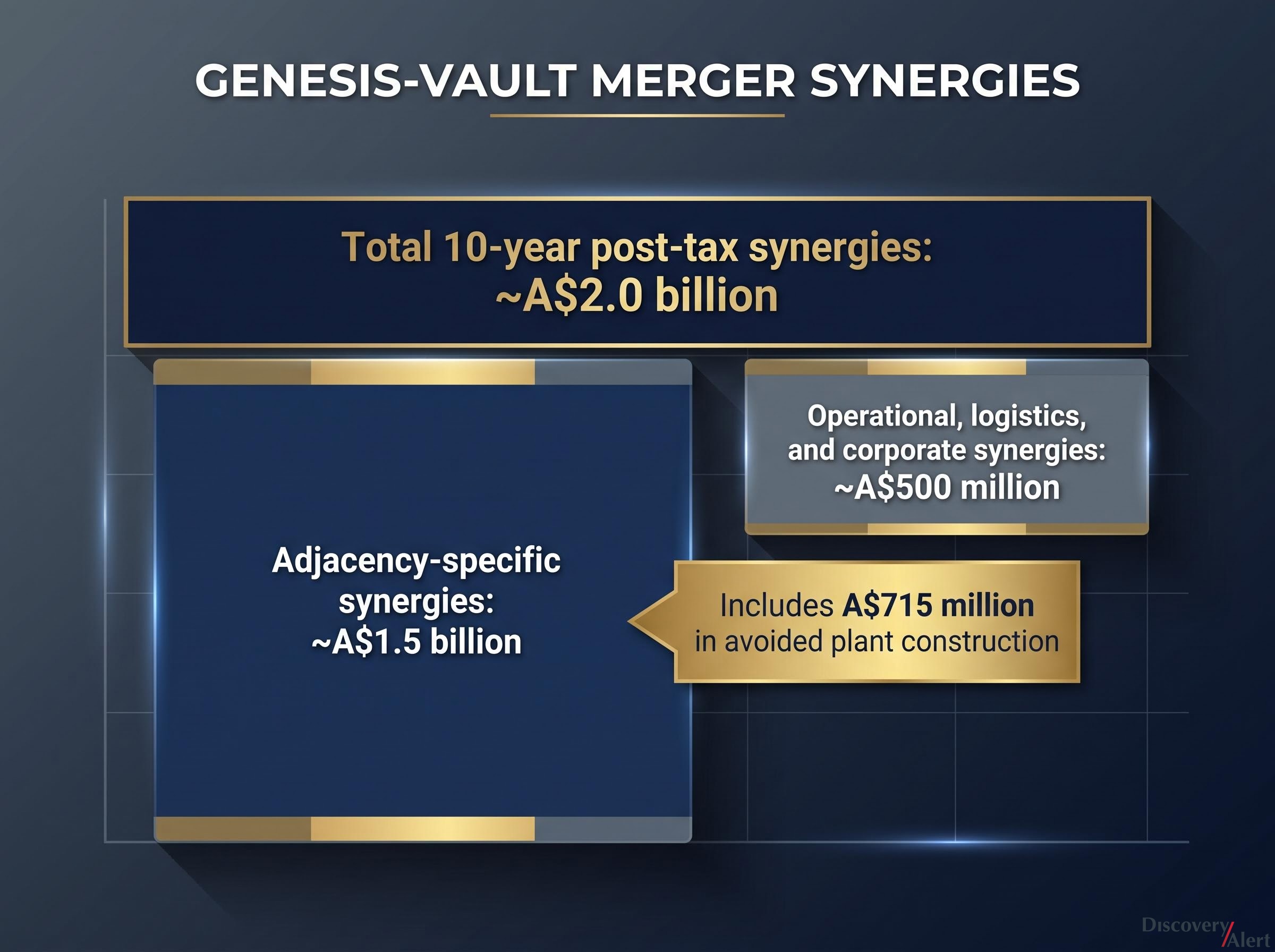
| Synergy category | Estimated value | Source |
|---|---|---|
| Adjacency-specific synergies | ~A$1.5 billion | Geographic proximity (structurally unavailable to non-adjacent acquirer) |
| Operational, logistics, and corporate synergies | ~A$500 million | General scale efficiencies |
| Total 10-year post-tax synergies | ~A$2.0 billion | Combined |
The A$715 million in capital avoidance sits within the adjacency-specific component. It is a line item with a physical basis: a plant that does not need to be built because another one already exists 35 km away.
Adjacency premium: Approximately A$1.5 billion of the total synergy pool is identified as available only because of the specific geographic adjacency of these two asset portfolios. A different acquirer, regardless of corporate scale, could not replicate this portion.
The remaining A$500 million reflects operational, logistics, and corporate efficiencies that are more typical of merger synergy claims. These are less structurally defensible but represent a smaller portion of the total.
One qualifier investors should hold alongside these figures: the synergy realisation horizon is 10 years from transaction completion. For present-value assessments, the discount rate applied to synergies captured in years seven through ten materially affects the net present value of the headline figure.
The northern pairing of Tower Hill and KOTH is not a one-off. The same structural logic appears in the south.
Two independently logical asset pairings within one merged portfolio reduce the execution risk profile of the combined entity. Both rely on existing infrastructure and approved development pathways, not speculative construction timelines.
Development approvals for the Zoroastrian underground within the Bardoc ground are already secured. In practical terms, this means permitting is not a gating constraint on the southern production ramp.
DEMIRS mining proposal assessment timelines in Western Australia averaged 123 days end-to-end for the 2023-24 period, a benchmark that underscores why secured approvals at Zoroastrian represent a tangible schedule advantage over projects still navigating the regulatory queue.
This distinction matters. Greenfield projects routinely face permitting delays that push production timelines by 12-24 months or longer. With Zoroastrian approvals in place, the southern pair’s contribution to group production carries a lower timeline risk than investors might assume when assessing the combined entity’s ramp trajectory.
If a credible alternative acquirer could unlock equivalent synergies, the adjacency premium Genesis commands would be a negotiating position rather than a structural fact. Independent commentary suggests it is the latter.
Regis Resources’ geographic distance from Vault’s assets structurally limited its potential synergy capture. The A$1.5 billion in adjacency-specific synergies is a function of physical geography, specifically the 35 km corridor between Tower Hill and KOTH and the proximity of Bardoc to Randalls. These distances cannot be engineered by a different bidder regardless of deal size or corporate capability.
Competitive positioning: The adjacency-specific synergy pool of approximately A$1.5 billion is structurally unavailable to any geographically distant acquirer. This is not a negotiating position; it is a consequence of map coordinates.
The specific structural advantages Genesis holds over a non-adjacent acquirer include:
The district-scale operating model, multiple open-pit and underground mines with centralised processing, ore blending, and flexible scheduling, is consistent with cost structures achieved by Northern Star, Evolution, and Regis at comparable production scales. The merger positions the combined entity to operate within the same cost and efficiency bracket.
Gold sector consolidation at scale has accelerated in 2026, with the Equinox-Orla combination forming a US$18.5 billion producer on similar logic: routing ore through existing processing infrastructure to avoid major capital outlays and lift production into a peer tier that attracts institutional mandates.
The Leonora-Laverton corridor produced approximately 465,000 ounces in the most recent financial year. That is not a projection. It is a demonstrated operational baseline.
From that base, the production trajectory builds in two stages. The Leonora district target is approximately 500,000 ounces per year by FY2029, reflecting the integration of Tower Hill ore into KOTH. The group-wide target, including southern assets, is 600,000-700,000 ounces per year, which would position the merged entity as Australia’s third-largest listed gold producer and place it inside the global top-20.

| Production stage | Output (oz/year) | Australian ranking context |
|---|---|---|
| Current Leonora-Laverton output | ~465,000 | Second only to Newmont’s Boddington |
| Leonora district target (by FY2029) | ~500,000 | Largest single-district output on the ASX |
| Group-wide target | 600,000-700,000 | Third-largest listed gold producer in Australia |
Moving from sub-200,000 ounce scale to the 600,000-700,000 ounce bracket places the merged group in the same peer set as Northern Star, Evolution, and Regis. That peer set comparison is not merely symbolic. It changes index inclusion criteria, ETF eligibility, and institutional mandate thresholds.
A pro-forma market capitalisation of approximately A$12.6 billion has been cited in connection with the deal (this figure has not been independently verified and should be treated as indicative). If accurate, it would position the combined entity well within the range where passive fund flows, analyst coverage breadth, and institutional mandate eligibility could drive structural re-rating independent of gold price movements.
The Genesis-Vault merger thesis reduces to one irreducible fact: the assets are where they are.
A processing plant at KOTH exists 35 km from Tower Hill. A processing plant at Randalls exists near Bardoc. Development approvals at Zoroastrian are secured. These are geographic and regulatory facts, not management projections or cost-cutting assumptions. They do not change with commodity cycles, executive turnover, or integration complexity.
The three-part investment case distils as follows:
The 10-year synergy realisation horizon is a qualifier investors should hold firmly alongside the A$2.0 billion headline figure. Synergies captured in later years carry meaningfully less present value.
The gold price trajectory in the second half of 2026 carries meaningful implications for the synergy arithmetic: higher spot prices expand the dollar value of each incremental ounce recovered through grade substitution, while a sustained pause in the bull run would compress the present-value contribution of synergies captured in years seven through ten of the realisation horizon.
The question investors are ultimately being asked to evaluate is whether the merger premium reflects the full structural value of the adjacency, or whether residual upside remains from the re-rating the combined scale could trigger.
For investors wanting to situate the Genesis-Vault merger within a broader framework for evaluating resource sector consolidation plays, our full explainer on commodity positioning strategy covers how to assess timing, capital cycle positioning, and deal structure in the context of approaching commodity dislocations, including the conditions under which merger premiums tend to be validated or eroded by subsequent price moves.
This article is for informational purposes only and should not be considered financial advice. Investors should conduct their own research and consult with financial professionals before making investment decisions. Financial projections referenced in this analysis are subject to market conditions and various risk factors. Past performance does not guarantee future results.
The Genesis Vault merger is a proposed combination of Genesis and Vault's gold mining assets in Western Australia's Leonora-Laverton district, designed to eliminate the need for a standalone processing plant by routing ore to existing mills, targeting group-wide production of 600,000-700,000 ounces per year.
Grade substitution means replacing lower-grade open-pit ore (around 0.3 g/t) at the KOTH mill with higher-grade Tower Hill underground ore (around 2.0 g/t), recovering substantially more gold per tonne processed without expanding the mill's physical throughput capacity.
The A$715 million represents the estimated cost of building a standalone processing plant that Genesis would otherwise need to fund for its Tower Hill deposit; because the KOTH mill already exists just 35 kilometres away, the merged entity avoids this construction obligation entirely.
Approximately A$1.5 billion of the A$2.0 billion total is identified as adjacency-specific, meaning it is structurally available only because of the geographic proximity of the two asset portfolios, while the remaining A$500 million reflects broader operational and corporate efficiencies; the full figure is realised over a 10-year horizon, so present-value assessments depend heavily on the discount rate applied to later-year synergies.
Regis Resources lacks the geographic proximity to Vault's assets that makes the A$1.5 billion in adjacency-specific synergies possible; the 35-kilometre haulage corridor between Tower Hill and KOTH, and the proximity of Bardoc to Randalls, are fixed map coordinates that no alternative acquirer can replicate regardless of deal size or corporate scale.


