
Stelar Metals Greenlit for Maiden Drilling at 6.1% Tungsten Discovery Site

Stelar Metals greenlit for maiden tungsten drilling at Hill of Leaders
Stelar Metals (ASX:SLB) has received environmental licence approval from the NT Department of Mining and Energy for its maiden RC drilling program at the Hill of Leaders Tungsten Project (EL33232), located approximately 80km from Tennant Creek. Rig mobilisation is scheduled for August 2026, with the Phase 1 program comprising ~3,000m of RC drilling across three sections. The approval comes roughly three months after the company acquired the project in May 2026, delivering rapid execution against a backdrop of structurally tight global tungsten supply driven by Chinese export restrictions and accelerating Western efforts to secure critical minerals supply chains.
When big ASX news breaks, our subscribers know first
What the Phase 1 program is designed to prove
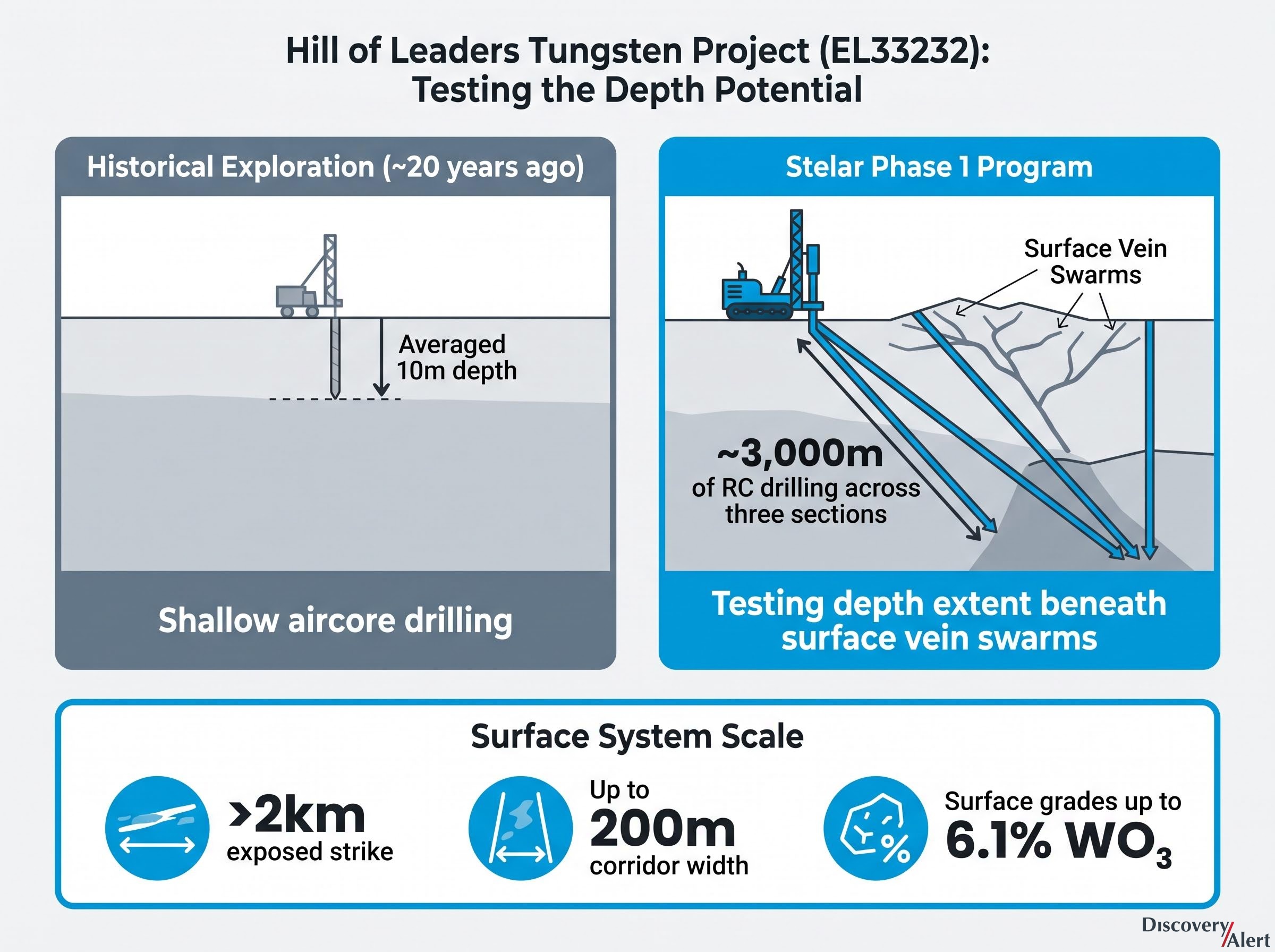
The program is designed to test the depth extent, continuity and grade of the tungsten-bearing quartz vein and greisen system. The mineralised system has been mapped over more than 2km of exposed strike and up to 200m of corridor width, and remains open in multiple directions.
Stelar’s Phase 1 RC program represents the first genuine test of the tungsten system at depth in the field’s 75-year history, despite tungsten first being discovered at the site in 1951 with subsequent historical mine production. Shallow aircore drilling conducted approximately 20 years ago, averaging 10m depth over a broad area, intersected near-surface tungsten mineralisation. However, Stelar’s program will be the first to test the system at depth beneath the surface vein swarms.
Phase 1 program specifics:
- ~3,000m of RC drilling across three sections
- Target: depth extent and continuity beneath mineralised surface vein swarms
- Testing a proven surface system with exceptional high-grade assays
- Mineralised corridors remain open in multiple directions, supporting scope for expansion
The depth testing beneath a proven surface system de-risks the discovery thesis and positions Stelar to potentially unlock a scalable tungsten resource in a jurisdiction with established mining infrastructure.
Surface grades that stand out
Surface rock chip sampling has returned exceptional tungsten grades, with the company previously reporting 6.1% WO₃, 2.1% WO₃ and 1.45% WO₃. Phase 1 sampling returned multiple assays exceeding 1% WO₃, well above typical economic cut-off grades for tungsten deposits. The system also shows elevated co-products, including molybdenum (averaging 0.026% Mo), bismuth (to 0.4%), and copper (to 6%).
| Sample Result | WO₃ Grade | Notable Co-products | Significance |
|---|---|---|---|
| Peak assay | 6.1% WO₃ | Mo, Bi, Cu present | Exceptionally high-grade surface result |
| Second assay | 2.1% WO₃ | Elevated Mo, Bi | Confirms grade consistency across vein field |
| Third assay | 1.45% WO₃ | Cu to 6% | Demonstrates multi-element mineralisation |
| Phase 1 sampling | Multiple >1% WO₃ | Mo avg 0.026%, Bi to 0.4% | All above typical economic cut-off grades |
How Stelar refined its drill targets
Target selection has been informed by three complementary datasets generated by Stelar since acquiring the project:
-
Phase 1 and Phase 2 mapping and rock chip sampling — confirmed wolframite and scheelite mineralisation hosted in multiple subparallel and stacked quartz veins, and in the adjacent altered granite and greisen, supporting the company’s interpretation of a widespread system of scale.
-
High-grade surface assays — including multiple results exceeding 1% WO₃, well above typical economic cut-off grades for tungsten deposits, with elevated molybdenum (averaging 0.026% Mo), bismuth to 0.4% and copper to 6%.
-
UHD airborne magnetic and radiometric survey — processed and interpreted using AI-assisted algorithms, which resolved subtle structures and alteration zones that correlate with the known tungsten-rich vein sets at historical mines and workings. These patterns were not visible in historical datasets.
Modern geophysical datasets and AI-assisted processing sharpen targeting accuracy and improve the probability of a maiden discovery by identifying drill-ready targets that correlate directly with known high-grade surface mineralisation.
Why tungsten matters right now
Tungsten is a critical mineral prized for its exceptional hardness, high melting point, and density. It is used in industrial applications including cutting tools, drill bits, and high-temperature alloys, as well as in defence, aerospace, and advanced manufacturing sectors. The metal’s unique physical properties make it irreplaceable in many applications.
The global tungsten market is experiencing a structural supply squeeze. Chinese export restrictions have tightened availability, whilst accelerating Western efforts to secure critical minerals supply chains have elevated tungsten to a strategic priority. The Northern Territory is rapidly re-emerging as a globally significant tungsten province, with nearby projects including Hatches Creek (ASX:TGN) and Molyhil Tungsten (ASX:TVN) advancing development timelines.
A high-grade, scalable tungsten discovery in a stable Western jurisdiction with established mining infrastructure is strategically valuable amid structurally tight supply and rising demand from industrial and defence sectors.
Executive Chair on the path from acquisition to drilling
Stephen Biggins, Executive Chair
“Receiving this drilling approval is the green light our team has been working towards since the day we acquired Hill of Leaders. In a matter of months we have gone from acquisition to a widespread high-grade tungsten discovery at surface, to receiving environmental licence for our maiden drill program. That is a remarkable pace of execution by any measure.
“What makes this so compelling is that we are sitting on a tungsten field with more than two kilometres of exposed strike, corridors up to 200 metres wide, surface grades as high as 6.1% WO₃. Very few opportunities of this quality remain untested anywhere in Australia.
“Tungsten is one of the most strategically constrained critical minerals in the world today, and the Northern Territory is rapidly re-emerging as a globally significant tungsten province. With the rig to arrive in August, the next few months will be transformational for Stelar and our shareholders.”
The next major ASX story will hit our subscribers first
What’s next for Stelar
Stelar is now positioned to execute its maiden drill program, with rig mobilisation scheduled for August 2026. The Phase 1 ~3,000m RC program across three sections will test the depth extent, continuity and grade of the tungsten system beneath the proven surface vein field. Mineralised corridors remain open in multiple directions, supporting scope for expansion beyond the initial program.
Upcoming milestones and catalysts:
- Rig mobilisation: August 2026
- Phase 1 RC drilling: ~3,000m across three sections
- Assay results: First drill results expected following program completion
- Expansion potential: Mineralised system open along strike and at depth
Imminent drilling positions Stelar for a potential first-mover discovery at depth beneath a proven high-grade surface system, with assay results representing the next major share-price catalyst. The rapid timeline from acquisition to maiden drill approval demonstrates execution capability and positions the company to capitalise on strategic tungsten supply dynamics.
Get ASX Tungsten News Before the Market Moves
Join 30,000+ investors receiving FREE breaking ASX mining alerts delivered within minutes of release, complete with in-depth analysis. Click the “Free Alerts” button at Big News Blast to stay ahead on critical minerals news the moment it breaks.