
Green360 Lands First Binding Supply Deal With Global Giant Holcim

Green360 lands first binding supply deal with global giant Holcim
Green360 Technologies has executed its first binding commercial supply agreement with Holcim (Australia) Pty Ltd, marking the company’s transition from product development to revenue-generating operations. Under the deal, G360’s wholly owned subsidiary Suvo Minerals Australia Pty Ltd will supply up to 4,800 tonnes of MKX-CC (Calcined Clay) over an initial 12-month period into Holcim’s Victorian concrete operations across five Melbourne-area batching plants.
The agreement represents independent commercial validation of MKX by one of the world’s largest construction materials companies, following commercial production commencing in April 2026 — less than three months ago. Holcim operates across 45 markets globally, with 2025 net sales of CHF 15.7 billion, and maintains an extensive national footprint in Australia supplying advanced building materials to major infrastructure projects.
This is G360’s inaugural commercial customer for its proprietary high-reactivity metakaolin and low-carbon cement replacement product. The agreement formalises commercial terms from the previously announced Memorandum of Understanding disclosed in May 2026, demonstrating the successful progression from technical evaluation to binding commercial supply.
When big ASX news breaks, our subscribers know first
Inside the Holcim agreement
The binding commercial supply agreement establishes clear terms for the initial supply relationship:
- Supplier: Suvo Minerals Australia Pty Ltd (G360 subsidiary)
- Volume: Up to 4,800 tonnes per year of MKX-CC
- Term: Initial 12-month supply period
- Pricing: Based on a fixed price per tonne with technical compliance standards
- Manufacturing: At Calix Limited’s Bacchus Marsh facility under existing Toll Treatment Agreement
- Delivery: Five Holcim batching plants in the Melbourne area
- Legal status: Binding on commercial supply terms with industry-standard termination rights
Manufacturing will occur at Calix Limited’s Bacchus Marsh facility under G360’s existing Toll Treatment Agreement, providing a capital-light pathway to commercial production without requiring the company to build its own calcination plant upfront.
George Agriogiannis, Holcim Australia Chief Executive
“Demand for high performance, sustainable construction materials continues to grow nationally, and that demand is particularly strong in Victoria where we’ve been supplying lower carbon concrete products to major infrastructure projects for more than a decade. Introducing calcined clay as a supplement is an innovation that will support our efforts to further future-proof the concrete industry. Widespread use of this new supplement will reduce our reliance on fly ash and slag; two materials that will continue to decline in availability as we see the renewable energy sector ramp up, and heavy industries continue to decarbonise.”
Commercialisation executed in four months
G360 has moved from development to commercial supply through a sequence of execution milestones delivered within a four-month window. The progression demonstrates the company’s ability to establish an integrated supply chain and deliver product to commercial customers at scale.
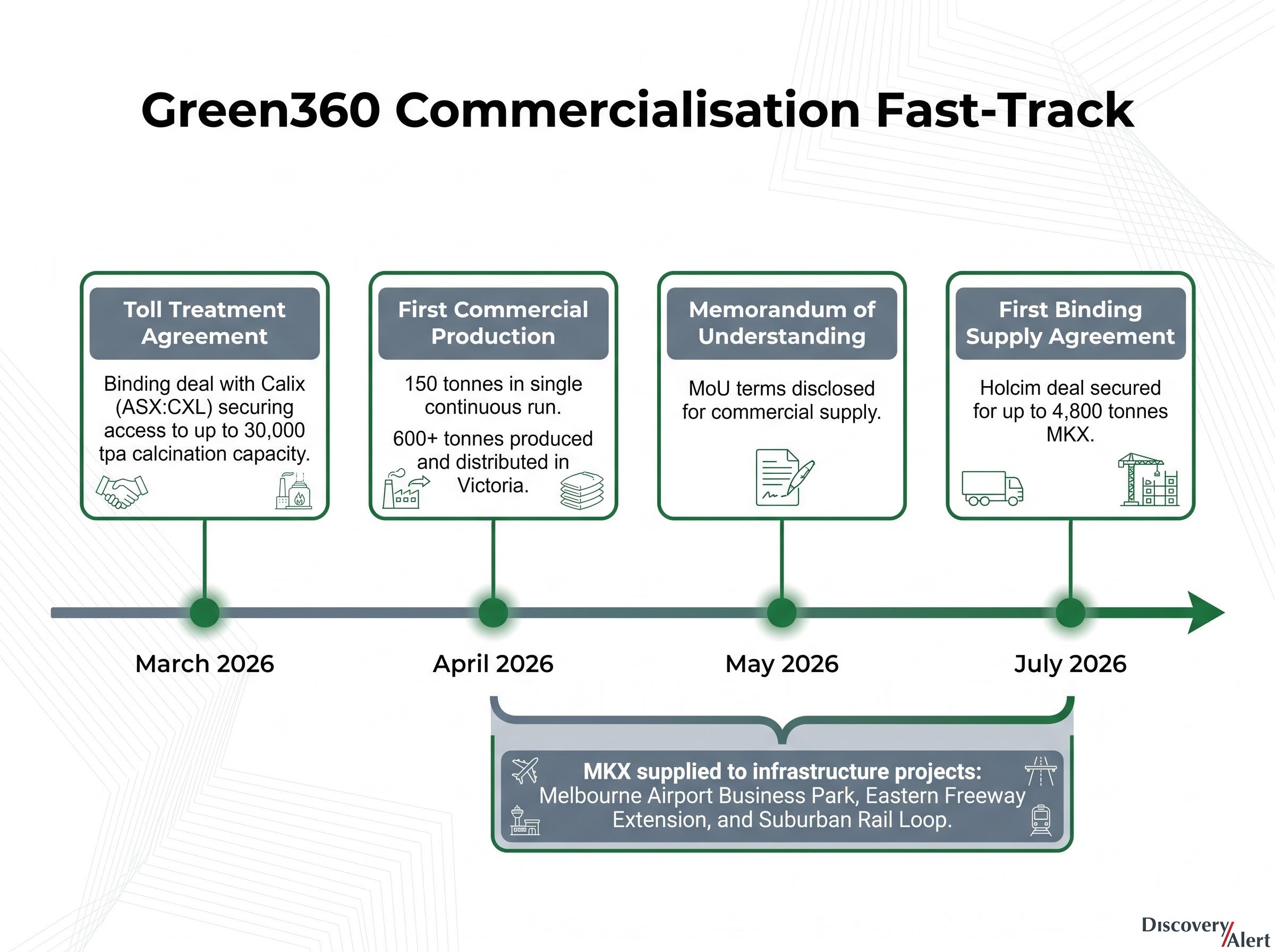
| Milestone | Date | Achievement |
|---|---|---|
| Toll Treatment Agreement | March 2026 | Binding deal with Calix (ASX:CXL); access to up to 30,000 tpa calcination capacity |
| First commercial production | April 2026 | 150 tonnes in single continuous run; 600+ tonnes produced and distributed in Victoria |
| First binding supply agreement | July 2026 | Holcim deal for up to 4,800 tonnes MKX |
Between April and July, G360 also supplied MKX to infrastructure projects including:
- Melbourne Airport Business Park
- Eastern Freeway Extension
- Suburban Rail Loop
These commercial-scale concrete validation projects provided real-world testing and demonstrated product performance in demanding infrastructure applications prior to securing the Holcim agreement.
Aaron Banks, Executive Chairman
“This is the moment where our investment thesis becomes commercial reality. Holcim is one of the world’s largest construction materials companies with a strong national footprint and diverse customer base built over decades here in Australia. Their decision to enter into a binding commercial supply agreement for MKX is a significant endorsement of both the quality of our product and our ability to reliably supply it at commercial scale. Over the past four months we have systematically removed every obstacle between our Pittong resource and the customer. We secured commercial calcination capacity through our agreement with Calix, completed our first commercial production campaign, successfully supplied MKX to infrastructure projects such as Melbourne Airport Business Park, Eastern Freeway Extension, Suburban Rail Loop and today announce our first binding commercial customer.”
Why SCMs matter — the structural supply challenge
Supplementary cementitious materials are added to concrete to reduce both carbon emissions and cost. Traditionally, the Australian concrete industry has relied on three main SCMs: fly ash (from coal-fired power stations), blast furnace slag (from steelmaking), and silica fume (from silicon metal production). All three are industrial by-products rather than dedicated products.
This supply model is now facing structural breakdown. Coal-fired power stations are retiring as Australia transitions to renewable energy, reducing fly ash availability. Steel production is increasingly adopting lower-emission technologies that generate significantly less blast furnace slag. Domestic silicon metal production has declined, reducing silica fume availability and increasing reliance on imports.
The tension is straightforward. Supply of traditional SCMs is shrinking at the same time demand for lower-carbon concrete continues to accelerate across infrastructure, commercial, and residential construction. The industry is increasingly competing for a declining pool of materials.
MKX is positioned as a dedicated, scalable and locally produced alternative to these industrial by-products. Because it is manufactured from kaolin clay rather than sourced as a by-product, its supply is not tied to declining legacy industries.
G360 states it “was the first company to commercialise metakaolin (calcined kaolin) as a supplementary cementitious material (SCM) in the Australian concrete market.” The company produces two variants under the MKX platform:
- MKX CC (Calcined Clay) — replacement for fly ash and slag in standard concrete applications
- MKX UF (Ultra Fine) — replacement for silica fume in high-strength concrete applications
Both products are produced at G360’s Pittong (VIC) kaolin operations and calcined via the Calix toll agreement at Bacchus Marsh.
What the Holcim deal means for the investment case
Independent validation by a global industry leader de-risks G360’s commercial model. Holcim’s decision to enter a binding supply agreement followed extensive technical evaluation and commercial-scale testing, indicating the product meets performance standards required by one of the world’s most demanding concrete producers.
The capital-light strategy removes upfront construction risk. By producing MKX via the Calix toll treatment arrangement rather than building its own calcination plant, G360 has established commercial supply without the capital expenditure and construction timeline typically required to bring a new building materials product to market.
G360 is positioned as an early mover into a market facing structural, long-term SCM shortages. The declining availability of fly ash and slag is not a temporary supply disruption but a permanent shift driven by Australia’s energy and industrial transition. Companies that establish supply chains for dedicated SCMs are entering a market with favourable supply-demand dynamics.
The first contract creates a platform to pursue additional supply agreements. With a reference customer in Holcim and demonstrated ability to deliver product at commercial scale, G360 can approach other concrete producers with proven performance data and an operational supply chain.
The next major ASX story will hit our subscribers first
What’s next for Green360
The company has outlined two near-term catalysts:
- Further commercial discussions with additional concrete producers are expected to progress through H2 2026
- A scoping study in Q4 2026 will assess scale efficiencies of a dedicated commercial calcination facility adjacent to the Pittong operations
The strategic ambition extends beyond securing individual supply contracts. G360’s stated objective is to help build the next-generation supply chain for the concrete industry as traditional SCM sources decline. The company is positioning MKX not as a niche alternative but as a scalable replacement for industrial by-products that have underpinned lower-carbon concrete production in Australia for decades.
Want the Next Manufacturing Breakthrough in Your Inbox?
Join 20,000+ investors receiving FREE breaking ASX news and in-depth analysis within minutes of release. Get alerts on emerging opportunities across manufacturing, construction materials, and industrial innovation delivered straight to your inbox. Click the “Free Alerts” button at Big News Blast to start receiving real-time coverage the moment market-moving announcements drop.