
Peninsula Scraps 2026 Uranium Target as Lance Ramp-Up Hits Flow Rate Snags

Peninsula withdraws CY2026 uranium guidance but reaffirms CY2027 target
Peninsula Energy has withdrawn its CY2026 production guidance of 400,000–500,000 lbs U3O8 following a slower-than-anticipated wellfield ramp-up at its Lance Uranium Project in Wyoming. The announcement, which lifted a trading halt requested on 20 July 2026, revealed that reduced flow rates and gas generation issues have delayed the production schedule. However, the company reaffirmed its CY2027 guidance of 500,000–600,000 lbs U3O8, signalling confidence that the setback is operational rather than fundamental. Peninsula remains in a strong financial position, supported by a recently secured US$56m funding package and an unaudited cash balance of US$47.1m as at 17 July 2026. Management emphasised that the challenges relate primarily to wellfield hydraulics and chemistry optimisation, not resource quality or the effectiveness of the low-pH ISR recovery process, which continues to validate the project’s long-term potential.
When big ASX news breaks, our subscribers know first
What went wrong in CY2026 — and why management calls it temporary
The production shortfall centred on Mine Unit 1 (MU-1), Mine Unit 3 (MU-3), and the first 2-3 header houses of Mine Unit 4 (MU-4), where the company encountered lower-than-expected solution flow rates despite extensive maintenance efforts. Wellfield hydraulics, solution flow management, and chemistry optimisation proved more challenging than forecast, delaying the achievement of stable production rates. Gas generation within portions of the operating wellfield reduced recovery performance and overall flow, while the timing and rate of hydrogen peroxide addition required recalibration to manage gassing issues—leading to extended periods with hydrogen peroxide injection halted.
Operational complexities also arose from co-mingled acidification and production activities between adjacent header houses, particularly during the early stages of MU-4 operation. While acidification performance has largely progressed in line with expectations, the Company continues to refine its approach to converting strong uranium grades into consistent production through improved wellfield performance and revised operating practices.
The learning-curve context
Lance represents the first commercial-scale application of low-pH (acid leach) ISR uranium recovery in the United States. Unlike conventional alkaline ISR operations, there has been minimal domestic operating experience, established workforce capability, or industry knowledge to draw upon. The decade-long slowdown of uranium ISR projects across the US until market conditions improved over the past 2-3 years further compounded the challenge of recruiting and training a specialised workforce. As a result, the transition involved a steeper operational learning curve than originally anticipated, requiring Peninsula to develop new technical capability and refine operating practices under commercial production conditions.
Key factors that impacted CY2026 production:
- Hydrogen peroxide timing and dosing rate relative to gas generation, with H2O2 addition halted for extended periods
- Co-mingled acidification and production between adjacent header houses in early MU-4
- Lower-than-expected flow rates across parts of the production footprint despite extensive maintenance
- Gas generation reducing recovery performance, injection performance, and overall flow rates
The grade story: why management remains confident
Despite the operational setbacks, the uranium grade response observed to date strongly supports management’s confidence in both the Lance uranium resource and the low-pH extraction methodology. Header House 14 (HH14) achieved average uranium concentrations of approximately 50-60 mg/L U3O8 during May and June 2026 (corresponding to Pore Volumes 5-6)—more than double the historical average during alkaline leach operations. Individual patterns within HH14 reported grades between 154-374 mg/L U3O8, with a peak grade in a single well reaching 476 mg/L U3O8. This compares favourably with historical alkaline ISR operations at Lance, which only achieved an average grade of 22 mg/L U3O8.
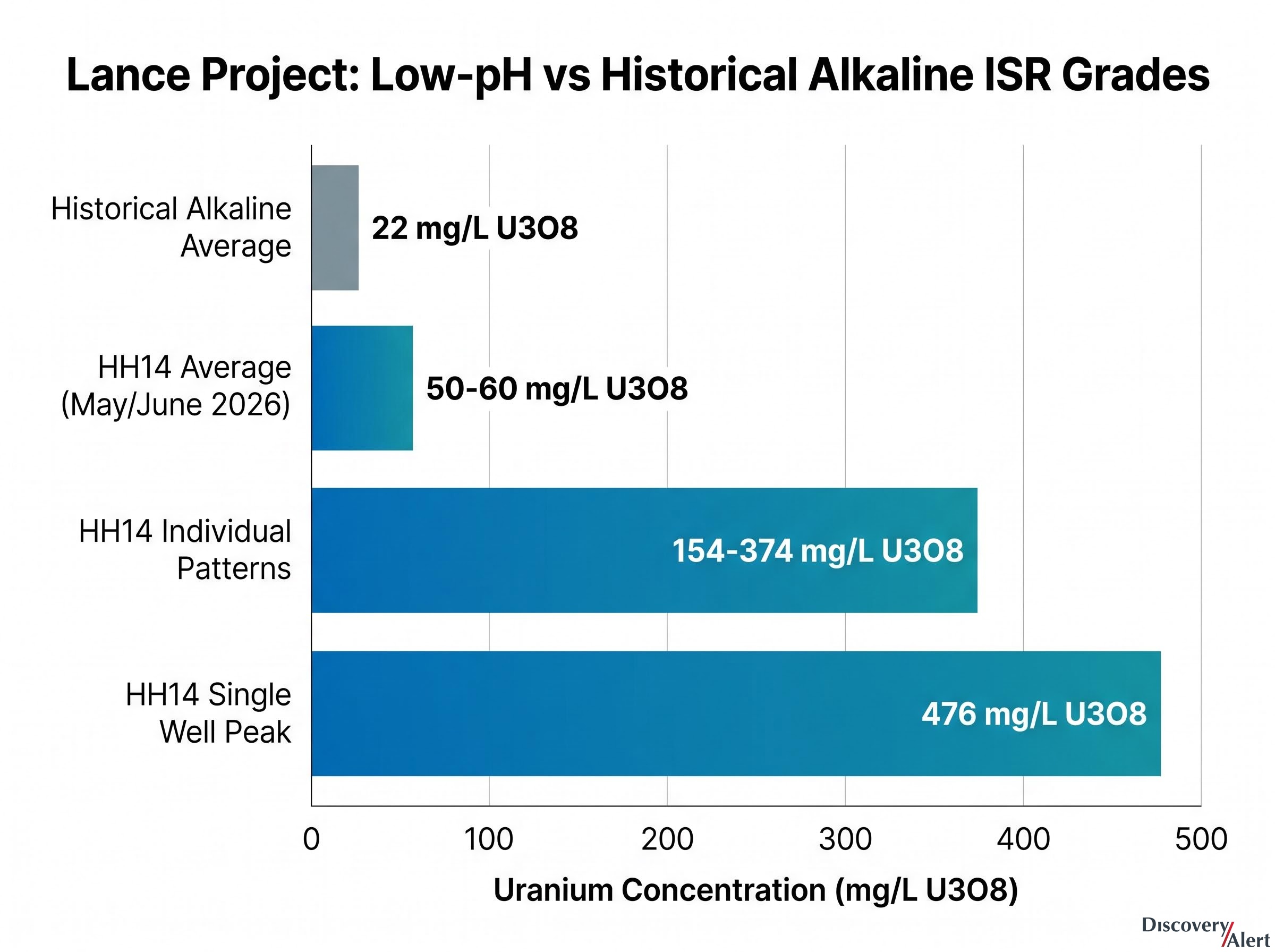
These results demonstrate that uranium mobilisation under low-pH recovery is performing strongly. The primary issues encountered during ramp-up relate to the efficient movement and management of solutions through the orebody, not the quality of the resource itself. Management believes the operational experience gained during this period has significantly enhanced its understanding of wellfield behaviour and positions the company to achieve better production performance as improvement initiatives continue.
George Bauk, Managing Director and CEO
“Uranium grades being achieved from Header House 14 in MU-4 have significantly exceeded those achieved historically under alkaline ISR operations, confirming the ability of the low-pH process to effectively mobilise uranium.”
Understanding low-pH ISR uranium recovery
In-situ recovery (ISR) is a uranium extraction method where a lixiviant solution is circulated through the orebody to dissolve uranium, which is then pumped to the surface for processing—eliminating the need for conventional mining. Low-pH (acid leach) ISR uses an acidic solution to mobilise uranium, whereas alkaline leach uses a basic solution. Acid leach can mobilise more uranium from the ore, resulting in higher head grades (the concentration of uranium in the solution pumped to surface). Head grade is measured in milligrams per litre (mg/L), flow rate is measured in gallons per minute (GPM), and pore volume refers to the number of times the lixiviant solution has cycled through the orebody. Higher grades combined with adequate flow translate into more pounds of uranium produced, which directly impacts revenue. The current bottleneck at Lance is flow performance, not the grade of uranium being mobilised.
The strategic pivot: prioritising Mine Unit 4
Following a review of operating performance, Peninsula has elected to scale down production support within MU-1 and MU-3 to prioritise operational and technical resources on MU-4. This decision reflects a disciplined resource allocation approach focused on production areas with the strongest pathway to sustainable growth and improved returns. MU-1 and MU-3 were developed under earlier operating regimes and currently require a disproportionate level of maintenance relative to expected near-term production outcomes, while MU-4 incorporates revised wellfield designs, updated development methodologies, and operating learnings generated during the transition to low-pH ISR mining. MU-4 accounts for approximately 60% of forecast production under the reset plan. While wellfield maintenance will be scaled down in MU-1 and MU-3, the company expects total flow rates of 600-850 GPM from these mine units during the second half of CY2026.
Benefits of prioritising MU-4:
- Simplify operations
- Lower overall operating costs, including acid costs
- Improve deployment of personnel and equipment
- Accelerate the improvement in wellfield performance of MU-4
- Enhance the company’s ability to deliver sustainable long-term production growth
MU-4 header house progress
| Header House | Current Status | Grade / Pore Volume | Target Flow Rate & Date | Key Actions |
|---|---|---|---|---|
| HH14 | Commenced production 25 March 2026 | 52.3 mg/L U3O8 / Pore Volume 6 | 375 GPM by end of July 2026 | Flow rate optimisation; hydrogen peroxide management improvements; wellfield chemistry optimisation; targeted maintenance |
| HH15 | Commenced acidification 23 June 2026 | Pore Volume < 0.3 | 400 GPM by September 2026 | Apply lessons from HH14; enhanced flow monitoring; improved production balancing; improved acid injection using dual manifolds |
| HH16 | Commenced production 20 June 2026 | 23 mg/L U3O8 / Pore Volume 4 (H2O2 injection off during PV 2&3) | 330 GPM by end of July 2026 | Production pattern rebalancing; wellfield infrastructure modifications; gas management improvements |
| HH17 | Targeting acidification end of July 2026 | Not yet producing | 450 GPM by October 2026 | Enhanced header-house infrastructure design; refined operating procedures; greater field monitoring capability |
| HH18 | Targeting acidification August 2026 | Not yet producing | 650 GPM by November 2026 | |
| HH19 | Targeting acidification November 2026 | Not yet producing | 550 GPM by February 2027 | Increased wellfield spacing to 70 feet; trailing line drives |
Cost reduction and the shift to owner-operated drilling
In parallel with operational improvements, Peninsula has commenced several initiatives designed to improve safety, project economics, reduce dependency on contractors, and lower cash costs. The most significant initiative is the proposed transition of wellfield drilling activities to an owner-operated model, which is expected to materially reduce ongoing drilling costs. The company has engaged the services of Mr Kent Swick, founder and former Managing Director of Swick Mining Services, to review drilling operations and provide a strategic plan for drilling going forward. The company’s first owner-operated drill rig was delivered on Monday 20 July 2026.
Following a trial period of approximately one month to confirm the expected operational performance and cost benefits, the company aims to roll out this model for its entire drilling programme.
Expected benefits of in-house drilling:
- Modern high-capacity drilling equipment
- Greater scheduling flexibility
- Improved equipment utilisation
- Reduced contractor reliance
What’s next: CY2027 as the inflection point
Production guidance for CY2027 remains unchanged at 500,000–600,000 lbs U3O8. While there are various ranges of flow rates and head grades that would result in achieving this guidance, by way of example, an average flow rate of approximately 3,000 GPM at an average net head grade of approximately 45 mg/L U3O8 would result in production of approximately 600,000 lbs U3O8. Importantly, the CY2027 production guidance excludes any production from Mine Unit 5 (MU-5).
De-risking activities for MU-5, including increased delineation drilling, wellfield pump tests, and carbonate content testing, are nearing completion. Peninsula expects to make a final investment decision on the development of MU-5 in September 2026. Completion of monitoring wells is expected in the September 2026 quarter. The business case will incorporate learnings from the development and operation of MU-4, as well as expected drilling efficiency benefits.
Peninsula’s financial runway remains secure, supported by the recently secured US$56m funding package and a cash balance of US$47.1m (unaudited) as at 17 July 2026.
The CY2026 production sensitivity table
Rather than providing specific production guidance for CY2026, Peninsula has offered a flow-rate and net head grade sensitivity range to outline a range of projected production outcomes. This pragmatic approach acknowledges the current wellfield optimisation challenges while providing investors with a framework to understand the potential production envelope. The table below illustrates the relationship between average flow rates, average net head grades, and expected production outcomes, with figures rounded to the nearest 10,000 lbs.
| Avg Net Head Grade (mg/L U3O8) | 1,700 GPM | 1,900 GPM | 2,100 GPM | 2,300 GPM | 2,500 GPM |
|---|---|---|---|---|---|
| 40 | 150,000 lbs | 160,000 lbs | 170,000 lbs | 190,000 lbs | 200,000 lbs |
| 45 | 160,000 lbs | 180,000 lbs | 190,000 lbs | 210,000 lbs | 230,000 lbs |
| 50 | 180,000 lbs | 190,000 lbs | 210,000 lbs | 230,000 lbs | 250,000 lbs |
| 55 | 190,000 lbs | 210,000 lbs | 230,000 lbs | 250,000 lbs | 270,000 lbs |
| 60 | 210,000 lbs | 230,000 lbs | 250,000 lbs | 270,000 lbs | 290,000 lbs |
The next major ASX story will hit our subscribers first
The bigger picture: uranium market fundamentals
The long-term outlook for uranium remains compelling. Whilst spot uranium price has been steady at US$85/lb, long-term contract prices are currently reported at US$94–US$97/lb by UxC and TradeTech. Demand for domestically produced US-origin uranium continues to strengthen as utilities, government agencies, and strategic end-users increasingly seek secure and reliable domestic supply sources. The strategic importance of US uranium production continues to grow as the United States seeks to rebuild domestic nuclear fuel capabilities and strengthen energy security through the development of a resilient domestic nuclear fuel cycle.
Against this backdrop, Lance remains one of the few fully permitted, operating uranium projects in the US capable of delivering meaningful long-term production growth. The project’s extensive 58 million pounds U3O8 resource base, established processing infrastructure including a fully paid 2.0 Mlb per annum capacity Central Processing Plant, and long operating life provide Peninsula with a unique platform from which to participate in what management believes will be a sustained period of increasing demand for domestic US-origin uranium.
George Bauk, Managing Director and CEO
“Lance remains one of the largest permitted ISR projects in the United States, with an established processing plant, a substantial resource base and significant expansion potential. At a time when the strategic importance of domestically produced US uranium has never been greater, we believe that establishing sustainable production from an asset of this quality and scale is well worth the effort. While the production ramp-up has taken longer than expected, our confidence in the long-term value of the Lance Project and its ability to create value for shareholders remains undiminished.”
Want the Next Energy Breakout in Your Inbox?
Join 20,000+ investors getting FREE breaking ASX energy news delivered within minutes of release, complete with in-depth analysis. Click the “Free Alerts” button at StockWire X to start receiving alerts the moment market-moving announcements hit the ASX.